

[비즈한국] The daily necessities industry has recently dived into the competition for ultra-low-priced sanitary pads. Since President Lee Jae-myung mentioned the domestic sanitary pad price issue early this year, the industry has been expanding its lineup of ultra-low-priced products. However, some are raising concerns about quality due to the low price. What are the differences between ultra-low-priced sanitary pads and regular products? This reporter personally purchased '100-won range sanitary pads' sold at Daiso, Homeplus, and 7-Eleven to compare their prices and full ingredient lists.
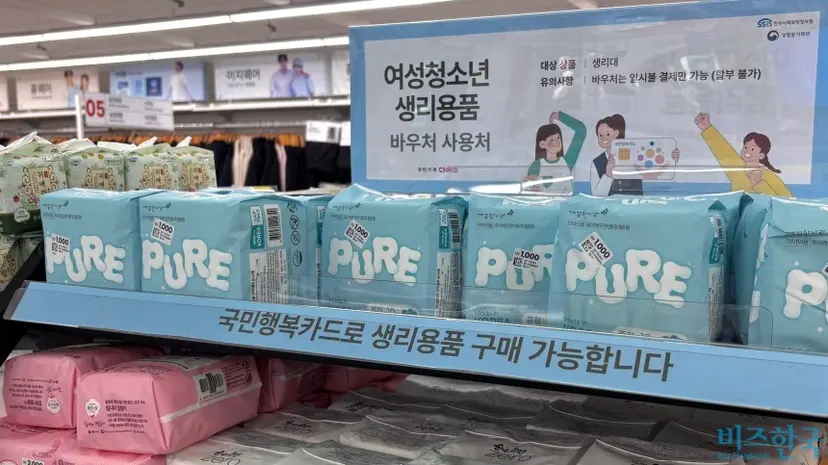
Ultra-low-priced sanitary pads differ in top sheet and absorbent layer materials
The low-cost sanitary pads recently released by Homeplus, Daiso, and 7-Eleven are priced at 1,180 won (12 count), 1,000 won (10 count), and 2,900 won (16 count) respectively for the medium size. The price per piece is around 100 won, at 98 won, 100 won, and 181 won.
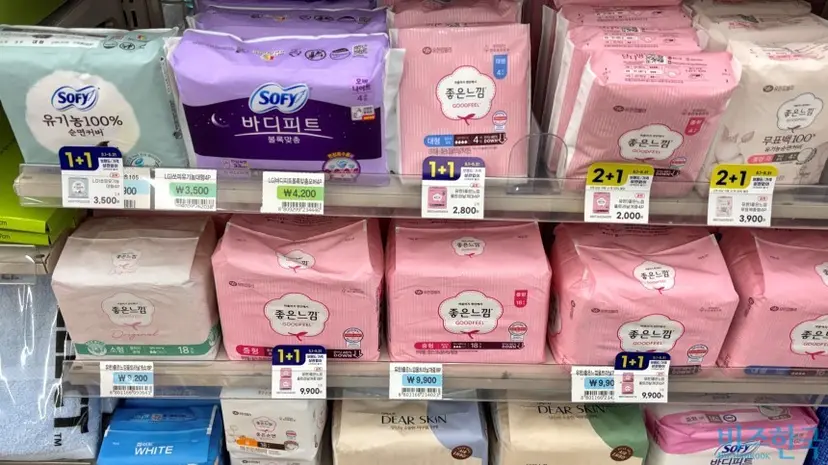
This is up to 300 won cheaper per piece compared to the representative products from the three major sanitary pad companies: Yuhan-Kimberly, LG Unicharm, and Kleannara. However, since sanitary pads are often priced high and then sold via 1+1 or bundle discounts, the actual perceived price may differ.
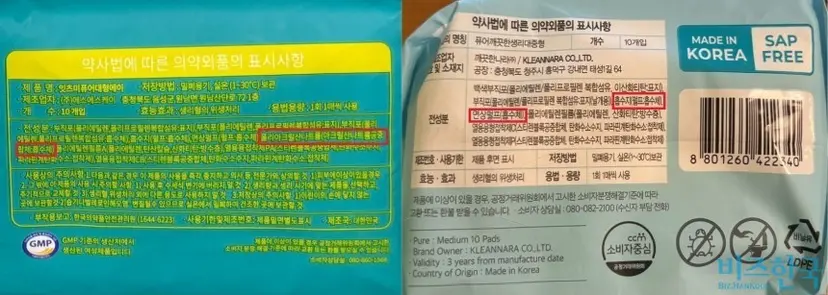
After checking the full ingredients listed on the packaging, this reporter found that the basic materials of all three low-cost products were not significantly different. This is because the Ministry of Food and Drug Safety classifies the structure of disposable sanitary pads into top sheet, absorbent layer, and waterproof layer, and prescribes the permitted raw materials. The top sheet helps menstrual blood pass into the pad, while the absorbent layer holds it. The waterproof layer prevents the absorbed blood from leaking out.
However, differences were identified in specific materials. In the case of the top sheet, all three low-cost products used composite fiber non-woven fabric. This material is made by tangling thermoplastic polymer fibers, such as polypropylene, and then binding them with hot air. In contrast, existing products use pure cotton to improve texture and breathability.
Differences also appeared in the absorbent layer. While the Daiso and 7-Eleven products used materials commonly found in regular sanitary pads, such as absorbent paper and air-laid pulp, the Homeplus product used 'sodium polyacrylate' as an absorbent ingredient. This is in contrast to Daiso's 'Pure Clean Sanitary Pad,' which is labeled as SAP-free.
Sodium polyacrylate is a representative SAP (Super Absorbent Polymer) and is widely used to increase absorbency, but some consumers avoid it due to the potential for skin irritation or environmental concerns. In Korea, there is no standard for SAP content limits, making it difficult for consumers to check the usage amount per product. As a plastic polymer material, concerns about decomposition and environmental burden after disposal are also consistently raised.
However, being a low-cost product does not mean that safety standards are lower. Sanitary pads are classified as quasi-drugs and are subject to approval and management by the Ministry of Food and Drug Safety. Products distributed on the market are subject to the same quasi-drug standards regardless of price.
Persuading consumers on 'safety,' not just price
Sanitary pads are a representative essential for women and are directly linked to the burden of living costs. For women in vulnerable social groups, the price of sanitary pads is a significant burden. Accordingly, the government and local governments are operating voucher support programs for low-income youths. Following President Lee Jae-myung's remark that "domestic sanitary pad prices are excessively expensive compared to overseas," the industry's focus on sales prices is clear.
However, consumers say it is difficult to choose a product based on price alone. This is because sensitivity toward ingredients and safety has increased since the controversy over Volatile Organic Compounds (VOCs) in some sanitary pads in 2017. There is also no shortage of anxiety that low-cost products might be of lower quality.
The industry is emphasizing ingredients and manufacturing standards to ensure the perception of a low-cost product does not lead to quality concerns. They explain that since even ultra-low-priced products are sanitary pads approved as quasi-drugs, they are managed according to Ministry of Food and Drug Safety standards and their main composition ingredients are displayed on the packaging. Retailers and manufacturers are focusing on segmenting product lines so consumers can choose with confidence while increasing value-oriented products that lower price burdens.
An official from Kleannara stated, "The demand for products that have basic quality and safety while lowering the price burden has been expanding recently," adding, "We plan to continue expanding various options from value-oriented to premium by operating a product portfolio tailored to consumer lifestyles and distribution channel characteristics."
A Homeplus official also said, "We decided to sell ultra-low-priced sanitary pads after much deliberation to satisfy customers even in difficult company situations," and added, "We will continue to make efforts to expand customer product choices and alleviate the burden of rising prices."