

[비즈한국] The U.S. administration under Donald Trump has reaffirmed its commitment to restructuring the global semiconductor supply chain with the U.S. at its center. As President Trump publicly vowed to bring 50% of global semiconductor production into the U.S. within his term, the Office of the United States Trade Representative (USTR) is strategically weighing the timing for imposing a 'comprehensive semiconductor tariff'—a powerful weapon to realize this goal. While the immediate shock of tariffs has been avoided, the blueprint of the Trump 2.0 administration is becoming clear: using tariffs as leverage to explicitly pressure global semiconductor firms to invest in U.S.-based production facilities.
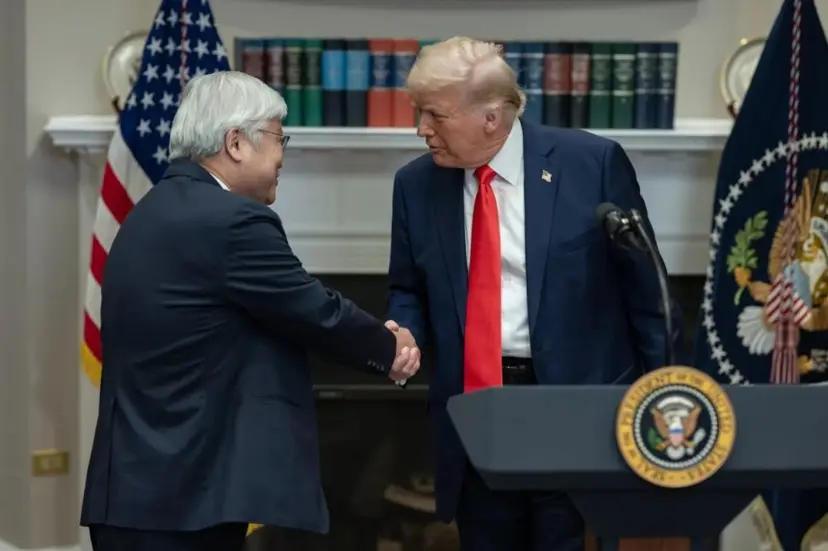
Trump's 'Love for Tariffs' and Semiconductor Hegemony Even at the Federal Reserve Chair's Inauguration
On May 22 (local time), President Trump identified tariffs as a core pillar of economic growth during the inauguration ceremony of the new Federal Reserve (Fed) Chair, Kevin Warsh, held at the White House. While emphasizing the Fed's inherent duties of price stability and job creation, and promising to guarantee Chairman Warsh's independence, Trump strongly advocated for a U.S.-centered manufacturing revival. President Trump expressed strong confidence, stating, "Thanks to tariffs, by the time I leave office, we will have 50% of the world's chip manufacturing capacity, and perhaps even more than that."
In particular, President Trump highlighted that global semiconductor production facilities are shifting from places like Taiwan to the U.S., citing the factory being built by Taiwan's TSMC, the world's number one foundry (contract chipmaker), in Arizona. This is interpreted as a move to promote the legitimacy of his core economic policy—'tariffs'—even at the inauguration of a central bank head, where independence is vital, and to signal to the market that the U.S. intends to seize control of the future global semiconductor industry. In previous media interviews, President Trump has not hidden his intentions, harshly criticizing Taiwan for "stealing" the U.S. semiconductor industry and expressing his desire for all Taiwanese semiconductor manufacturers to move to the U.S.
Not 'Immediately', But 'Inevitably' Coming… USTR's Tariff Leverage
While President Trump presented the macro goals, U.S. Trade Representative Jamieson Greer fleshed out the practical trade policy implementation plan. On the same day, at an event for the expansion of Micron Technology's memory semiconductor plant in Virginia, Representative Greer dismissed concerns about immediate tariff impositions, stating, "There is no immediate semiconductor tariff being introduced tomorrow or next week."
However, he premised his remarks by saying, "Imposing tariffs on semiconductors is really important," leaving the possibility of introducing comprehensive tariffs for national security purposes based on Section 232 of the Trade Expansion Act as a valid card. Representative Greer stated that protecting core domestic facilities like Micron is of utmost importance, and for this purpose, he would implement tariffs at the most appropriate time and scale to promote 'reshoring' (the return and relocation of overseas businesses back to the home country).
What is noteworthy is that the U.S. administration has signaled its intention to apply tariffs in a way that induces changes in corporate behavior rather than imposing them uniformly. Representative Greer hinted that for companies producing semiconductors within the U.S., a so-called 'multiplier' effect could be applied, allowing them to import a certain amount of semiconductors tariff-free or under preferential conditions during the facility construction (reshoring) phase.
This is interpreted as a strategy to prevent short-term semiconductor shortages and cost spikes that U.S. AI companies or IT manufacturers might face upon a full-scale tariff imposition, while simultaneously luring foreign companies to invest directly within the U.S.