

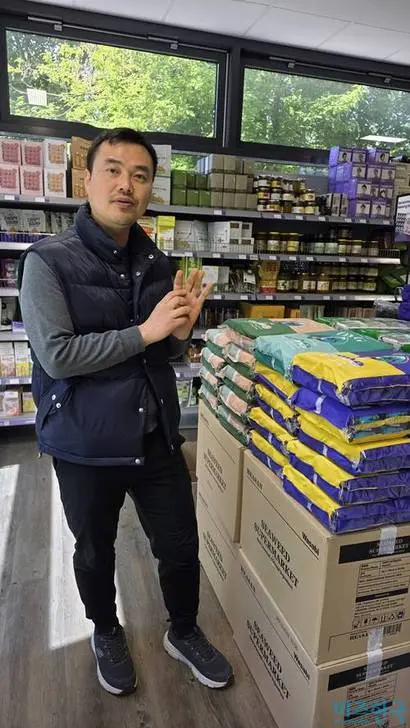
[비즈한국] Even though it's a successful startup with sales tripling every year, the CEO's attire remains consistently humble. I met Lee Min-cheol (44), CEO of Momogo, who showed up for the interview in the 'official uniform' of Berlin: neutral-colored clothes, Skechers sneakers, and a slightly glossy navy padded vest.
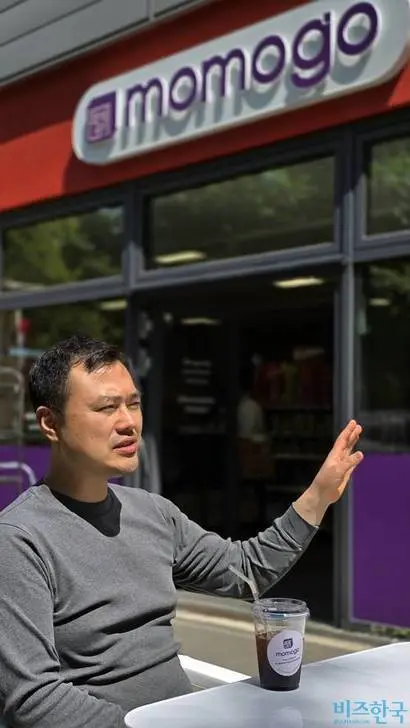
When I interviewed him for Biz Hankook in February 2022, he was the CEO of the meal-kit startup 'Easy Cook Asia' (Related article: [European Startup Chronicles] Why the CEO of a meal-kit startup skips lunch to work). Last September, CEO Lee changed the brand name to 'momogo' and opened an offline store in the Pankow district of northern Berlin, embarking in earnest on the K-Food distribution business.
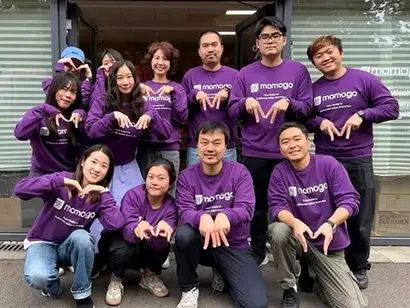
Just four years ago, this startup had only five or six employees. Since the rebranding, the headcount has grown to over 30 to manage the store and logistics. The space, which used to be just an office and a warehouse, has expanded to over 330 square meters (100 pyeong) including the store and office.
When I visited the Momogo store around 11 AM on a weekday, a dozen employees were busy organizing shelves. Unlike typical German supermarkets that open between 6 AM and 8 AM, the Momogo store doesn't open until 2 PM. Occasionally, customers wander in and pick up a few items, but they have to ring the bell at the counter to make a purchase.
Q. Isn't 2 PM a bit late to open the store?
A. Most of our staff focus on delivery in the morning since there aren't many walk-in customers. We ship nearly 500 boxes from this store daily these days. The DHL truck can't carry everything at once, so they have to come two or three times. Still, we keep the doors open and are prepared for customers to come in and shop.
Q. I'm curious why you changed the brand name. Whose idea was it?
A. As we did the meal-kit business, we gradually expanded into groceries. However, the name 'Easy Cook' still gave off a meal-kit image. So, we changed it to 'momogo,' which is a phrase every Korean knows, derived from 'Mo-mo-go?' (What are you eating?). It was my wife's (Lee Yu-ri, co-founder of Momogo) idea, and it seems to be accepted naturally by locals as well.
Q. If you're shipping 500 boxes a day online, I assume online sales represent a larger portion.
A. Actually, offline store sales account for only 5–10%. Online is about 90%. Of that, our own online mall (momogo.de) accounts for over 50% of total sales. Beyond that, there are many orders through social media and Amazon. B2B sales are also emerging. Recently, we've been supplying pouch beverages like seaweed and convenience store coffee to major retail chains like REWE (a large German supermarket chain). For now, we are in three REWE stores operated by individual owners, and we are preparing data to trade with the headquarters.
Q. Which social media channels do your orders come from?
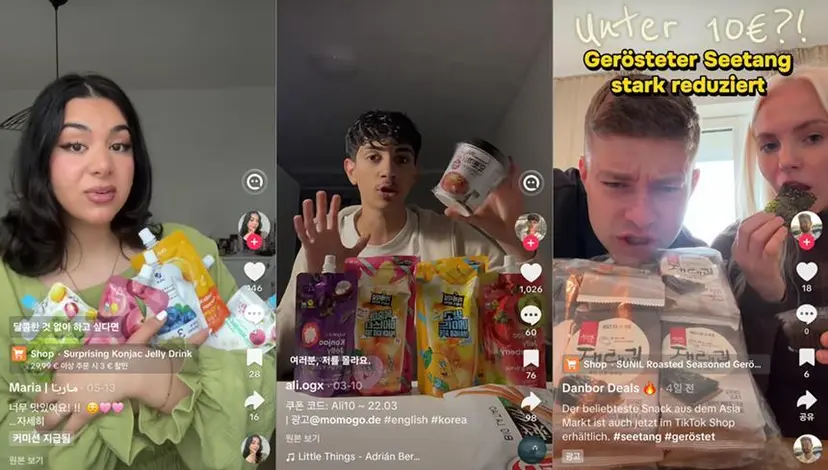
A. We use various social media, but TikTok is the biggest. We do viral marketing through our own account and also work with creators. While other social media require directing traffic to external links like our mall, TikTok has its own shop, which has the advantage of allowing customers to order easily with one button without leaving the platform.
Q. Which products usually go viral?
A. Starting with pouch beverages that maintain popularity through K-Dramas and K-pop stars, konjac jelly and lunchbox seaweed (seasoned seaweed) are selling like crazy these days. Recently, a diet culture has emerged in Germany. It’s a significant change, as Germans didn't usually care about what others thought. Most of our customers are young women in their 20s and 30s who look for low-calorie products. Many Korean products fit this. We localized the packaging and listed the calories on the labels for the konjac jelly. Germans don't eat seaweed with rice like we do; they mostly eat it as a snack, and it's much lower in calories than potato chips. Besides this, low-calorie products like tofu noodles are consistently popular. At one point, seaweed reached 21st place in the TikTok Shop rankings, and konjac jelly is around 70th. This ranking among countless TikTok Shop products is huge. Thanks to this, we are now the sixth-largest seller among F&B companies in the German TikTok Shop.
Q. Your sales must have increased significantly.
A. For the first three years after launching in 2020, we grew 3 to 4 times. Since 2023, we seem to be growing by two times every year. The average annual growth rate since 2020 is about 150%.
Q. Is twofold growth possible this year as well?
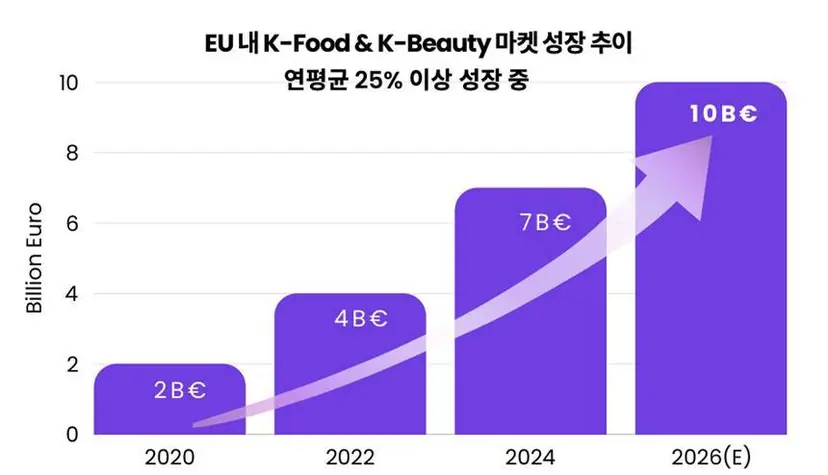
A. "We started a K-Beauty business this month. We realized that our K-Food customers are young women in their 20s and 30s who love K-Dramas and K-pop and are naturally interested in K-Beauty. However, many small and medium-sized Korean K-Beauty brands find it difficult to enter Europe. There are many regulations, and marketing and logistics are not easy. So, we received many requests to introduce their products to European channels. When we tried it, our existing capabilities applied perfectly. The marketing methods are similar, we can use the same fulfillment system, and we already have experience dealing with regulations. There is also an intersection in product lines. Beyond konjac jelly, there are inner-beauty products with collagen where the boundary between K-Food and K-Beauty is blurred. We can naturally recommend them to our existing customers. We have already signed contracts with two K-Beauty brands and have begun full-scale GTM (Go-To-Market) services. With this, I think we can grow about three times this year compared to last year.
Q. Could you explain the GTM service more specifically?
A. First, for Korean brands to enter Europe, they usually go through local wholesalers. That adds wholesaler margins and retailer margins, pushing the cost ratio to about 50%. But Momogo eliminates these middle steps, contracts directly with Korean manufacturers, and imports/sells, which lowers this ratio to about 30%. Also, since we understand the local market, we conduct marketing including social media aimed at local target customers. We provide online channels like our own mall, TikTok Shop, and Amazon, and if needed, we connect them to offline retail stores. Simultaneously, we monitor market reactions and provide feedback to manufacturers, supporting them to improve packaging and products for the local market. We also handle EU compliance such as CPNP (cosmetic ingredient notification), packaging regulations, and distribution certification. What would take a Korean company 6 months to do, we can do in 2 to 3 months.
Q. You named it Momogo as a food brand; how does it connect with cosmetics?
A. An acquaintance suggested I could connect it as 'What are you eating (Mo-mo-go) for your skin?' (Laughs). I think the name was chosen very well.
Q. You'll need more space to sell K-Beauty products as well.
A. We are trying to secure additional warehouse space, but it's expensive. So, we are currently preparing for Series A investment and have created a pitch deck. If we receive funding, about 40% of it will be used to secure a logistics warehouse of over 1,000 square meters. About 30% is aimed at introducing an AI agent to build an automation system capable of handling over 2,000 logistics orders per day by the first half of 2027. The rest will be used for marketing to attract new customers.
Q. How far do you plan to go? What is the goal?
A. We plan to expand categories step by step. After K-Food and K-Beauty, we plan to expand to K-pop merchandise, K-Fashion, and K-Travel. I believe the target demographic is the same. Geographically, we plan to go beyond Germany to all of Europe, including France, Poland, Italy, and Spain. Our goal is to establish ourselves as the 'gateway' for the European K-consumer goods market. We are looking at 100 million euros (176 billion won) in revenue by 2030.
Q. Do you also consider an exit?
A. Of course. While it would be nice to continue this work, I want to try an exit. My personal hope is to create opportunities to work with Korean founders in German society once I have the funds. Since we paved this path, I want to make it a little easier for those who come after us.
Q. Any advice for Korean startup founders planning to enter Germany and Europe?
A. It’s about mindset. In the past, many people came from Korea to learn about the German startup scene. I always told them, 'There is absolutely nothing to learn. Germany is the one that needs to learn. Korea is much better.' Korean startups don't realize how good they are. So, there is a lot of comparing, being self-conscious, and things like that. Of course, having an attitude to learn is good, but it would be better if they knew how good they were and were more aggressive. If we enter with confidence and initiative, I think we can take it all. The German and European markets are hard to change at first, but once they change, they stay that way. And it's the younger generation leading that change, and they are extremely interested in Korean culture. In terms of culture, the position previously held by Japan is gradually shifting to Korea. So, the market potential is definitely there.
Author Lee Jung-woo served as a journalist for 17 years, covering a wide range of fields including major industries like automobiles, secondary batteries, and heavy industry, as well as national defense, diplomacy, environment, education, and health/welfare. In particular, he covered the structural changes in industry centered on mobility, energy transition, and sustainability on the ground. Currently, he resides in Berlin, Germany, and is a partner at the startup accelerator '123 Factory'.