

[비즈한국] South Korea has embarked on basic research to attempt its first independent crewed spacecraft mission. The blueprint involves launching an astronaut into suborbital space using the already performance-proven Korean launch vehicle, 'Nuri,' and subsequently launching a SpaceX 'Dragon'-class crewed spacecraft capable of carrying three people using a next-generation launch vehicle currently under development. If realized, this would be the greatest achievement in the aerospace field since the nation's founding. However, because it is only now beginning what the United States achieved over 60 years ago, challenges remain in establishing project feasibility to address concerns over 'cost-effectiveness' and public opposition.
At the academic conference of the Korean Society for Aeronautical and Space Sciences held in Busan on May 6, researchers and professors Seo Dae-ban, Lee Geum-o, and Kim Hyun-jun from the Korea Aerospace Research Institute (KARI) and Changwon National University unveiled the preliminary design for an indigenous crewed spacecraft, titled 'Re-entry Mission Design for a Domestic Launch Vehicle-Based Crewed Transport Mission.'
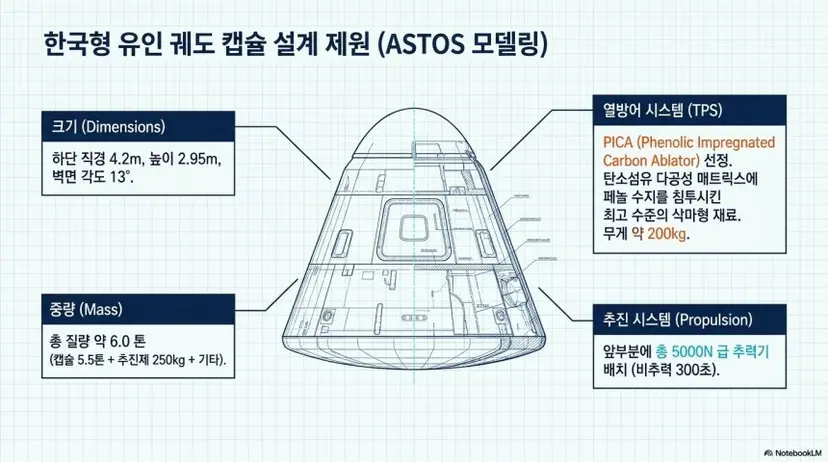
The first step toward this is the 'Nuri-based Suborbital Flight Mission.' The plan is to equip the Nuri rocket, which has proven its reliability through repeated successful launches, with a two-person test spacecraft to secure various experimental data. By mounting a 2-ton class spacecraft instead of a satellite on top of the Nuri and launching it from the Naro Space Center, the spacecraft would rise to a maximum altitude of 203km, crossing the Kármán line (100km), the threshold of space, before returning to Earth. Although it will not orbit the Earth like a satellite, this process will test whether the spacecraft can withstand the high gravitational forces, vacuum, and intense frictional heat generated during atmospheric re-entry—the same conditions astronauts experience during actual spaceflight. This will be used as core data for future crewed spacecraft development.
Such suborbital flights are a mandatory gateway for any nation attempting crewed space development. The United States also had to verify crewed suborbital flight first through the 1961 'Mercury-Redstone 3' mission before it could proceed to the Gemini program, which involved Earth orbit.
However, according to KARI's analysis, if a 2-ton spacecraft is currently launched on Nuri to an altitude of over 200km, the crew would face the issue of having to endure extreme acceleration reaching over 11G, which is 11 times the force of gravity. To resolve this, researchers are considering reducing the fuel payload to lower the maximum altitude, thereby suppressing the gravitational force to under 7G.
The technical difficulty of the spacecraft itself is also high. Structural design that protects the crew from powerful shocks during launch is fundamental. Furthermore, it must incorporate PICA (Phenolic Impregnated Carbon Ablator) heat shielding to withstand the thousands of degrees Celsius generated during atmospheric re-entry. Numerous technical hurdles must also be cleared, such as controlling a traditional capsule-type spacecraft to maintain a precise attitude and deploying parachutes at the right time.
KARI anticipates that once the suborbital mission is successfully concluded, a full-scale crewed orbital spacecraft will be mounted on a next-generation launch vehicle. As it will utilize a next-generation launch vehicle with significantly greater thrust than Nuri, it is designed to carry a crew of three or more, similar to SpaceX's Dragon spacecraft. After rising to an altitude of over 300km to orbit the Earth and returning, the landing site, due to South Korea's geographical characteristics, would likely be the Woomera Desert in Australia, on the opposite side of the globe.
The blueprint for crewed spacecraft development conceived so far will be materialized based on the 'Revision Plan for the 4th Basic Plan for Space Development Promotion.' Among the five major missions proposed by the government, 'completion of space transport' has the core goal of securing independent crewed transport capabilities, beyond simple improvement of launch vehicle performance. However, this is a long-term vision, and specific budgets or schedules have not yet been finalized.
If crewed spacecraft development begins in earnest, South Korea would join the ranks of the world's sixth crewed spacecraft-possessing nation, following the United States, China, and Russia—which currently operate crewed spacecraft—as well as India, which is pursuing the 'Gaganyaan' project, and the European Space Agency (ESA), which is exploring independent development. While it may be difficult to generate immediate commercial profit from a crewed spacecraft, it would certainly serve as a powerful indicator that South Korea's aerospace and defense technology has reached the world's highest level.
However, there are not only rosy prospects. Even though it is a mountain the U.S. crossed over 60 years ago, suborbital spaceflight remains an extremely dangerous and high-difficulty technology. The political and economic burden the state would have to bear in the event of an accident is enormous.
Above all, the wall that is hard to overcome is securing 'project feasibility.' Even if we develop a SpaceX Dragon-class spacecraft, SpaceX is already approaching the commercialization of the 'Starship,' a super-heavy spacecraft with far more overwhelming economic efficiency. In the 'New Space' era, where private space companies like Blue Origin are competing to offer space tourism products, the logical justification for latecomer South Korea to invest massive national budgets in developing an independent crewed spacecraft is bound to weaken.
In fact, our neighbor Japan also explored potential crewed spacecraft development for a long time through projects like 'HOPE,' but ultimately abandoned the independent route in the face of astronomical costs and uncertainty. Currently, Japan has shifted its direction toward developing the 'Lunar Cruiser,' a crewed lunar rover, by participating in NASA's 'Artemis' crewed lunar exploration program. Considering this, it is unclear whether South Korea's crewed spacecraft plan, which would require trillions of won and over a decade, will smoothly pass the threshold of budget authorities.
However, even in modern warfare, where AI and drones are dominant, the need for crewed space missions has not disappeared. This is because having independent ISS transport capability or the ability to put astronauts into satellite orbit means possessing powerful 'space operational assets' that can directly repair and maintain core national satellites in emergencies and actively respond to hostile space operations by enemy nations. It is time to meticulously refine the legitimacy of the crewed space development mission from a macroscopic perspective, focusing on national security and future space hegemony, beyond the narrow view of mere cost-efficiency.
![[Military Tales] LIG's 'Secret Weapon' Anti-Drone Missile: Could it Shoot Down a North Korean Version of the Shahed?](https://s.bizhankook.com/attachments_webp_no_wm/2026/07/134404_no_wm_67d0cb50.webp)
![[Defense Story] Why Canada Submarine Bid Failure Proves Need for New Presidential Secretary for Defense Industry](https://s.bizhankook.com/attachments_webp_no_wm/2026/07/134454_no_wm_eee848e4.webp)
![[Military Story] [Exclusive] Indonesia Completes Final Payment of KF-21 Adjusted Contribution](https://s.bizhankook.com/attachments/2026/07/e8e440c2ed1c_17a7336a.jpg)
![[Mil-Duck Telling] The Root Cause of the 'Rubber Mallet Incident' That Caused Cracks in LAH-1 Engines](https://s.bizhankook.com/attachments/2026/07/50b076aac26a_6fa9356d.jpg)
![[Military Talk] Hanwha Unveils 'Drone-Blocking Command Armored Vehicle' N-MCV for the First Time](https://s.bizhankook.com/attachments/2026/07/096f15b33ac1_a76e4ddb.jpg)
![[Military Talk] The Blueprint for a Crewed Spacecraft Using South Korea's Independent Technology Has Emerged](https://s.bizhankook.com/attachments_thumb/2026/06/98717_thumb_a7e83bdd.webp)