

[비즈한국] The bidding war for riverfront reconstruction projects in Seoul's Gangnam area will reach a turning point on the 30th. As both the integrated reconstruction of Sinbanpo 19th & 25th and the Apgujeong District 5 reconstruction will hold contractor selection general meetings on the same day, the outcomes for the four major construction companies participating will be decided simultaneously. These two project sites are rare instances where a competitive landscape has formed, despite a recent string of failed bids for major urban renewal projects. Beyond competition in river-view designs and brand value, each builder has set out to secure votes by prioritizing the practical benefits for the association members.
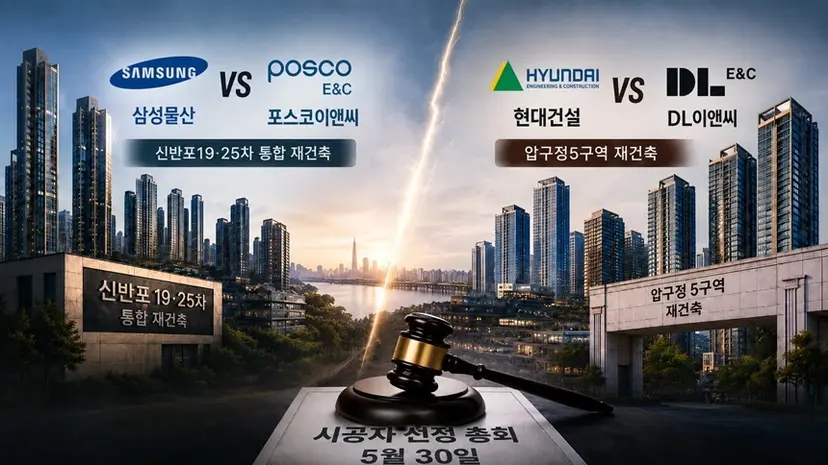
According to the urban planning industry, two key reconstruction project sites in Seoul's Gangnam area will hold their contractor selection general meetings on the 30th. For the Sinbanpo 19th & 25th integrated reconstruction in Seocho-gu, Seoul, Samsung C&T and POSCO E&C will face off, while Hyundai E&C and DL E&C will compete for the Apgujeong District 5 reconstruction in Gangnam-gu, Seoul. Unlike recent major projects such as Apgujeong District 3 and Mok-dong Complex 6 in Yangcheon-gu, which saw bids fail due to single-bidder scenarios, both of these sites have successfully formed competitive bidding, drawing significant attention from the industry.
The common keyword for this competition is 'member benefits.' While past Gangnam reconstruction bids focused heavily on brand value and exterior design, the core variables this time have shifted to how much builders can reduce the financial burden on members, including personal contributions, relocation expenses, interest rates for project funding, and construction cost increases. Analysts suggest that with overlapping challenges like high interest rates, loan regulations, and rising construction costs, financial terms have emerged as the primary criterion for selecting a contractor.
A Rematch Two Years in the Making: Samsung vs. POSCO at Sinbanpo 19th & 25th
The Sinbanpo 19th & 25th integrated reconstruction is an urban renewal project that involves demolishing two complexes in Jamwon-dong, Seocho-gu, to rebuild seven buildings (614 households) ranging from 4 basement levels to a maximum of 49 floors above ground. The estimated construction cost is 10.1 million won per 3.3㎡, totaling 443.4 billion won. This is the first time Samsung C&T and POSCO E&C have faced off in a reconstruction bid in about two years and three months since the Busan Chokjin 2-1 redevelopment project in January 2024. At that time, POSCO E&C won the project by a 47-vote margin after a tight race.
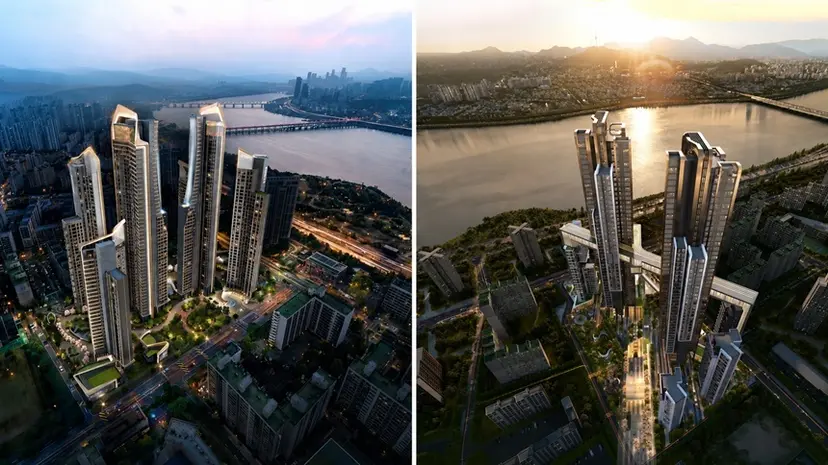
Samsung C&T is focusing on financial stability and the expansion of its 'Raemian' town with the proposal 'Raemian Illucera'. It offered a construction cost of 10.05 million won per 3.3㎡, lower than the association's estimated price. It promised to secure project funds at the lowest interest rate without a cap. Other key conditions include an LTV (Loan-to-Value) ratio of 100% for relocation expenses and a 56-month construction period. In terms of design, it proposed a layout with 6 buildings—reducing the original plan by one—and ensured that 533 households, more than the 446 association members, would have Han River views. Leveraging its experience with integrated reconstruction, the company is expressing confidence in executing the 'on-site' reconstruction and the independent settlement system.
POSCO E&C is highlighting reduced member burdens and project speed with 'The Banpo Hautier'. It proposed a construction cost of 9.798 million won per 3.3㎡ and offered to secure all association project costs at a CD-1% interest rate. The construction period is also relatively short at 49 months. The offer includes guarantees for relocation funds at the level of local newly-built apartment jeonse prices and the early disbursement of 200 million won per household for all members. Its design features include Han River views for all member households, a 17m pilotis, a 250m skybridge, and 3.55m ceiling heights.
First Bidding War in Apgujeong: Hyundai vs. DL in District 5
Apgujeong District 5 is an urban renewal project involving the demolition of Hanyang Apartments 1 and 2 in Apgujeong-dong, Gangnam-gu, to rebuild eight buildings (1,397 households) with 5 basement levels and up to 68 floors above ground. It is the only site among the four Apgujeong Apartment District zones (2, 3, 4, and 5) that has successfully established a competitive bidding environment so far. The estimated construction cost is approximately 1.496 trillion won. Both Hyundai E&C and DL E&C are emphasizing the symbolic prestige of the Apgujeong riverfront location.
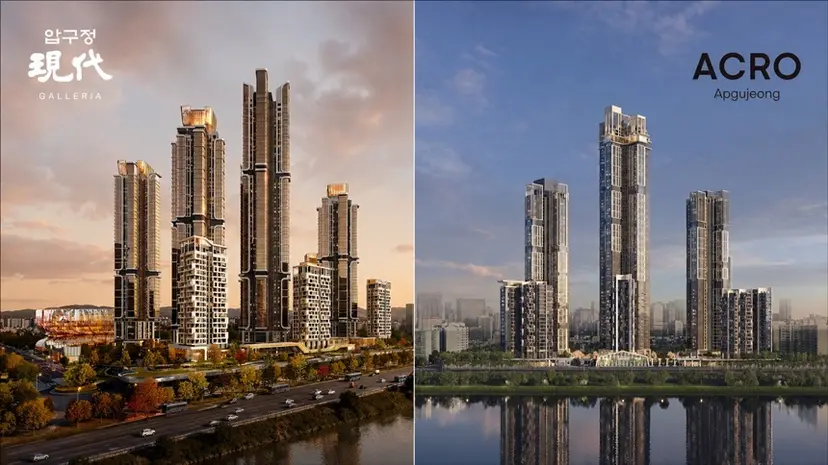
Hyundai E&C is highlighting project stability and guaranteed financing with 'Apgujeong Hyundai Galleria'. The proposal includes 192.7 billion won for specialized complex features within the total construction cost of roughly 1.496 trillion won, and it sets a fixed interest rate of COFIX + 0.49% for all project funding. Key conditions include a 67-month construction period, 100% LTV for relocation expenses, a 4-year deferment on member contributions, and guaranteed procurement if financial institutions cannot provide funds. The design concept aims to maximize the riverfront advantage by providing Han River views for all households, 240-degree panoramic vistas, and 17m pilotis.
DL E&C is aiming for both product excellence and member benefits with 'Acro Apgujeong'. Its fixed construction cost is 11.39 million won per 3.3㎡, which is over 1 million won lower than the association's estimate, and it proposed a 0% additional interest rate based on the new COFIX balance for essential project funding. It set the construction period at 57 months and proposed 150% LTV for relocation expenses and up to a 7-year deferment on member contributions. The design features include one household per floor, specialized terraces, large-scale super penthouses, and Han River views for all member households.
An industry official stated, "While the Urban Renewal Act restricts proposals regarding matters not directly related to construction, such as moving expenses or relocation funds, the reality is that without financial support from contractors, it is difficult to proceed with renewal projects due to housing loan regulations and high additional contributions. Since there is a limit to competition based on specialized design, the competition over interest rates for project funding and support for relocation expenses and member contributions will inevitably continue as long as loan regulations and high-interest-rate environments persist."