

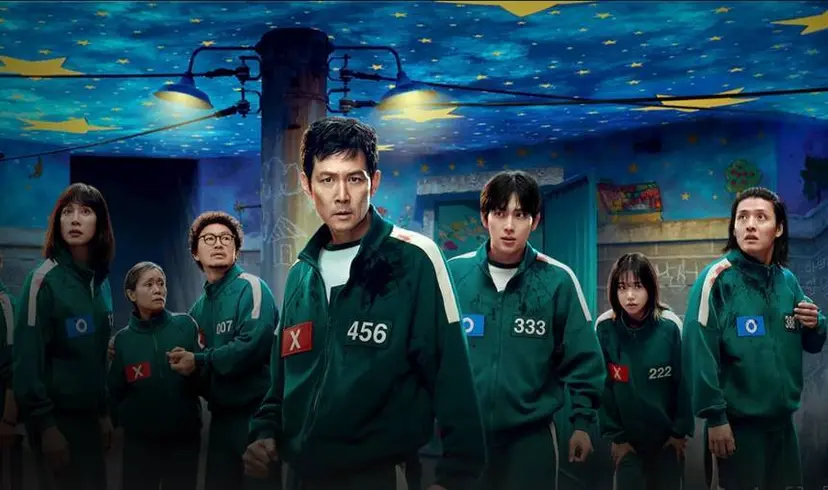
[비즈한국] Netflix filed for trademarks before the release of 'Squid Game' on September 17, 2021. About two years prior, on August 30, 2019, they filed for trademarks covering the online provision of digital content, which was registered on October 20, 2020. As third parties began filing imitation trademarks in other fields, Netflix followed suit by expanding its trademark filings to cover a wider range of sectors. Given that a second season of Squid Game was confirmed, it is clear that they had future IP-based business in mind.
In July 2025, they independently filed for trademarks with the U.S. Patent and Trademark Office (USPTO) regarding the animation 'K-Pop Demon Hunters.' The categories covered include household goods, glassware, apparel, toys, and sporting goods. Essentially, it spans almost every industry. Since a new season for K-Pop Demon Hunters has also been confirmed, it is necessary to build a business model that utilizes its IP. What is noteworthy here is the all-encompassing nature of their trademark registration.
Business models utilizing IP are becoming increasingly important. This is a natural phenomenon and the essence of 'fan-dom economics.' Looking at global trends, there is a clear shift toward actively securing not only trademark rights for titles but also design rights for costumes and props in drama production.
While such cases are still rare in Korean films and dramas, the trend of using IP for promotional marketing is growing in the drama sector. An example is the running campaign 'Run with tvN: Twi-b-n,' linked to popular tvN content in October 2024. It gained attention by incorporating the MZ generation's running craze, but the key element was 'placeness.'
The campaign involved running on courses that connected tvN filming locations and verifying them on social media; these courses were run in partnership with the Seoul Metropolitan Government's 'Soul Spot' project. 'Soul Spot' refers to locations infused with the souls of protagonists from K-Content. By configuring running courses around filming sites for shows like 'Marry My Husband,' 'Lovely Runner,' and 'Queen of Tears,' they boosted fan participation and interest. However, because these shows had already concluded, there were limits to driving fan participation.

Multi-season dramas are more advantageous for maximizing IP utilization. SBS is the broadcaster that produces the most multi-season dramas. The 'Dr. Romantic' series aired up to its third season, and the 'Fiery Priest' series also continued into a second season. The 'Taxi Driver' series premiered its third season by the end of 2025. In 2026, the second seasons of 'Flex X Cop' and 'Good Partner' are scheduled to air. These dramas have already secured a loyal fan base, making them highly suitable for IP exploitation.
Some critics argue that multi-season dramas are just 'milking' the franchise. They claim it’s a lazy reliance on established structures and popularity. That may be true to an extent. However, we are in a media content environment where consumer-driven decisions are paramount. Content that users want holds value, and it is necessary to provide it in line with fan expectations. Satisfying fans is the key to sustainability. That is the principle of content in a smart mobile environment.
Seasons, sequels, and series should now be built not just for world-building, but as broadcasting revenue models. Derivative content business models using IP were originally Disney's specialty. There are prerequisites for this: the content must be enjoyable by all generations, and it is most effective when it is a multi-season or serialized work. Furthermore, it requires a foundation in space. It is even better if the story and concept allow for participation in physical space through the medium of 'placeness.'

Our dramas now target global audiences, not just those in Korea. The drama 'Brave New World,' which is currently gaining popularity, effectively showcases spatial characteristics where one can experience Korea's traditions, modern life, and living culture. If produced as a multi-season series and utilized as sustainable IP, the chances of success will be even greater.
The author, Kim Heon-sik, has been walking through or navigating the forest of pop culture phenomena since his 20s, driven by the hope that there is a way to make the world better through culture. Even in the 21st century, dominated by AI and quantum computers, he continues to follow that same path with the same belief.