

[비즈한국] Garrick Higgo of South Africa received a two-stroke penalty at the 2026 PGA Championship before he even hit his first tee shot in the first round. This was because he arrived at the teeing area one minute late. Had it not been for this penalty, Garrick Higgo could have been in a tie for the lead in the first round. According to Rule 5.3a of the Rules of Golf, even a one-second delay at the teeing area results in a two-stroke penalty. If a player fails to arrive within five minutes, they are disqualified, regardless of the reason.
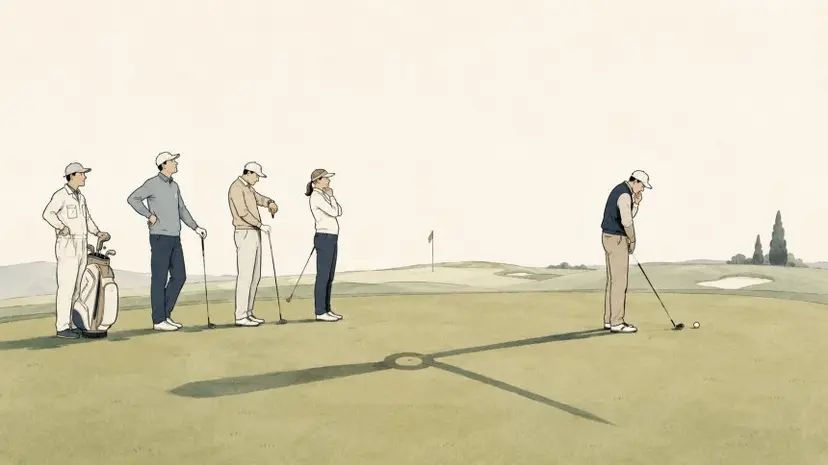
Of course, being 'late' at a professional tournament with massive prize money is a very rare occurrence that makes headlines. Seeing this news reminded me of a younger friend. We have known each other for a long time and are quite close, but this friend is generally late whenever we make plans. Since he often hears, "What’s gotten into you?" when he actually shows up on time, there is no way he doesn't know he is late. One time, we agreed to meet at the start, and I received a call from him. He said traffic was bad and he wouldn't arrive on time, so he told me to start without him. He arrived breathlessly after I had finished the 2nd hole. With an apology, he joined the play from the 3rd hole. I don't recall if he asked, but the caddie recorded his 1st and 2nd holes as par and par. I thought to myself, ‘If he keeps this up, he might shoot his personal best today,’ but after seeing him score an 'onion' (double par or worse) on that hole, I said nothing.
In golf, the recommended time to make a shot is '40 seconds.' The R&A and USGA, which oversee the rules of golf, implemented the '40-second rule' because they identified slow play and excessively long broadcast times as the primary factors diminishing interest in the game. Efforts to shorten match times are a trend not just in golf, but across all sports. A 'pitch clock' was implemented in baseball, and it has significantly shortened game times. In golf, violating the 40-second rule leads from warnings to penalties and can even result in disqualification. Of course, a separate, large fine is also imposed.
There are also 'slow players' among weekend golfers. Often called by their abbreviation, these slow players are the type that many golfers rank highly as 'partners they don't want to play with.' The problem is that most of these slow players don't know how slow they are, and even if they do, they have no intention of fixing it. Their arguments are like this: We aren't professionals, are we? We're just among ourselves, so let's play at a leisurely pace. Why are you rushing when we paid a lot of money to be here? And so on. If you talk about 'pace of play,' they might say, "Pace of play is something you worry about for the golf course's benefit, right?" I had a slow-player friend. After several rounds, I was determined to bring it up, but he told me, "You play too fast, which makes me feel rushed." After hearing that, I said nothing.
In 2021, at the Wells Fargo Championship, Phil Mickelson's shot landed in the deep rough. He knew the general area, but because the rough was so deep, he couldn't find the ball. He exceeded the three minutes allowed by the rules to search for the ball. He received a one-stroke penalty and recorded a double bogey on that hole. Strangely, the time I spend looking for my ball feels short, while the time my partner spends looking for theirs feels long. It's difficult for a partner to be the first to say, "The ball is gone. Let's just go." No one actually times the three minutes precisely. However, if the ball is clearly lost according to the judgment of the caddie and partners, refusing to let go of the ball and searching beyond three minutes is a way of marking oneself as someone people want to cut ties with.
At the 2021 RBC Heritage, Kim Si-woo's 7-meter birdie putt stopped on the edge of the hole. With the wind blowing, Kim waited near the cup for the ball to drop, and eventually, the ball did fall in. However, Kim received a one-stroke penalty and recorded a par. This was because he violated the '10-second rule,' which is the time allowed for a player to wait for the ball to drop once it reaches the edge. Amateur golfers who stand over their balls, casting shadows and wishing desperately for the ball to fall, please remember this: it is '10 seconds.'
Sometimes, when weekend golfers talk, I hear this phrase often: "That’s for the pros..." Are 'pro golf' and 'our golf' different? If someone doesn't keep the time, the pace of play stops for that long. This is not about the pace of play for the sake of the golf course's revenue. It is about the pace of play with your partners. If one person uses too much time, someone else is forced to be rushed. No one in this world likes to wait. My time is also someone else's time.
About the author, Kang Chan-wook: An advertiser and writer. He began his career as a copywriter at Cheil Worldwide and is currently the CEO of the video production company 'Gaze of the Times.' He enjoys golf and holds a USGTF teaching professional certification. With a passion for writing, he has published golf books including 'The Joy of Golf,' 'Bad Golf,' 'Sincere Golf,' and 'Golf Thoughts, Thinking Golf.' He runs the YouTube channel 'Bad Golf,' sharing various stories and thoughts about golf with readers and viewers.