

[비즈한국] One of the most intriguing concepts in the film 'Project Hail Mary' is how the alien being Rocky perceives the world. His species, the Eridians, does not perceive light directly with eyes like humans do. Instead, they understand stars through tools that translate light into other sensory inputs. For an Eridian, starlight might be something akin to dark matter or gravitational waves to humans—something that cannot be felt directly through bodily organs, but can only be perceived through sophisticated instruments.
Just as Rocky uses tools to see stars and explore the universe, humans also sense the invisible universe through their own instruments. Gravitational waves, in particular, are ripples in spacetime itself that cannot be felt by the human body. Perhaps for the Eridians, gravitational waves are a more natural concept than starlight. For a civilization that cannot see light directly, one can imagine that their understanding of the universe might be based on spatial vibrations rather than electromagnetic waves.
Humans have built enormous devices to feel these ripples. We erect laser interferometers spanning several kilometers across the Earth, using mirrors, vacuum tubes, and lasers to measure the minute deformations of spacetime. In essence, the entire civilization of Earth has become a sensory organ, feeling what the individual human body never could. Modern astronomy is evolving beyond the study of light through telescopes into the study of the echoes of vibrations, particles, and gravity left by the universe.
Recently, this massive sensory apparatus captured a very strange signal that could shake the very foundations of cosmology. If the interpretation of this signal is correct, humanity may have witnessed the oldest traces of a black hole left behind shortly after the Big Bang. These are potential signatures of primordial black holes that could have formed even earlier than the first few minutes or seconds of the universe's birth. Furthermore, this signal could be connected to the origin of dark matter.
Over the last decade, LIGO, VIRGO, and KAGRA have been 'listening' to the tremors of the universe. The events primarily captured by these gravitational wave detectors were the violent spacetime disturbances left behind by colliding black holes or neutron stars that had been orbiting one another. Most gravitational wave events detected so far have fallen within mass ranges explained by current stellar evolution theory: massive stars are born, evolve, and explode, and the resulting black holes or neutron stars collide to emit gravitational waves.
However, signals from celestial bodies significantly lighter than the Sun have rarely been confirmed. A significant limitation for astronomers remains that existing detectors are primarily sensitive to tremors caused by massive objects exceeding the mass of the Sun. Generally, black holes formed from the death of a star are much heavier than the Sun. It is difficult to create a black hole lighter than the Sun through standard stellar evolution alone.
Therefore, if evidence of a black hole lighter than the Sun is discovered, it is highly likely to be a primordial black hole created directly by the universe shortly after the Big Bang. Primordial black holes are not products of stellar death. They may have been formed before stars and galaxies even existed, created by the direct gravitational collapse of density fluctuations when the universe was extremely hot and dense.
In this respect, the gravitational wave signal reportedly captured by the LIGO, VIRGO, and KAGRA detectors on November 12, 2025, is highly notable. The possibility has been raised that this signal was created by the merger of two primordial black holes. In particular, the analysis suggests a greater than 99% probability that at least one of the two objects is lighter than the Sun. The estimated mass range falls into a very light regime, roughly 10% to 80% of the Sun's mass.
Even more interesting is the fact that no corresponding electromagnetic signal was observed at the same time. No distinct accompanying signals were confirmed in visible light, X-rays, or gamma rays. This lends weight to the possibility that the event was a merger of compact objects—specifically black holes—that leave behind almost no light. Of course, this has not been fully concluded as an astrophysical event just yet. While further analysis is lowering the possibility of it being random noise, it remains at a stage where verification must be handled with great caution.
Nevertheless, the reason astronomers are paying attention to this event is clear. If the signal originated from an actual astrophysical event and its identity is indeed a black hole lighter than the Sun, humanity has discovered a black hole in a mass range that cannot be explained by typical stellar evolution. While the possibility of a neutron star (which is slightly lighter than a black hole) or some other unknown high-density object cannot be entirely ruled out, it is certainly an event that is difficult to understand through the familiar explanation of the final stages of normal stellar evolution.
The possibility of primordial black holes is significant because it connects directly to the earliest epoch of the universe. Primordial black holes do not require supernova explosions or nuclear fusion-based stellar evolution. When the universe was still in a hot plasma state, if certain regions had a slightly higher density than their surroundings, those regions could have collapsed directly under their own gravity. Black holes formed this way do not need to follow stellar mass rules; theoretically, they could range from as light as an asteroid to as massive as supermassive black holes.
For this reason, primordial black holes have long been considered a candidate for dark matter. Dark matter is an unknown component that neither emits nor absorbs light but exerts a decisive influence on the motion of galaxies and galaxy clusters through gravity. If a vast number of primordial black holes were created in the early universe and have survived until now, it is possible that some of them play the role of dark matter.
An especially intriguing aspect of this discussion is the formation model for primordial black holes. In the early universe, the physical conditions of fundamental interactions—such as strong, weak, and electromagnetic forces—differed significantly from today. It has been suggested that there was a specific transition period as the universe cooled, during which density fluctuations were amplified, leading to the collective formation of primordial black holes. In this model, the mass distribution of primordial black holes can be spread widely, which naturally accounts for black holes lighter than the mass of the Sun.
The form of the reported gravitational wave signal is interpreted as fitting well with such a population model of light primordial black holes. Researchers estimate that when applying the mass distribution and merger probabilities of primordial black holes, roughly 0.8 to 8 such collisions could be detected annually by LIGO, VIRGO, and KAGRA. While not a very high frequency, it implies that such an event is not at all impossible.
Furthermore, if this signal did indeed originate from the merger of primordial black holes, some argue that primordial black holes could account for at least about 4% of the total dark matter in the universe. This does not mean that all dark matter consists of primordial black holes, but it demonstrates that a portion of the still-unidentified dark matter could be explained by them.
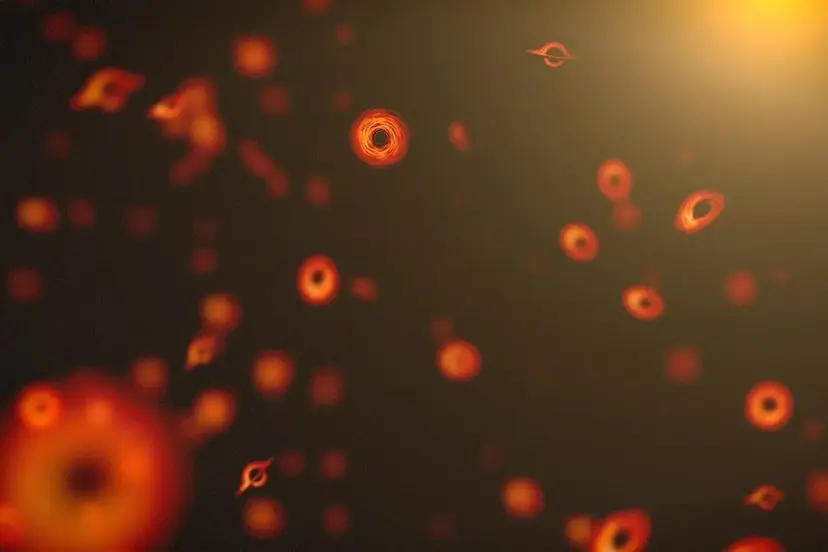
If this interpretation is correct, the identity of dark matter may be far more complex than we thought. Dark matter might not be a simple component made of a single new fundamental particle. Part of it may be primordial black holes, another part could be as-yet-undiscovered particles, and yet another part might have a completely different physical origin. The invisible mass of the universe may not be a problem solved by a single answer, but rather a complex structure mixed with various types of dark components.
It has even been suggested that some of the merger events involving black holes several to dozens of times the mass of the Sun—or even heavier—previously detected by LIGO, VIRGO, and KAGRA could also be collisions of primordial black holes. We have interpreted many past gravitational wave events as mergers of stellar-mass black holes. However, if a population of primordial black holes formed in the early universe actually exists, some of them might have already been captured by today's gravitational wave observation network.
Humanity is passing through a very curious era. We sense a universe we cannot see directly through various translation devices. Telescopes translate radio, infrared, X-ray, and gamma rays beyond visible light, while gravitational wave detectors convert the tremors of spacetime into numbers and waveforms. Just as Rocky reads starlight through texture, humans read the vibrations of the invisible universe through massive devices made of lasers, mirrors, and vacuum tubes.
Through those translation devices, humanity is even attempting to find faint traces of black holes once thought too light to exist. If these are indeed the voices left by primordial black holes shortly after the Big Bang, we are standing near the moment when the universe's oldest secrets make a sound for the first time. It is possible that black holes, which may have existed before light, before stars, and before galaxies, are now revealing their traces through the ripples of spacetime 13.8 billion years later.
If an Eridian civilization capable of freely feeling the vibrations of gravitational waves existed, the universe would never be a silent space to them. Every time black holes and neutron stars collide, the universe would hum, and the traces of massive mergers occurring deep in galaxies would propagate through all of spacetime. For them, the night sky might not be a landscape of glowing dots, but a vast sea of endless vibration and resonance.
Just as Rocky first understood the existence of stars, human civilization has entered a new stage of sensing dark matter and the tremors of spacetime, which once seemed invisible. We have evolved beyond a civilization that merely looks at the universe to one that hears and interprets its vibrations. And hidden within those tremors might be the oldest memories left by the universe before the first star was born.
Who is author Ji Woong-bae? He loves cats and the universe. After watching 'Galaxy Express 999' as a child, he dreamed of sharing the beauty of the universe. He is currently an assistant professor in the Division of Liberal Arts at Sejong University, engaged in various science communication activities such as lecturing and writing. He has authored books including 'Everyday a Piece of the Universe', 'Scientists of the Starry Universe', 'Can't Go, But Can Know', and 'Strange Questions That Come to Mind When Looking at the Universe', and has translated 'The Hitchhiker's Guide to the Real Universe', 'How I Killed Pluto', 'Quantum Life', and 'Cosmigraphics'.