

[비즈한국] The European Union (EU) and Korean companies are building industrial cooperation centered on the clean energy transition. The idea is to go beyond merely addressing the climate crisis, and instead, to create a new pillar of economic security by combining mutual technological prowess and infrastructure amidst the global supply chain crisis.
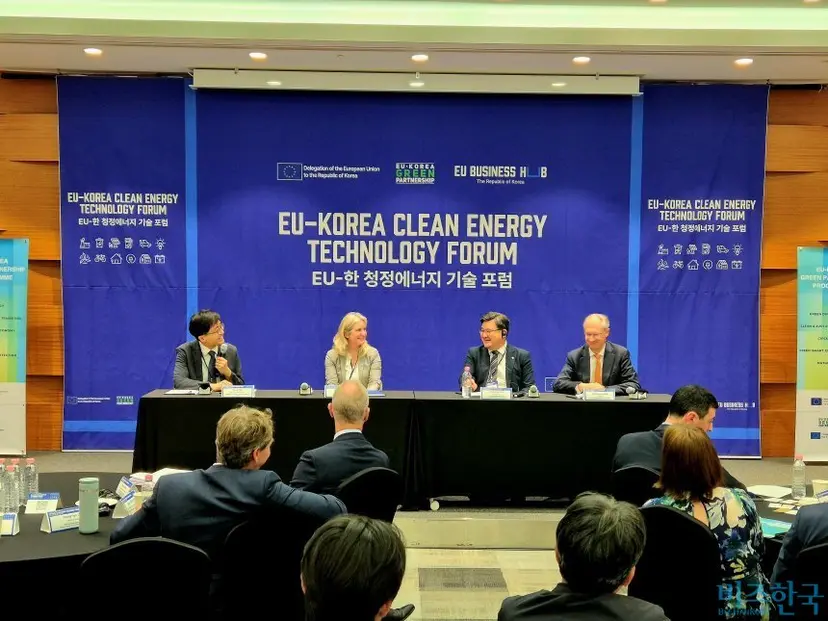
On May 19, the 'EU-Korea Clean Energy Technology Forum' was held at COEX in Gangnam-gu, Seoul, hosted by the Delegation of the European Union to the Republic of Korea. This event was organized as part of the 'EU-Korea Green Partnership Program (GPP)' and the 'EU Business Hub,' with about 100 participants, including officials from the European Commission, approximately 40 EU companies in the green industry, and domestic industry representatives, gathering to discuss technological innovation and ways to promote investment.
Courting Korean Manufacturing
A notable aspect of this forum was the potential for cooperation presented by both Korea and Europe, based on their respective strengths. From the EU side, there was active wooing of Korean companies' advanced manufacturing. Sergio Albu, Technical Director at Lumcloon Energy, an Irish energy developer, remarked, "Korea is a global technology leader in Battery Energy Storage Systems (BESS) with a mature supply chain." Mentioning a collaboration with Hanwha 000880 on a 63MW BESS project, he pointed to overwhelming technical prowess and vertical integration—encompassing technology, construction, and finance—as the strengths of Korean companies.
At the same time, the EU also demonstrated its willingness to cooperate with Korea, leveraging their long-accumulated advanced renewable energy technologies and policy know-how. Europe particularly took note of Korea’s immense offshore wind power potential, given that it is a peninsula. Philipp van Hoof, Chairman of the European Chamber of Commerce in Korea (ECCK), said, "Korea has 10 times the sea area available for offshore wind compared to Germany, yet its generation capacity is only one-third the size. Offshore wind costs are heavily influenced by regulations, and these regulations depend on the Korean authorities." Jose Luis Gallardo, Commercial Counselor at the Spanish Embassy in Seoul, also expressed a strong desire for cooperation in the Korean offshore wind market, citing Spain’s specialized expertise in large-scale fixed and floating offshore wind platforms.
Beyond power generation facilities, there were active moves to transplant 'energy efficiency' technologies for daily life and industry into Korea. Dennis Bloh, Counselor at the German Embassy in Seoul, proposed technological cooperation to improve energy efficiency in industrial production processes and smart heating systems. Furthermore, European energy technologies—such as Dutch greenhouse agricultural energy efficiency technology or Northern European residential building insulation technology that withstands severe cold—were presented as new business opportunities to fill gaps in Korea. Korea's 'advanced manufacturing and battery technology' and Europe's 'renewable energy infrastructure and efficiency know-how' were mentioned as key areas for cooperation.
"Chemical and Machinery Powerhouse Korea, an Optimal Partner Amidst Supply Chain Crisis"
In particular, this forum highlighted Korea's role in battery supply chains and the recycling of core raw materials. Kerstin Jorna, Director-General for Internal Market, Industry, Entrepreneurship and SMEs (DG GROW) at the European Commission, who gave the keynote speech, noted that Korean companies are making large-scale investments in battery cell manufacturing within Europe and emphasized the importance of building an entire battery supply chain starting from raw materials. She evaluated that Korea possesses outstanding capabilities in key material sectors such as cathode and anode materials.
Furthermore, Jorna pointed out the supply chain risks overly concentrated on China and presented 'rare earth recycling' as a new business breakthrough for both sides. She diagnosed, "Currently, the large-scale supply chain for core raw materials, including rare earths, exists only in China. Conversely, this means a huge business opportunity for both sides to cooperate and develop new recycling technologies." She predicted, "The recycling of rare earths or other raw materials is ultimately a fusion of chemistry and mechanical engineering, and since both Korea and Europe have outstanding strengths in these fields, it could become a core business model of the future."
The Korean government has set a goal to supply 100GW of renewable energy by 2030 to achieve net-zero by 2050 and is increasing its commitment to energy transition. However, it faces realistic barriers such as underdeveloped infrastructure and cost issues. Cho Young-joon, head of the Institute for Sustainable Management at the Korea Chamber of Commerce and Industry, pointed to power grid shortages and delayed grid connections, noting, "Power generation businesses are currently in a queue due to the lack of grid capacity where demand is concentrated."
Koh Eun, Deputy CEO of Next, analyzed that while EU policies and markets have created an environment that attracts low-carbon investment, Korea still lacks that foundation, leading companies to perceive the transition as a significant 'cost burden.' In the flow of global greenhouse gas emission regulations, finding a breakthrough that goes beyond costs is urgent.
Deregulation and Policy Stability: What Korea Must Learn
Amidst these difficulties, the EU's bold regulatory innovation and experience in building infrastructure offer important implications for Korea. Director-General Jorna emphasized that the EU is working hard on so-called 'simplification,' which bundles multiple bills through Omnibus-style legislation to quickly abolish regulations that burden businesses and shorten licensing processes.
The long-term policy stability of EU countries was also notable. Dennis Bloh, economic counselor at the German Embassy, where renewable energy now accounts for about 60% of total power, emphasized that energy transition is an economic opportunity, stating, "Germany's renewable energy sector alone employs 280,000 people." He added, "The core lesson Germany learned from its energy transition experience is the importance of reliable, long-term policies. To encourage investment and foster innovation, clear direction and certainty are needed. Frequent policy changes, regulatory uncertainty, and unpredictable procedures create many difficulties for investment and growth." Counselor Gallardo also cited the combination of clear targets and public policy as the secret to Spain's success.
The EU's move to introduce carbon-related regulations, such as the Carbon Border Adjustment Mechanism (CBAM), has gone beyond environmental conservation and is directly linked to industrial survival. The partnership between the two sides, aimed at seizing economic initiative amidst the global supply chain crisis—from battery cells to rare earth recycling and energy—has been put to a real test.