

[비즈한국] As 'Choline Alfoscerate (Choline),' the dominant leader in the brain function improvement market, faces the threat of exit due to efficacy controversies and pressure for clinical re-evaluation, 'Ginkgo biloba extract,' which shares the same indications, is rapidly emerging as an alternative. It has now secured objective clinical data showing that it suppresses the accumulation of beta-amyloid, a primary cause of Alzheimer's disease.

Yang Young-soon, a professor of neurology at Soonchunhyang University Cheonan Hospital (Insurance Director of the Korean Dementia Association), announced at a media roundtable held at the Korea Press Center in Seoul on the 18th, "We have confirmed through PET-CT (Positron Emission Tomography) that Ginkgo biloba extract suppresses the accumulation of beta-amyloid in the brains of patients with mild cognitive impairment." Beta-amyloid is a key toxic protein that causes Alzheimer's dementia, and this is the first time its aggregation-inhibiting effect by Ginkgo biloba extract has been proven through imaging equipment. This is significant in that it has visually proven the efficacy of Ginkgo biloba extract, which previously relied on subjective cognitive function evaluations or symptom improvement indices, through objective biomarker data.
Professor Yang analyzed clinical trials conducted over 18 months on patients with mild cognitive impairment (MCI) who tested positive in amyloid PET scans. The results showed that while 28.6% of the control group, which received existing cognitive supplements (omega-3, choline precursors, etc.), progressed to Alzheimer's disease, none of the patients in the group taking 240mg of Ginkgo biloba extract daily progressed to dementia.
In a blood-based test (MDS-Oaβ) that measures toxic protein clumps (oligomerization), the control group showed a significant increase in levels from an initial 0.86±0.11 to 0.95±0.21, whereas the Ginkgo biloba group saw a decrease from 0.87±0.14 to 0.79±0.13.
Professor Yang explained, "This objectively proves that the aggregation of beta-amyloid, the core cause of Alzheimer's dementia, is suppressed by the extract."
Professor Yang further emphasized, "While existing drugs that supplement neurotransmitters involved in cognitive function had limitations in preventing the disease itself because they only temporarily suppressed symptoms to aid daily life, this study serves as an opportunity to shift the treatment paradigm from symptom suppression to cause removal, as it acts directly on the underlying causative factors of the disease like beta-amyloid aggregation."
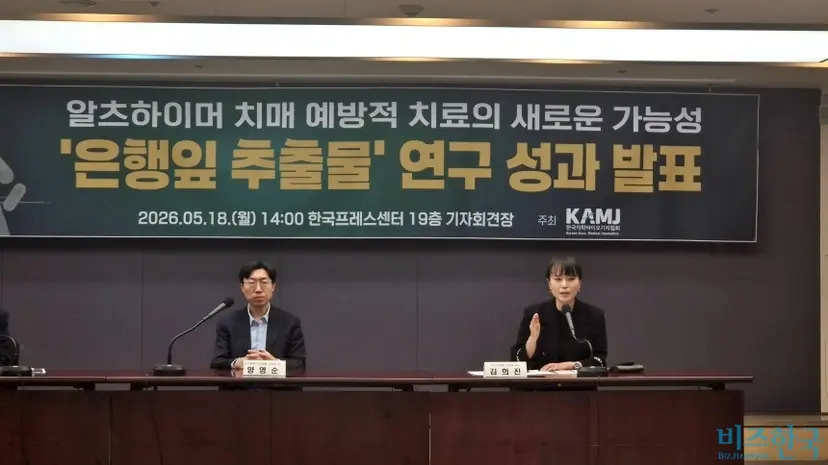
Kim Hee-jin, a professor of neurology at Hanyang University Hospital, who participated in the discussion, evaluated that these research results would serve as an important milestone in actual clinical practice.
Professor Kim predicted, "Ginkgo biloba extract will become an excellent pharmacological alternative that goes beyond simply observing memory symptoms to delaying amyloid accumulation and cognitive decline. In particular, if taken in combination with antibody treatments capable of removing amyloid, the effects could be further enhanced."
The reason why these clinical achievements of Ginkgo biloba extract carry such explosive weight is that Choline preparations, which once dominated the brain disease treatment market, are on the edge of a cliff.
Choline preparations, which once recorded annual prescriptions of 600 billion KRW, saw their coverage significantly reduced following a Supreme Court ruling due to controversies over clinical utility. While a 30% co-payment rate is maintained for patients diagnosed with dementia, it has increased to 80% for non-dementia conditions such as mild cognitive impairment, stroke sequelae, and geriatric depression.
Furthermore, if dozens of pharmaceutical companies, including Chong Kun Dang185750 and Daewoong Bio, which have formed a joint clinical front, fail to prove efficacy within the year in the clinical re-evaluation by the Ministry of Food and Drug Safety, they risk not only the complete removal of indications from the health insurance coverage list but also a potential "bomb" of up to 500 billion KRW in health insurance clawbacks.