

[비즈한국] The KOSPI has surpassed the 7500 mark. It briefly neared 8000 during trading on May 11, but took a breather due to profit-taking. The U.S. S&P 500 has also broken through 7500, setting new all-time highs day after day. Both the Korean and U.S. stock markets are simultaneously rewriting history.
The problem is what comes next. Whenever I go to gatherings, everyone is talking about stocks. People say someone made a fortune with SK Hynix000660, or someone else made enough from NVIDIA to buy an apartment in Gangnam. Those who stayed out of the stock market due to financial constraints or caution are now kicking themselves. FOMO (Fear Of Missing Out) has begun to spread in earnest.
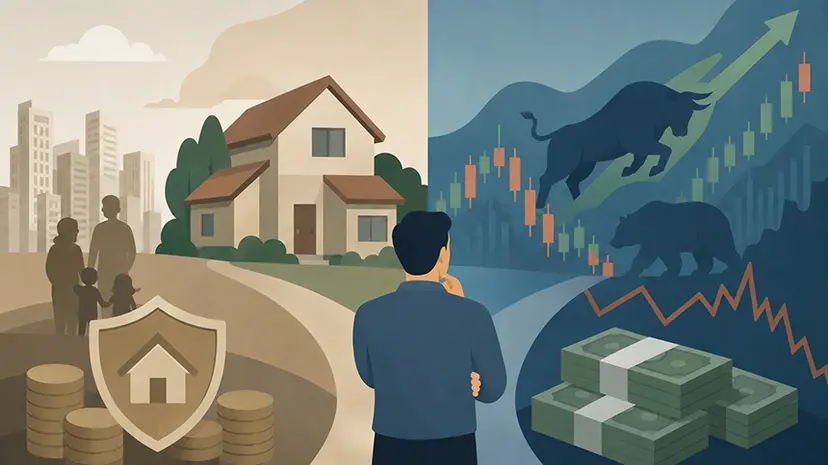
There is one extremely dangerous idea at a time like this: "Let's sell the house we're living in and go all-in on stocks."
Let me start with the conclusion: I am firmly against it. In any case, I oppose it. Having observed the real estate market for 30 years and witnessed countless cycles, I have almost never seen a case where someone became happy after selling their primary residence to go all-in on another asset. The opposite cases, however, are abundant.
If you don't trust my words, let's listen to the advice of the super-rich.
Warren Buffett, the world's greatest investor, bought a modest home in Omaha, USA, for $31,500 in 1958. And he still lives in that house today. He has stated in public, "The third best investment I ever made was buying this house." The first and second? Two wedding rings.
Let's not misunderstand. Buffett did not say that "a house is better than stocks in terms of rate of return." He honestly admitted, "If I had bought stocks with that money instead of the house, I would have made more money." Nevertheless, he calls buying the house one of the best decisions of his life. Why? Because a home is not just an investment asset. It is a sanctuary for family, a foundation for life planning, and above all, an asset that doesn't keep you awake at night.
Buffett goes a step further. At the 2014 Fortune Conference, he said, "People should be lining up to buy homes with 30-year mortgages." He also called the 30-year fixed-rate mortgage "the best financial instrument in the world." It is a means to hedge against inflation while ensuring stable residence. In a 2012 CNBC interview, he answered a young investor without hesitation: "If you ask me whether to choose stocks or a house, I would buy the house first with a 30-year mortgage. That is the best deal."
It doesn't end there. Another legend, Peter Lynch. He managed the Magellan Fund for 13 years and recorded an astonishing average annual return of 29%. In Chapter 4 of his masterpiece, 'One Up on Wall Street,' he introduces what he calls the 'Mirror Test.' These are three questions to ask yourself in the mirror before buying a stock. What is the first one?
"Do I own a home?"
Lynch is firm. "You must buy a home before investing in stocks. 99 times out of 100, a home is an asset that makes you money." He also says, "When people buy a house, they check the school district, the road conditions, and even the plumbing. They even inspect things carefully when buying a refrigerator. But when they buy stocks, they throw $10,000 away because someone said something on the bus on their way to work. Then, when they lose money, they blame their luck."
It's a piercing insight. I think of the countless investors I've met over the last 30 years. A person who spent a whole month analyzing school districts, checking traffic developments, examining surrounding infrastructure, and summarizing apartment prices and jeonse (charter) rates in Excel to buy a 30-pyeong apartment in Bundang would, just a few days later, decide to buy a stock based on a single word a friend dropped during lunch. It's hard to believe it's the same person.
The reason Lynch says to buy a home first is clear. First, a home naturally utilizes leverage. You own 100% of the asset while putting down only 20% of your own money. It is a safe, long-term form of leverage that is in a different league than buying stocks on margin. Second, the price doesn't fluctuate 5% every day. There is no need to break into a cold sweat while staring at the ticker at midnight. Third, and most importantly, you live in it. Even if the price falls, the utility of living remains the same. If stocks are cut in half, your assets are cut in half, but even if house prices fluctuate temporarily, your family still lives in that house.
This difference is decisive.
Let's recall stock market crashes. The 2008 financial crisis, the 2020 COVID shock, the 2022 inflation shock, and the 12% KOSPI plunge caused by the Middle East this March. What was the difference between those who held their stocks until the end and those who dumped them out of fear? While it might be a matter of mentality, more fundamentally, it was about whether they had a 'base camp' to hold on. A person who has secured a home does not have their daily life collapse even when stocks fluctuate. However, it is different for someone who sold their home to go all-in on stocks. The moment stocks drop 30%, it is not just a loss, but leads directly to residential instability and the collapse of life planning.
Let's add the Korean context. In May 2026, the Korean real estate market is at a difficult inflection point. The surtax on capital gains for multi-home owners was reinstated on May 10, and exceptions for residential requirements in land transaction permit zones have been expanded. The market is once again showing the 'Korean paradox' where regulation tightening and price increases occur simultaneously. The most important variable is that jeonse is disappearing. The 2026-2027 shortage of move-in volumes in Seoul is right around the corner. Rent is in an environment where it is structurally bound to rise.
Think about selling your home at this point. It would be fortunate if you made a profit from stocks. But after you make that profit, where will you live? Jeonse is drying up, and monthly rent is rising sharply. The same goes for purchase prices. Once you sell your home, it's hard to move back into the same neighborhood. Even if you made 30% on stocks, if house prices rose by 30% in the meantime, you are effectively in the negative. Furthermore, what if your stocks drop by 30%? You lose both your assets and your residence. It's a double blow.
This is the real reason why the super-rich say, "Secure your own home first." It is because wealth accumulation is not a game of return rates, but a game of survival. Let's remember the two investment principles Warren Buffett has emphasized his whole life: "Rule 1: Never lose money. Rule 2: Never forget Rule 1." A residential home belongs to the realm of 'Rule 1' in an asset portfolio. It is the baseline that must not be lost under any circumstances.
Does this mean you shouldn't invest in stocks? Far from it. It's the opposite. You should also invest in stocks. However, there is an order. It is standard practice to buy your home first and then invest surplus funds into stocks based on the psychological and financial stability that comes from it. Neither Buffett nor Lynch said, "Don't invest in stocks." They just said, "Buy a home first, then buy stocks."
How much of your portfolio to allocate to investment assets depends on individual circumstances. However, increasing your stock exposure without having a home to live in is like driving at 200km/h without wearing a seatbelt. It seems fine normally. But if an accident happens once, it is irrecoverable.
The stock market is currently at an all-time high. Some say it will rise further, others say it's a bubble. Time will tell which side is right. But one thing is certain: a primary residence is an asset that supports a family's life regardless of market cycles. Regardless of the market, that house is where the family lives. Even if the market crashes, you can sleep in that house. Even if the market skyrockets, the utility of the house remains the same.
A massive wave of FOMO is coming. Friends, colleagues, relatives, and neighbors are talking about stocks. In the meantime, your own home might feel suffocating. The thought, "If I sold this house, I could buy so many shares of XX stock," sneaks in.
At that moment, let's look in the mirror. And let's ask ourselves Peter Lynch's first question: "Do I have a stable home to live in right now?"
If the answer is 'Yes,' never sell that house. Diversify only your surplus funds into stocks. If the answer is 'No,' use the money you thought was for stock investment to secure your home first.
Warren Buffett still lives in the house he bought in 1958. In the meantime, he became the richest person in the world. Not because he didn't sell his house, but because he sat on the house and invested calmly from that foundation.
FOMO is an emotion created by the market, while home ownership is a foundation created by life. Let's not confuse the two. The market will open tomorrow as well. But a home for your family to live in stably is hard to get back once you let it go.
※ Kim Hak-ryul, head of the Smart Tube Real Estate Research Institute, well-known by his pen name 'Pashong', previously served as a team leader at the Gallup Korea Real Estate Research Center. He runs the Naver blog 'Pashong's World Exploration' and the YouTube channel 'StuTV'. His books include '3040 Real Estate Beginner's First Real Estate Investment (2026)', 'Rewriting the South Korean Real Estate User Manual (2025)', 'The Power of Gyeonggi Real Estate (2024)', 'Absolute Principles of Seoul Real Estate (2023)', 'The Future of Incheon Real Estate (2022)', 'Kim Hak-ryul's Absolute Principles of Real Estate Investment (2022)', 'South Korean Real Estate Future Map (2021)', and 'From Now On, Only Places That Will Rise, Rise (2020)'.