

[비즈한국] As the KOSPI index surpassed 8,000 during intraday trading on the 15th, the stock market continues to thrive, and exports are also showing an upward trend. However, a closer look reveals that a K-shaped polarization—where sectors other than semiconductors are underperforming—is becoming the new normal for the Korean economy. This K-shaped polarization is not limited to stocks or companies but is expanding into the labor market.
Since the beginning of this year, while the total number of employed persons has increased, full-time jobs have remained stagnant while part-time positions have risen. Furthermore, the wage gap between workers at small businesses and those at large corporations has reached an all-time high, indicating that the K-shaped polarization is becoming evident in terms of employment quality as well.

President Lee Jae-myung emphasized the need to resolve labor market polarization multiple times around Labor Day (May 1st), the first since his administration took office. While presiding over a meeting of senior secretaries at the Blue House the day before Labor Day, President Lee stated, "Starting this year, Labor Day is particularly meaningful not only because it has reclaimed its rightful name of 'Labor' but also because it has been designated as a legal public holiday." He presented the resolution of polarization as a major task, adding, "To create a country where labor is properly respected and valued, it is important to narrow the gaps in the labor market."
In his congratulatory message on Labor Day the following day, President Lee stated, "The extent of one's rights should not differ simply because the form of employment or the way of working is different." He added, "I will take special care to ensure that all working people, from regular and irregular workers to prime and subcontractors, as well as platform workers and freelancers, receive fair treatment and that no blind spots in protection are created."
However, our current labor market is trending toward an increasingly clear K-shaped polarization. According to the National Data Agency, the total number of employed persons in the first quarter of this year was 28.398 million, an increase of 183,000 compared to the same period last year (28.215 million), showing a superficial improvement. Yet, a closer examination reveals that the situation is not so positive. The number of people working less than 36 hours a week—most of whom are part-timers or freelancers—increased to 6.597 million in the first quarter, up 123,000 from the same period last year (6.474 million).
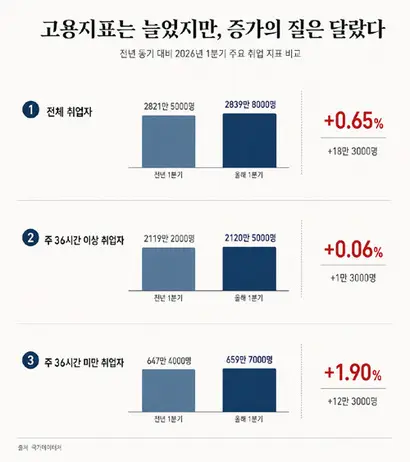
In addition, the number of temporary leave-takers increased by 47,000, from 549,000 to 596,000, during the same period. In contrast, the number of people working 36 hours or more per week, which can be considered relatively stable employment, only increased by 13,000, from 21.192 million to 21.205 million during the same period. The proportion of those working 36 hours or more among the total number of newly employed in the first quarter was a mere 7.1%.
Furthermore, the increase in workers employed for less than 17 hours a week—referred to as "ultra-short-term" workers—among those working less than 36 hours shows that job polarization is becoming serious. In the first quarter, the number of people working less than 17 hours was 2.582 million, an increase of 34,000 compared to the same period last year (2.548 million). Consequently, the proportion of those working less than 17 hours out of total employment rose from 9.0% to 9.1% during the same period. As polarization in the labor market deepens, more people appear to be giving up on entering the job market altogether. The number of people preparing for employment in the first quarter was 619,000, a decrease of 36,000 compared to the same period last year (655,000).
It was found that even after overcoming these difficulties and finding a job, workers are facing another K-shaped polarization as the wage gap between small/medium-sized enterprises and large corporations continues to widen. According to the Ministry of Employment and Labor, for small businesses with fewer than 10 employees last year, the average monthly total wage was 2,940,609 won, an increase of only 73,027 won compared to 2004 (2,867,582 won). The situation is similar for small and medium-sized enterprises (SMEs) with 300 or fewer employees. The average monthly total wage for SME workers rose from 3,641,650 won in 2004 to 3,733,256 won, an increase of 91,606 won.
In contrast, for large corporations with 300 or more employees, the average monthly total wage rose significantly by 251,568 won, from 6,220,175 won in 2004 to 6,471,743 won. As a result, the wage gap between workers at large corporations and those at small businesses widened to 2.20 times last year, marking an all-time high, while the wage gap between workers at large corporations and those at SMEs also recorded an all-time high of 1.73 times.