

[비즈한국] Lee, a 23-year-old fan of the animation 'Jujutsu Kaisen', recently visited a Gacha shop in Paldal-gu, Suwon. He wanted to get a 'Mejirushi' figure keychain. Lee tried pulling from the same machine about 12 times to get his desired character, but the figure never appeared. Instead, he ended up with four or five copies each of two relatively unpopular characters among fans. The amount Lee spent that day reached approximately 70,000 won.
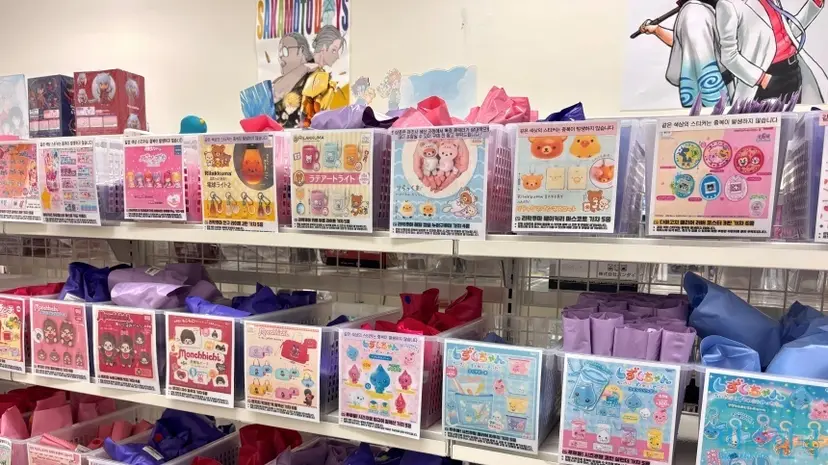
Total lineup ratios are a mystery
As the consumption of random character-themed goods has become a form of entertainment culture, the so-called GOTCHA market is growing rapidly. According to the industry, the domestic Gacha market, which stood at only 10 billion won in 2023, surpassed 50 billion won last year and is projected to grow to 100 billion won this year.
The fact that large retailers are consecutively expanding their Gacha sections also proves the market's growth trend. In the case of the HDC IPARK Mall Yongsan branch, which has installed a total of 1,000 Gacha machines, monthly sales are approaching 2 billion won. Lotte Mart, which operates Gacha machines in 112 stores nationwide, saw its Gacha sales increase by 20% compared to the same period last year as of August this year.
At the AK Plaza Hongdae branch in Mapo-gu, Seoul, over 200 capsule toy machines are lined up in two tiers, and there are over 20 Gacha shops just in the Hongdae area. Global market research firm Verified Market Research projected that the global capsule toy market will grow by an average of more than 10% annually from 2024 to 2030, reaching $630 million (approximately 939.8 billion won).
Despite this massive growth, critics point out that consumer protection measures are still inadequate. Suspicions that popular characters are being removed in advance and product compositions are being arbitrarily swapped are recurring, and phenomena where products that do not contain the full lineup are sold as random goods are also emerging. However, there are limited ways for consumers to verify the full composition or raise issues.
Gacha products are broadly categorized into capsule toys, random boxes, and Ichiban Kuji. Capsule toys work by inserting a set amount of money into a machine to receive a product inside a capsule. Random boxes allow consumers to choose one of many identical-looking boxes directly. Ichiban Kuji operates by purchasing a raffle ticket and receiving a prize based on the grade drawn. The industry also distinguishes between 'self-made Kuji,' produced and sold by domestic companies, and 'imported Kuji,' which are products brought in from overseas, including Japan.
The problem is that even though products are sold randomly, it is difficult for consumers to know if they are truly random. Because capsule toys prevent the inside of the machine from being seen, it is difficult for buyers to verify in advance if a specific product is coming out repeatedly. For random boxes, since products often arrive in 'full box' units with set character distributions, suspicions are raised that store employees might know the location of popular characters and set them aside.
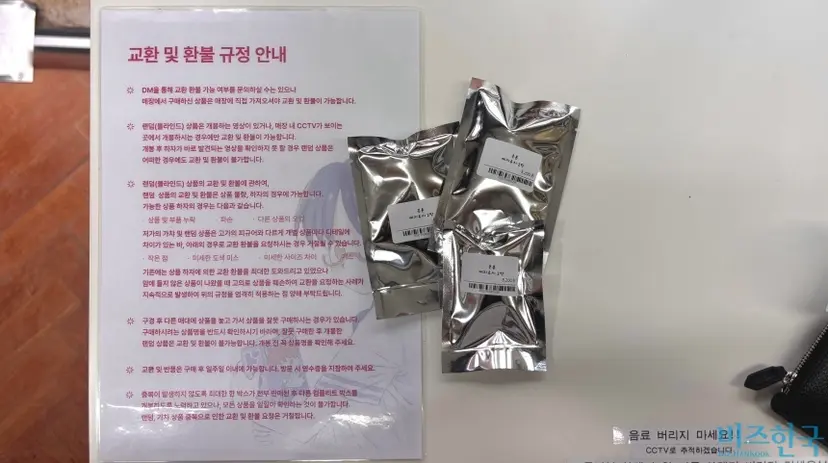
On-site: "No refunds for duplicates"... Consumers bear the cost even when getting the same product
On the 13th, when the reporter visited six goods shops in Mapo-gu and Yongsan-gu, Seoul, every store visited informed customers that "exchanges and refunds due to duplicates are impossible" for Gacha products. In particular, random boxes were operated by adding new products to existing inventory. In this case, the possibility that multiple identical products are mixed inside one machine or box increases.
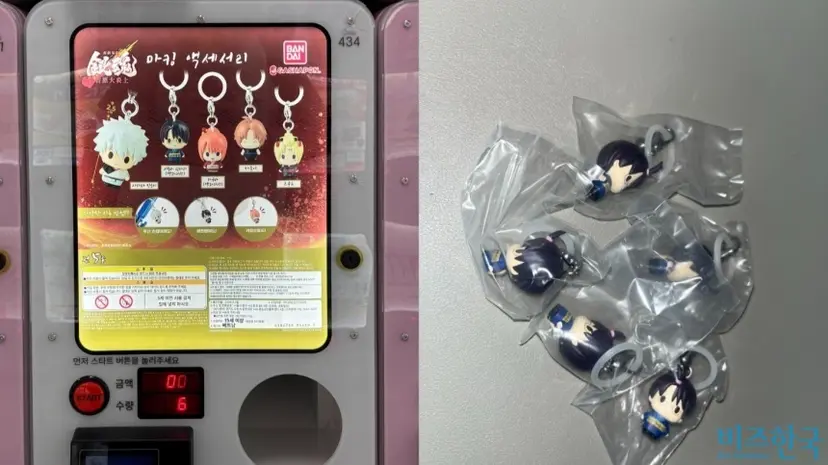
The situation was similar for unmanned capsule toy stores. When the reporter pulled from one machine five times, the same character appeared every time. Inside the store, there were no staff to inquire with, and notices were posted stating that exchanges and refunds due to duplicates were difficult. The cost per pull was 6,000 won.
Moon, a 25-year-old met at a goods shop in Mapo-gu that day, said, "I like the animation 'Gintama,' and I hope to get my favorite character, Gintoki," adding, "I usually spend about 30,000 won whenever I visit." Moon said, "The characters people want are mostly similar, so secondary market prices are high," and "I play Gacha because I think it's cheaper to pull them myself if I get them in one or two tries, but if they don't come out, I end up spending more money than expected."
Mini-figures are generally sold for 4,000 to 7,000 won at official stores and 6,000 to 8,000 won at some unofficial goods shops. As repeat purchases increase to get desired characters, the burden on consumers is growing. Secondary trading, where duplicate products are resold or exchanged, is also active. Some popular characters or limited-edition items are traded for several times their original price.
However, there are no specific regulations under current law for offline Gacha products. While games are required to disclose the composition ratios and acquisition probabilities of probability-based items under the Game Industry Promotion Act, offline random goods are not subject to such regulations.
Standardized consumer protection needed for offline Gacha as well
As suspicions of duplicate products and tampering grew, some goods shops began offering explanations. Store A, located in Yongsan-gu, Seoul, stated through a notice, "Although these products are sometimes distributed by the box, the inventory we secured this time was received as individual random items, not 'full boxes' from the time of import."
In other words, it means they secured inventory by individual unit rather than by boxes containing the full set of characters, due to scarcity issues. In this case, even if the store did not manually pick out popular characters, there is a possibility that certain characters were not included in the sales volume from the start. From the consumer's perspective, they thought they were pulling from the full lineup at random, but they might have actually been purchasing from a batch that only contained a portion of the items.
Experts point out that the offline random goods market also needs minimal labeling standards. Lee Eun-hee, a professor of Consumer Science at Inha University, said, "Even if they are Gacha products, information regarding which types and how many of each are included in the total pool should be provided," and "Consumers should be able to make a purchase decision after estimating their probability of pulling the item they want."
Professor Lee explained, "Institutions like the Fair Trade Commission need to establish standards or guidelines for providing information related to the sale of random goods. Disclosing composition information is not necessarily disadvantageous to business owners. If consumers can challenge with knowledge of the probabilities, it could actually have the effect of increasing the desire to purchase."
An official from the Korea Consumer Agency stated, "Looking at recent consultations and damage reports, cases haven't accumulated enough for the agency to investigate the unfairness at an institutional level," adding, "While there are relevant laws for games, offline Gacha products have ambiguous regulations, making it difficult to give a clear answer on consumer protection standards for the current sale of random goods."