

[비즈한국] There are foods that I have come to love more after reading the comics of Lee Doo-ho. The honey-dipped yakgwa of Meoteori that teases Ttomae, the beef soup with rice that Charsoni loved, the freshwater fish porridge of Gadochi, and the jar of takju (rice wine) enjoyed by Im Kkeok-jeong. Since 80% of my 'old-fashioned' palate, compared to my peers, comes from his comics, I had high expectations when I asked him about his own 'tastes,' but his response was surprisingly indifferent.
“I don't have a preference. I eat whatever is served well.”
Born in 1943, he belongs to a generation that eats what is given and doesn't fuss. It was the era of the 'barley hump' (the lean season). Perhaps it was a difficult question to ask someone who was born before liberation and vividly remembers the hardships of the Korean War. Since I couldn't let my column go hungry either, I scouted around with the desperation of searching for edible roots and bark, and found out that he did, at least, enjoy beef. Well, he did draw 'Im Kkeok-jeong' after all.
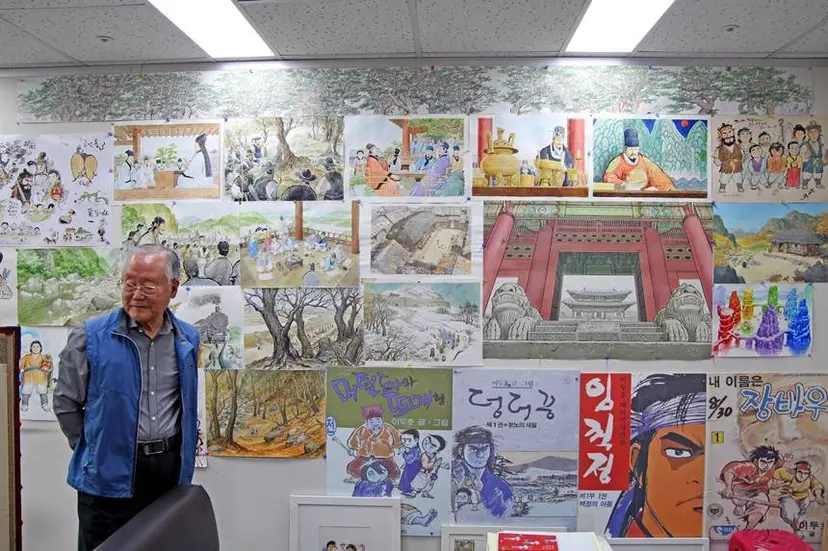
I visited Artist Lee Doo-ho's studio at the Korea Manhwa Museum in Bucheon, Gyeonggi Province. He was coloring Meoteori, put down his pen, and welcomed us. Looking around the studio, one wall is filled with books. From the 'Korean Language Dictionary,' 'Dictionary of Korean History,' and 'Encyclopedia of Korean Ethnic Culture' to materials on humanities, natural heritage, traditional culture, and biographies, the shelves are packed. The bookshelves of a 'cartoonist who footnotes,' who realistically recreated the Joseon Dynasty, were no different from those of a folklorist.
The other walls are lined with rows of drawings. Covers and illustrations from works he drew, such as 'Deong-deo-kkung,' 'Im Kkeok-jeong,' 'My Name is Jang Ba-u,' and 'Meotori Dosa and Ttomae-hyeong,' are densely displayed. They say we are in an era beyond CG and now AI-generated images, but the 'taste' of bean paste is still in the 'hand-taste.' His hand-drawn pictures hold one's gaze for a long time.
“Because I am a commoner”
Although there are occasional fallen nobles, most of the protagonists in his works are common folk. Objects of contempt and disdain become the subjects who correct a distorted world. He said he didn't necessarily keep the resistance of the common people in mind when creating, but because he himself is a commoner, it happened naturally.
Commoners are those who cook in one pot and gather at the same table to eat. While nobles each received a square dining table, the commoners—his characters—gathered around a single low legged table or a communal table, whether in a thatched-roof room or a tavern at the marketplace. Did the comic 'Kirara's Work' call eating "a task to sustain life"? To them, a dining table is the foundation of solidarity that sustains life together.
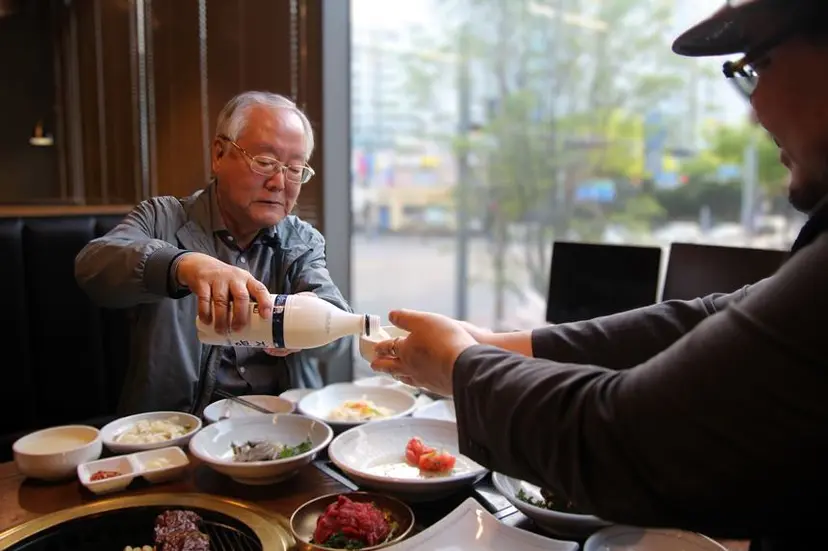
Having learned about human decency from his mother's table and hunger from a meager rented room, he drew dining tables in every work to bring people together. Even if the table is not bountiful, no one goes hungry. Those who shared even a bowl of water together were the ones who picked up sickles and crossed mountains.
“If people haven't eaten, they become ugly”
The idea that a family and a community are those who eat together without anyone going hungry might be a shared awareness of his generation. The 'Simsu-hoe,' a fishing club for cartoonists that Lee Doo-ho belonged to, donated a significant amount of money for flood relief in 1987 and 1990.
“It wasn't to show off. Eating is actually the foundation of life. When something like this (a flood) happened, we thought, ‘Aren’t those people starving?’ We decided to do what we could so that people wouldn't go hungry. I experienced it myself; if you have nothing to eat, you become ugly. So, the issue of eating must be fundamentally solved for humans and animals alike. Only then can morality emerge and peace be maintained.” It was a thought worthy of the writers of the 'barley hump' generation who have eaten together and starved together.
Memories of Simsu-hoe
As we moved to a barbecue restaurant in Sang-dong, Bucheon, I asked the teacher if he didn't like freshwater spicy fish stew. Having drawn so deliciously the stew cooked in a flipped-over hat after a fishing trip, I intended to ask him to go together next time. I was also curious why he, a renowned fishing enthusiast, didn't choose it as his soul food. His answer still couldn't cross the 'barley hump' era, but instead, his fishing stories followed.
Raised at the mouth of the Nakdong River, he learned to fish from his older brothers when he was young. He has been to almost every fishing spot imaginable, and among the cartoonists' fishing clubs like 'Sadari-hoe,' 'Simsu-hoe,' and 'Birinae-hoe,' he was involved in 'Simsu-hoe' and 'Birinae-hoe.' 'Simsu-hoe,' centered around the late Shin Moon-soo, who drew 'Robot Jjippa' and 'Dokkaebi Gamtu,' has continued for nearly forty years; they even considered pooling money to buy a fishing spot, which shows how much they loved fishing. Even now, as time passes and members pass away one by one, their second generations continue meaningful work, such as holding joint exhibitions of their fathers' works.
Looking at the records of Simsu-hoe anglers left by the late Shin Moon-soo, he described Lee Doo-ho as the true angler with the best form. In an interview with 'Fishing Chunchu' in 2009, he said he couldn't draw a fishing comic because he didn't want to turn his favorite hobby into work. Nevertheless, he connected the commonality between fishing and drawing with the 'buttom theory,' meaning both are things done with one's bottom (persistence).
Comics are drawn with the bottom
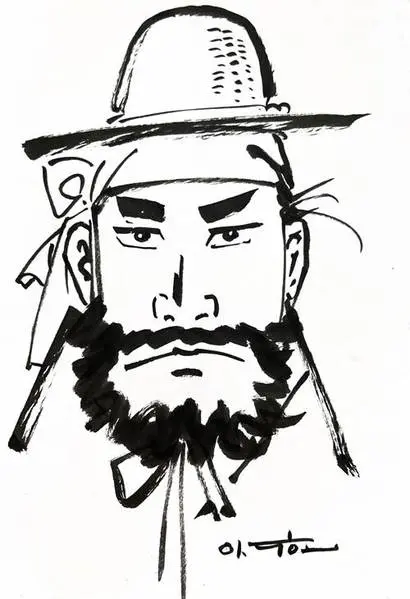
He has been drawing historical comics set in the Joseon Dynasty in earnest since the 1980s. He made constant efforts to recreate Korean sentiments and indigenous beauty, to the point of being nicknamed the "Baji-Jeogori (traditional Korean trousers and jacket) Cartoonist." While he looked back on his life and said, "Ignorance is brave," it was the artist's intensity and conviction. Perhaps that very intensity is what he wants to pass on to junior artists while continuing the 'Hell Camp' with Lee Hyun-se since 2001.
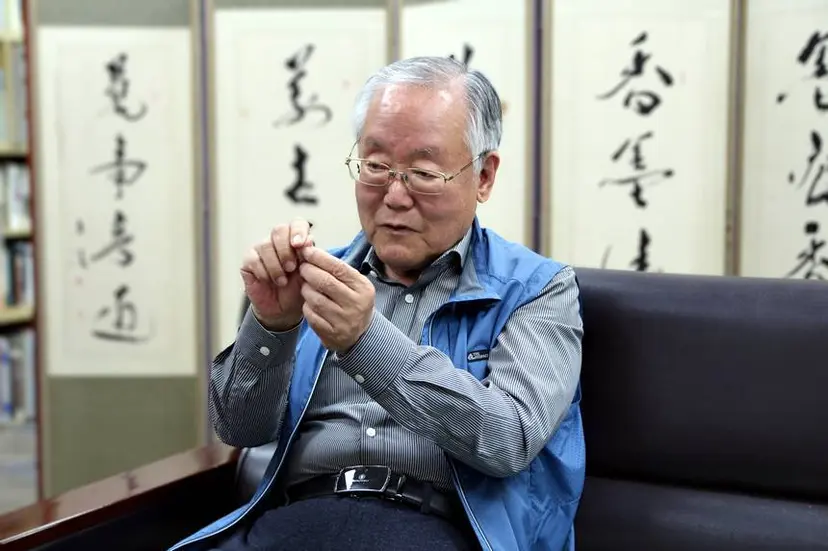
He still looks at his previous work and says, even though he has worked longer than anyone else, that he feels ashamed when looking at the work itself, and that he should have been more intense back then. Although he says he is now at a level of just "playing around," he still doesn't lift his bottom from the chair and continues to draw. The thirst for improvement revealed in his sharp eyes throws a challenge to his unworthy juniors.
Like a line from Kim Young-nam's poem 'Autumn Paro Lake,' which sings of the scenery of Paro Lake where the teacher said he often went to fish, perhaps the teacher has no intention of being satisfied with creating a large lake, but rather wants to become an even bigger pouch that contains everything.
When I placed a piece of well-grilled meat on his plate, the teacher asked, "Aren't you really going to drink?" Because my late father loved alcohol, I grew up viewing it as an enemy, and because I only heard the first half of the story that he drank well without ever getting drunk, I had purposely not ordered any alcohol. "It is something I am longing for but dare not ask." I quickly used a phrase I learned from his comics and ordered makgeolli. A piece of meat and a bowl of takju. Indeed, it is a refined pleasure learned from his comics.
Artist Lee Doo-ho was born in 1943 in Goryeong, Gyeongsangbuk-do, near the mouth of the Nakdong River, as the youngest of three sons and one daughter, and lived there until the year the Korean War broke out. He moved to Daegu in his second year of elementary school and attended school there throughout. He showed talent for drawing from a young age and swept school art competitions. That was also around the time he met Nam Moo-oh, an art teacher who became his lifelong mentor. Following his teacher, he decided on art as his path early on, painting in a studio during the day and going to school at night. From his second year of middle school, he became a professional artist by releasing comics in succession, such as 'Blow the Flute' (1958), 'Road' (1959), 'Lantern' (1959), and 'Toward the Sun' (1959), but his dream of art never wavered. Thus, in 1964, he entered the Department of Western Painting at Hongik University.
After entering university, he tried to quit comics to focus on his studies, but his livelihood held him back. After being discharged from the military, he dropped out of school and entered the studio of cartoonist Park Ki-jung to learn comic story construction and directing. This is why he cites Nam Moo-oh and Park Ki-jung as his lifelong mentors.
He had been active in the cartoon scene since 1969, but the emptiness regarding the "path not taken" grew larger. It is largely because the creation of comics at the time was about taking foreign movies, dramas, or Japanese comics and redrawing them. Being skilled, he drew those well too, but he couldn't erase the futility. Finally, in 1978, he entrusted his ongoing serials to artist Han Hee-jae and focused on studying fine arts for two years. He recalls this period as a 'cleansing of spirits' for art. Returning to the cartoon world after clearing his heart, he became immersed in creating historical comics. His agony over the form and content of our comics permeated every work, and that is how the teacher became the "Baji-Jeogori Artist." This is the reason why we learn the fermented taste of folklore and the taste of our language in his comics.
The summer vacation comic boot camp 'Hell Camp,' which the teacher started while teaching students at Sejong University in 1997, shows the process of completing actual manual manuscripts as the teacher himself meets the deadlines for his own manuscripts. It became known by word of mouth and has now become an annual event for all cartoon students. During the period when the Juvenile Protection Act was heavily eroding the cartoon industry, he served as the chairman of the Korea Cartoonists Association and co-chairman of the emergency committee for protecting freedom of expression in comics, acting as a breakwater for Korean comics. To the teacher, who was a reliable pillar who always stood where Korean comics needed him, even while feeling uncomfortable with stepping forward, his juniors called him 'our eternal teacher' (the title of a tribute documentary produced at his retirement from Sejong University).
Since shifting his focus to drawing our own things, he has continuously produced numerous works such as 'Secret Inspector Heo Pung-dae' (1980), 'My Name is Jang Ba-u' (1983), 'Baejigi' (1984), 'The One-Eyed Man and the Wanderer' (1984), 'Master, Master, Our Master' (1984), 'Jjaemari' (1985), 'Meotori Dosa' (1985), 'Deolgeodeok Deolgeodeok' (1986), 'Deong-deo-kkung' (1987), 'Im Kkeok-jeong' (1991), 'Duso-ni' (1993), and 'Garasadae' (2008). However, the octogenarian master, for whom the title is well-deserved, is still greedy about his art. His appearance of constantly reviewing his work, unfolding the drawings hung on the wall and the old bound projects, makes one realize what kind of intensity his work came from.
Author Seo Chan-hwi is a cartoon columnist who has explored and organized the flows and connections of comics and their surrounding cultures in a historical context. Since 1998, he has operated the comic information community 'Manhwain' and has written for various media such as The Hankyoreh, Ilyo Shinmun, Incheon Ilbo, and Defense Daily. Author Song Ha-won is the CEO of the Public Culture Development Center UrArt and operates the alternative comic specialty bookstore 'Homtong.' He is a cultural planner, cartoon researcher, an adjunct professor at the Department of Media and Communication at Sungkonghoe University, and a director of the Geumcheon Cultural Foundation. Through 'Cartoonist's Soul Food,' we intend to look into the lives and worlds of artists through the foods loved by Korea's representative cartoonists.
![[Cartoonist’s Soul Food] The Cream Bread of That Dawn, Sustained by Dreams](https://s.bizhankook.com/attachments_thumb/2026/05/98392_thumb.webp)
![[Cartoonist's Soul Food] Art is in the 'Hand-taste', Food is in the Joy of Eating Together](https://s.bizhankook.com/attachments_thumb/2026/05/98652_thumb.webp)
![[Cartoonist's Soul Food] 'Kkadegi' author Lee Jong-cheol's 'Mother's Kimchi Jjigae'](https://s.bizhankook.com/attachments_thumb/2026/06/106516_thumb_1a338228.webp)
![[Cartoonist's Soul Food] 'Ghost Teacher' Author Nam Dong-yoon: "Undoubtedly, Sundae-guk"](https://s.bizhankook.com/attachments/2026/07/e57a933e6fe0_36ef77a3.jpg)
![[Cartoonist's Soul Food] Artist Park Kun-woong, Whose Knife-Cut Noodles Soothe the Knots of History](https://s.bizhankook.com/attachments/2026/07/9f3485391c47_2d2281a7.jpg)
![[Cartoonist's Soul Food] "A Red Bean a Day": A Visit with Manga Writer and Film Director Lee Dong-eun](https://s.bizhankook.com/attachments_webp_no_wm/2026/07/134567_no_wm_0b8d2928.webp)