

[비즈한국] The global pharmaceutical and biotech industry is obsessed with the rosy future of cell therapies, which promise complete cures with a single administration. However, the wall of commercialization—turning a profit in the market—is far higher than merely overcoming technical hurdles to get a new drug approved. This is because it is difficult to escape the constraints of strict regulatory hurdles, limited non-reimbursable markets, and fragile supply chains for consumables. We take a sober look at the reality of commercialization facing the cell therapy industry.
As the cell therapy market 본격적으로 blossoms, the core paradigm of commercialization is shifting from new drug development to a speed race in production. Unlike conventional antibody drugs, cell therapy, which requires small-batch production of various customized products, relies on the competitiveness of minimizing the time from drawing blood to infusion and securing high yields.
To Overcome Production Issues and Regulatory Barriers… Growing Need for CDMO Collaboration
For small and medium-sized biotech firms, building their own GMP (Good Manufacturing Practice) production facilities, which cost tens of billions of won, is a daunting task. On top of that, navigating regulatory guidelines and building an RA (Regulatory Affairs) organization to respond to them is an uphill battle. Consequently, the industry is structured in a way that forces companies to reach out to Contract Development and Manufacturing Organization (CDMO) firms to increase efficiency with limited resources. Even if a cell therapy candidate is successfully developed, many cases of commercialization are delayed due to difficulties in meeting the strict Chemistry, Manufacturing, and Controls (CMC) standards required by the Ministry of Food and Drug Safety or the US FDA.
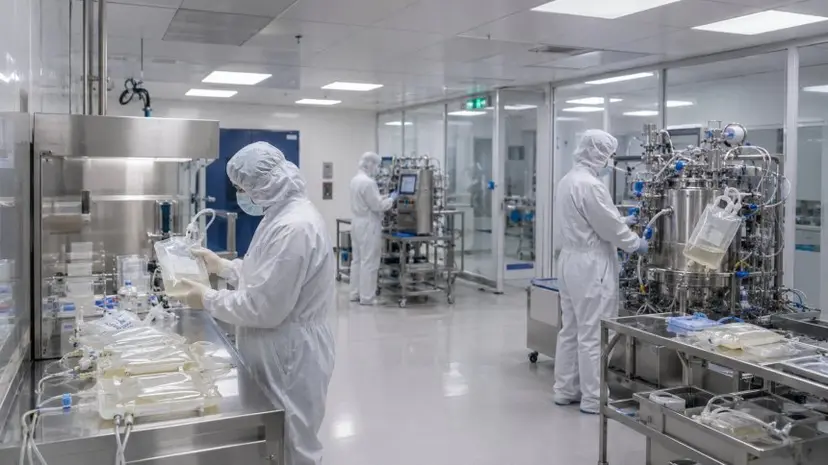
In fact, 'Ryoncil,' a stem cell therapy developed by Australia's Mesoblast, has been knocking on the doors of commercialization for over 20 years but has yet to pass the FDA threshold. At the end of 2023, it received its third Complete Response Letter (CRL) from the FDA—not due to clinical efficacy, but due to issues with manufacturing consistency and the optimization of potency assays—and only re-entered the approval process this March. Even Medigene of Germany, considered a global leader in cell therapy technology, recently shifted from its self-development strategy to a partnership model due to the enormous regulatory and cost barriers at the commercialization stage.
The trend is solidifying where even top-tier biotech companies focus on original technology research while relying entirely on global CDMOs for commercial production.
Amidst these regulatory barriers and fierce speed competition, Won Sung-yong, CEO of GC Cell 144510, emphasized the necessity of partnering with experts in every field, from drug development to production and licensing. CEO Won stated, "Excluding a few global big pharma companies, there are almost no companies with a perfect, self-contained value chain for cell therapy development," adding, "To reduce the trial and error that consumes massive costs and time, companies with strengths across the entire value chain must come together and cooperate closely to pass the final gateway of commercialization.”
Global Big Pharma and Ventures Embrace Large CDMOs… Intensifying Competition for Contracts
Global CDMO firms are expanding partnerships with cell therapy companies, leveraging their vast capital and track records in regulatory response to increase market dominance.
Lonza, the world's leading CDMO, has proven its unparalleled competitiveness in high-volume manufacturing by securing not only late-stage commercial cell therapy projects but also over 75 cell therapy clients worldwide.
Catalent is also taking an active stance in winning cell therapy CDMO contracts this year. It has expanded its commercialization contract for an iPSC (induced pluripotent stem cell)-based CAR-NK cell therapy with Australia's Catherics, and has also signed a partnership with S-Biomedics 304100, which is developing a Parkinson's disease cell therapy, to support the full-cycle production process from initial development to commercialization.
In the capital market, the value of the cell therapy CDMO business is skyrocketing. On the 7th, global private equity firm GI Partners acquired the CDMO and cell solutions division of Charles River, a global Contract Research Organization (CRO), and launched Rose Biosolutions, a company specializing in cell and gene therapy (CGT) manufacturing, accelerating the restructuring of the value chain.
What Are the Differentiation Strategies of Leading Domestic Companies?
Amidst global CDMO giants, leading domestic cell therapy CDMO firms have embarked on a survival race with different differentiation strategies.
GC Cell considers its experience in Regulatory Affairs (RA), having successfully cleared commercial authorization, as its primary competitive advantage. It experienced the entire commercialization cycle of 'Immuncell-LC,' an immune cell therapy that received approval from the Ministry of Food and Drug Safety in 2007 as an adjuvant therapy after liver cancer surgery and is currently on the market. Furthermore, it has received approval for Investigational New Drug (IND) applications for its NK (Natural Killer) cell therapy 'GCC2003' in the US and Australia. Isaac, the leader of the GC Cell RA team, stated during last month's Customer Day presentation, "Based on our know-how in navigating face-to-face meetings with the FDA and the strict Australian import clearance procedures (OGTR), we will reduce trial and error for clients who lack regulatory response organizations.”
CHA Biotech's strength lies in its large-scale production infrastructure. It expects its subsidiary Matica Biotechnology in Texas and the CGB (Cell Gene Biobank) under construction in Pangyo to act as the vanguard for its cell therapy CDMO business. By mass-producing viral vectors—an essential raw material for cell therapy—it aims to overcome the limitations of customized autologous therapies and target the market for 'allogeneic' off-the-shelf therapies, where mass production is essential. In particular, by securing 'cryopreservation' technology, it has solved not only the distribution problems of cell therapies, which require strict cold-chain management until the moment of administration, but also production cost issues.
EnCell can reduce production and development time by producing viral vectors and cells—the two pillars of gene therapy production—in one place. It has eliminated the logistical risks associated with separate production of the two materials, cutting the total production time in half compared to conventional methods. As a spin-off from Samsung Medical Center, it has high connectivity to clinical sites, and it is building global-level quality control capabilities by undertaking domestic contract manufacturing for Novartis's CAR-T therapy, 'Kymriah'.
Cell therapy commercialization is now transforming from a one-dimensional competition over who has the larger factory into a battle over who can more precisely design processes and navigate the maze of regulations. As innovative technologies move beyond the achievements of the lab to become part of patients' daily lives, K-Biotech CDMOs are evolving into 'Sherpas' that go beyond mere production to help design commercialization strategies together.