

[비즈한국] Convenience stores are transforming into local logistics hubs. Stores that once waited for customers to visit are now acting as instant delivery centers, sending daily necessities, ready-to-eat meals, beverages, and household goods to nearby homes and offices. With growth limited by the expansion of store numbers, the convenience store industry is showing a trend of seeking new revenue streams by increasing the utility of existing store networks.

According to the '2026 March Major Retailer Sales Trends' compiled by the Ministry of Trade, Industry and Energy, the year-on-year sales growth rate for convenience stores fell to 8.0% in 2023, 3.9% in 2024, and 0.1% in 2025. As growth slows, the convenience store industry is seeking new revenue sources by expanding the roles of existing stores. 'Quick commerce,' where products are delivered within an hour or two after ordering, is a prime example.
The four major convenience store chains are expanding their quick commerce services by linking with their own apps or third-party delivery apps. In particular, industry leaders GS25 and CU are aggressively growing their related businesses. GS Retail007070, which operates GS25, announced that its quick commerce sales grew by 75.4% in 2024 and 64.3% in 2025 compared to the previous years. BGF Retail282330, which operates CU, also explained that CU delivery sales increased by 98.6% in 2023, 142.8% in 2024, and 65.4% in 2025.
Experiences on the ground varied by store. The number of delivery orders differed significantly depending on the location. While some stores received almost no orders despite offering the service, others handled around 20 orders per day on average. A CU store near Sillim Station received up to 50 orders on busy days.

Store owners and staff interviewed on-site acknowledged that delivery orders help with sales. However, they did not see them as a significant source of profit. A CU store in Gwanak-gu receives an average of about 10 delivery orders per day, which account for about 5% of total sales. A store employee remarked, "Providing delivery service doesn't help much," adding, "but I feel like I'm losing out on sales if I don't, so I do it anyway."
A GS25 store in Gongdeok-dong, Mapo-gu, had a similar reaction. This location receives about 20 delivery orders per day and is among the top stores for delivery volume in the area according to Baemin (Baedal Minjok). However, the owner said that while delivery orders help sales, net profit does not increase proportionally. He said, "It's better than not doing it, but it's hard to say there's a significant profit left over."
Commissions and delivery fees were cited as burdens by store owners. Owners explained that delivery commissions are around 10%. An owner of a GS25 store located in an apartment complex in Mapo-gu said, "It's true that delivery commissions are a burden," adding, "Since delivery apps offer free shipping, it's also burdensome that convenience stores have to cover the delivery fees." They explained that when commissions and delivery tips are added, the increase in net profit is inevitably limited even if orders increase.
Variables during the delivery process also remain a burden for stores. Instances where products are swapped due to a rider's mistake or orders are canceled due to delayed dispatch are common. Multiple store representatives said that while delivery intermediary apps provide compensation, it is cumbersome because the business owner must apply for it personally.
Quick commerce is establishing itself as a new growth engine for the convenience store industry. For the headquarters, it is a means to expand the limits of fixed trade areas and reconnect customers with physical stores. However, for some local store owners, it is closer to an auxiliary sales tool maintained to keep up with competition rather than a major profit source. While sales increase, duties such as handling commissions, delivery tips, packaging, inventory management, and coordinating with riders follow.
For quick commerce to become a true growth engine for convenience stores, the increase in orders must fully translate into profit for store owners. If the burden of costs and additional labor exceeds the sales increase, it could be perceived as another strain on the field.
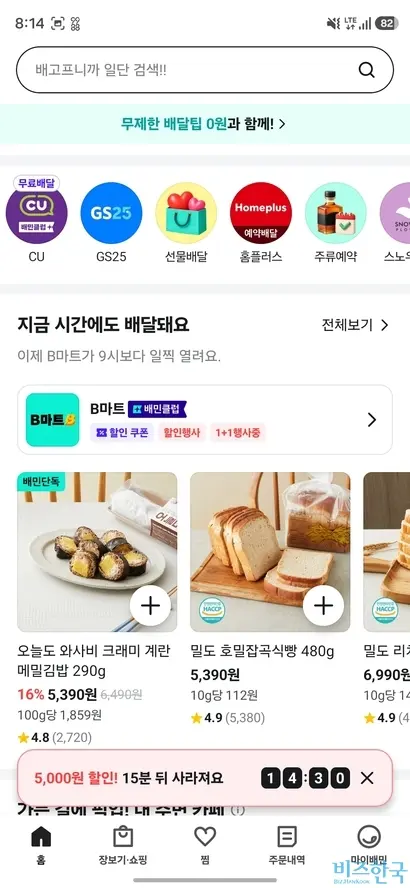
Convenience store headquarters view quick commerce as a means to supplement the limitations of existing trade areas and generate additional sales for franchise stores. A BGF Retail official said, "Convenience store delivery services complement the fixed trade area limits of offline-based stores and play a positive role in creating additional revenue," adding, "As they are based on minimum order amounts, they also contribute to improving the average transaction value." A GS Retail official also stated, "O4O (Online for Offline) services that connect customers' daily lives with stores, such as quick commerce, are key services that can supplement the physical limitations of offline trade areas while increasing customer repurchase and frequency, thereby strengthening customer 'lock-in' centered on our stores rather than competitor stores."
Regarding the burden of commissions and promotion costs, both companies stated that they are shared between the headquarters and stores and that support measures are in place. BGF Retail explained, "While operational burdens like promotion costs or delivery app brokerage fees exist, we manage them by sharing the burden between the headquarters and the stores to minimize the impact on the stores." GS Retail also stated, "We share commissions based on the franchise contract standards, and when additional promotions are conducted to revitalize sales, the headquarters provides support by bearing the additional costs," adding, "We plan to strengthen our operational support system in 2026, such as by running incentive programs and building profit-and-loss dashboards."
They also stated that they are pursuing improvements for field issues such as misdelivery, delayed dispatch, and order cancellations. BGF Retail explained, "When customer inconvenience occurs, it is handled primarily through correspondence between the store and the delivery platform, and the headquarters is also continuously monitoring field VOCs (Voice of Customer) and pursuing improvements in consultation with platform companies for recurring issues." GS Retail stated, "We are continuously refining response processes by major issue type and are reviewing improvements such as simplifying compensation and processing procedures and upgrading operational guides in consultation with delivery platform companies."