

[비즈한국] It has been confirmed that the Seoul Housing & Communities Corporation (SH) has initiated a consulting project to review the financial structure and sustainability of the Hangang Bus operator, which is currently in a state of total capital erosion. In this project, SH aims to evaluate Hangang Bus's projected future cash flows, the feasibility of repaying loans, and the financial performance of both Hangang Bus and SH. Notably, the project includes sensitivity analysis regarding changes to SH loan interest rates and debt-for-equity swaps, sparking interpretations that SH may be considering converting loans into equity if Hangang Bus fails to repay its debts.
Based on reporting by Bizhankook and documents obtained from the office of Rep. Chae Hyun-il of the National Assembly's Public Administration and Security Committee, SH launched the 'Hangang Bus Financial Structure Diagnosis and Sustainability Review Project' this past March. The objective is to review the sustainability of Hangang Bus by analyzing recent financial results and future balances. Specifically, the project includes an analysis of projected future cash flows, financial feasibility from the perspectives of both Hangang Bus and SH, and sensitivity analysis based on various variables.
The cash flow analysis for Hangang Bus appears intended to determine the feasibility of debt repayment. SH has mandated an analysis of operating cash flows, including ticket revenue and auxiliary business income during the operation period, as well as an assessment of the feasibility of repaying loans from private financial institutions and SH based on estimated operating profits. To date, Hangang Bus has borrowed 109 billion won from SH and 50 billion won from private financial institutions.
What stands out further is the sensitivity analysis included in the project tasks. SH included financial analysis based on changes in operating revenue, changes in SH loan interest rates, and debt-for-equity swaps within the scope of the project. This item was added after a revision to the original task list. In particular, the analysis on debt-for-equity swaps will evaluate how the balance changes depending on the timing and amount of the swap proposed by SH. This suggests that SH is considering adjusting loan interest rates or pursuing debt-for-equity swaps to alleviate the burden of Hangang Bus's loans.
Hangang Bus fell into a state of total capital erosion last year due to accumulated deficits. It recorded a net loss of 1.88 billion won in its first year, 2024, and 142.4 billion won in 2025. As deficits accumulated, it entered a state of partial capital erosion in 2024 by eating into the capital invested by shareholders, and last year, it fully exhausted its capital, resulting in a total equity of -6.1 billion won. As of the end of last year, its liabilities stood at 153.8 billion won, exceeding the company's total assets (147.6 billion won).
In its audit report, Hanil Accounting Corporation noted, “The company incurred an operating loss of 9.4 billion won and a net loss of 14.2 billion won for the period, and its net assets at the end of the period are in a state of capital erosion. Current liabilities at the end of the period exceeded current assets by 70 billion won. This indicates the existence of significant uncertainty that casts substantial doubt on its ability to continue as a going concern, and the company is in a situation where it needs to improve its financial structure by achieving stable operating profits.”
The review of Hangang Bus's financial structure and sustainability seems somewhat belated, as 114.1 billion won in public funds has already been injected. Since investing 5.1 billion won as startup capital in June 2024, SH has lent 27.1 billion won in July 2024, 49.5 billion won in November 2024, 11 billion won in April 2025, and 21.4 billion won in December 2025. In January of this year, SH subordinated its 87.6 billion won in loans (three separate loans), which previously held priority over commercial bank loans, and extended their maturity until 2045, the end date of the Hangang Bus project.
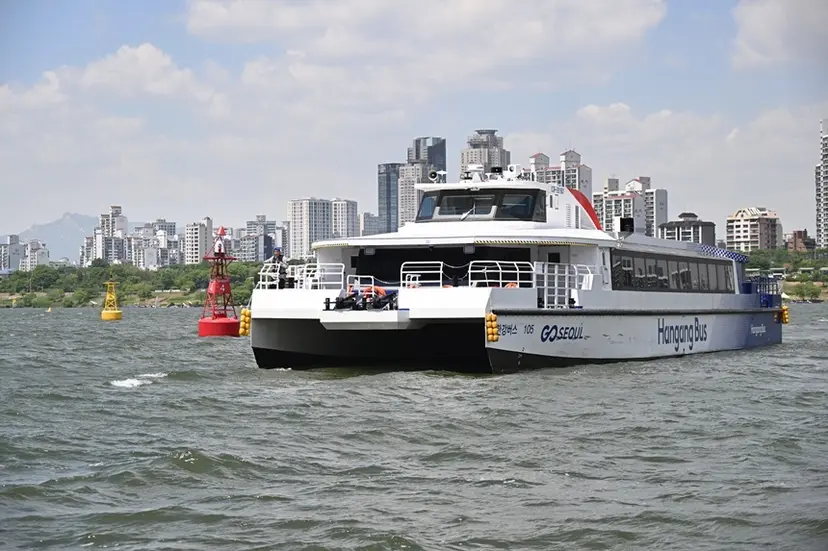
Hangang Bus is Seoul's first water-based public transportation system. The Seoul Metropolitan Government introduced it last September to supplement public transport and alleviate severe road congestion during commuting hours. It operates as a ferry service covering a total distance of 28.9 km across seven docks: Magok, Mangwon, Yeouido, Apgujeong, Oksu, Ttukseom, and Jamsil. The operator is Hangang Bus Co., Ltd., established by SH and E-Land Group's E-Cruise. With stakes of 51% and 49% respectively, the Seoul Metropolitan Government is effectively the majority shareholder.