

[비즈한국] “I heard so much about it from people around me that I just had to come see for myself. I’m not sure if it’s worth the long wait, but it’s delicious and feels more premium than regular milk tea.”
It was 11:00 AM on the 12th at Yongsan I-Park Mall in Seoul. A woman in her 30s surnamed A, who works nearby, shared this after trying a drink at the Chagee store located on the 6th floor. B, who visited with her, added, “The cup design and the receipt are so pretty that it feels like a waste to throw them away.”
Outside the store, a long line had formed for on-site orders, and people who had ordered in advance via the app were also gathered, waiting for their drinks. Some visitors checked the wait line and turned away. A notice board at the venue stated: “On-site orders are limited to the first 120 customers; once exceeded, ordering is not possible regardless of the physical wait line.”
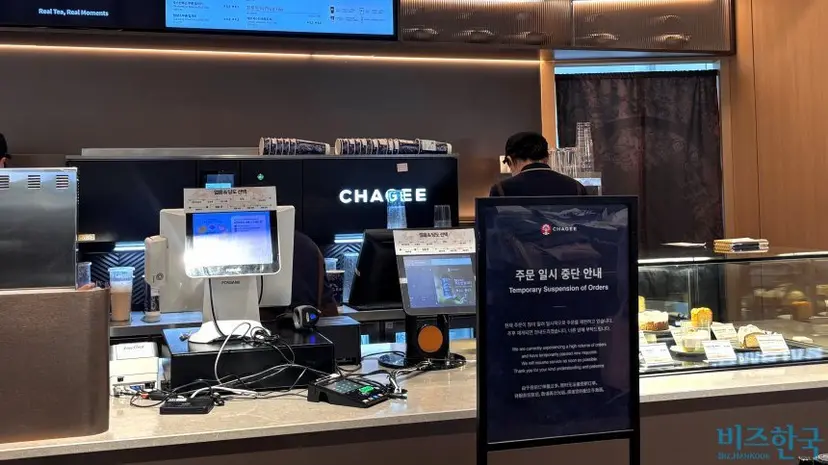
‘Sales Ended’ 5 Minutes After Opening, 116 Cups Waiting
The Chinese premium tea brand ‘Chagee’ has been drawing significant attention from the younger generation since its initial entry into Korea. On the 30th of last month, Chagee opened its Gangnam flagship store, Sinchon branch, and Yongsan I-Park Mall branch simultaneously in the Seoul area. Even two weeks after opening, the stores remain crowded, resulting in long wait times.
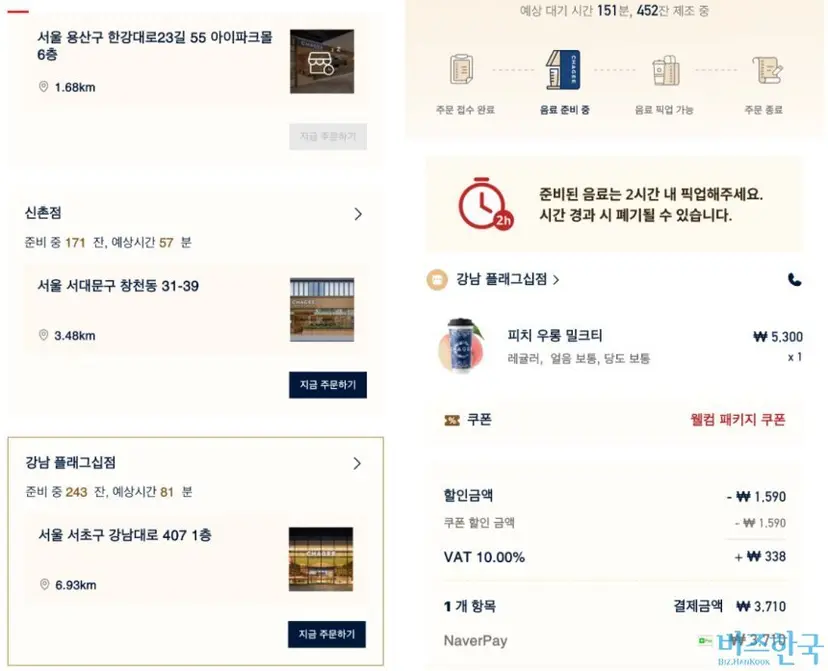
On this day, this reporter also attempted to place an order at 10:30 AM when the app opened, but was unable to complete the payment. As a surge of orders flooded in, the store status changed to ‘Sales Ended’ in just about 5 minutes. At the time, the app displayed 116 drinks in the preparation queue, with an estimated wait time of 39 minutes. Online ordering did not become available again until about 2 hours and 30 minutes later, around 1:00 PM.
A Chagee employee explained, “In the case of the Yongsan branch, we process offline customer orders first, then take online orders. It was originally supposed to be in a state where app orders were unavailable, but due to a system error this morning, it opened temporarily.” They added, “It is difficult to say exactly when it will open again, and you should check the app frequently.”
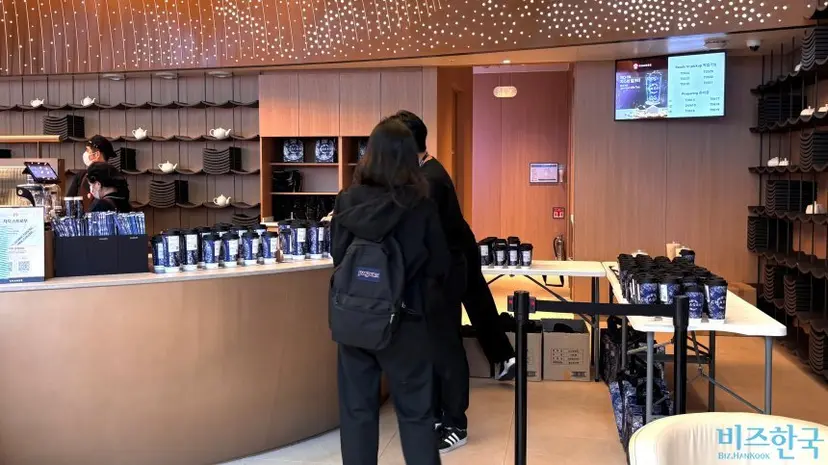
The Gangnam flagship store experienced the same influx of orders on the same day. When this reporter attempted to order a drink around 12:40 PM, the screen showed 452 drinks in the queue with an estimated time of 151 minutes. I actually received the drink around 2:30 PM. Inside the store, cups were piled high waiting to be made, and a staff member at the entrance checked for orders before letting customers in. This location only accepted app orders, with no option for on-site waiting.
The Sinchon branch also accepted orders via the app. At the entrance, staff guided customers to use the QR code to place orders. All three locations seemed to be managing demand by controlling the volume of incoming orders.
Visitors to the store generally responded that they had come out of curiosity. A college student surnamed C said, “I saw people around me visiting Chagee and posting it on Instagram. I think I’ve seen it at least five times.” They continued, “I knew it was popular, but I didn’t know the wait was this long. Since the app shows the required time, I placed an order before I went to eat and arrived just in time.”
A woman named D (26) remarked, “I had tried it when I traveled to China, so I’m happy it has entered Korea. This is my second visit since opening, and this time I even bought tea bags.” She added, “The wait has decreased quite a bit compared to the beginning. When I first came, I had to wait for almost 5 hours.”
Successful NASDAQ Listing, Differentiating Moves with Direct Entry into Korea
Chagee is a premium tea brand that started in China in 2017. It has targeted younger consumers with drinks combining fresh fruit, cheese foam, and tea brewed directly in the store. Since then, it has rapidly expanded its network of stores in Southeast Asia and the United States based on a franchise model, and it was listed on the NASDAQ last year.
According to the F-1 registration statement filed by Chagee Holdings with the U.S. Securities and Exchange Commission and earnings releases, Chagee’s net revenue has surged: 491.65 million yuan (approx. 108.2 billion KRW) in 2022, 4.64 billion yuan (approx. 1.028 trillion KRW) in 2023, 12.405 billion yuan (approx. 2.7292 trillion KRW) in 2024, and 12.91 billion yuan (approx. 2.8402 trillion KRW) in 2025.
Based on this growth, it officially entered the Korean market. According to the Supreme Court, Chagee established a Korean subsidiary last May under the name ‘Chagee Korea Co., Ltd.’ Its headquarters is located in Gwancheol-dong, Jongno-gu, Seoul, and the CEO is Fu Xi.
Typically, overseas F&B brands enter the Korean market through joint ventures (JV) with local partners. Notable examples include Starbucks and Shake Shack, which entered Korea by teaming up with E-Mart (139480) and SPC Group, respectively. Chagee’s decision to establish a direct Korean subsidiary and enter the market is interpreted as a strategy to more actively penetrate the Korean market by managing the brand and store operations directly from the beginning.
In fact, Chagee Korea is accelerating the expansion of its domestic stores. It is currently conducting large-scale recruitment for opening team members for its Seoul stores through recruitment platforms, and is reportedly preparing to open additional branches near City Hall Station. As demand has been verified by its initial success, forecasts suggest a high possibility of rapidly increasing the number of stores.
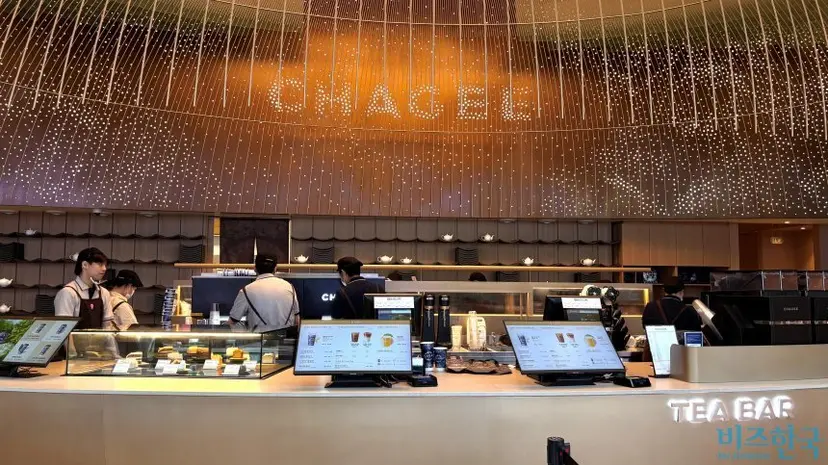
Initial Hype Success, Must Provide a Reason for Continued Visits
This early momentum for Chagee brings to mind the early days of Starbucks’ entry into the Korean market. It is similar in that it does not stop at just selling drinks, but forces consumers to experience the store and the brand image itself. While Starbucks established coffee as a symbol of an urban lifestyle rather than a ‘take-out beverage’ starting with its first branch in front of Ewha Womans University in 1999, Chagee is repackaging milk tea from a popular dessert beverage into a premium tea experience. The choices of symbolic commercial areas like Gangnam, Sinchon, and Yongsan, turning the cup and package design into objects for SNS verification, and the fact that the long wait itself is consumed as a scene that fuels brand buzz are all similar. Chagee attracted great interest on social media even before its opening, being referred to as ‘Jang Won-young’s milk tea’.
Of course, there is a difference in that while Starbucks settled in the market by teaming up with a domestic partner, Chagee established a Korean subsidiary to enter directly. However, it resembles Starbucks’ early expansion strategy in that it targets the tastes and daily spaces of young consumers simultaneously with a new beverage category.
However, early success does not guarantee long-term stability. Whenever an overseas F&B brand enters Korea, long lines and SNS verification are repeated at the time of opening, but as time passes, the buzz quickly turns into a daily option. Like the Canadian coffee brand Tim Hortons or the American burger brand Five Guys, which gained attention as ‘brands you stand in line to eat’ at the beginning of their entry into Korea, success ultimately depended on turning curiosity from the first visit into return visits.
The same applies to Chagee. The current waiting demand is a mix of the Chinese travel experience, the viral marketing of ‘Jang Won-young’s milk tea’, scarcity, and the desire for package verification. As the number of stores increases and accessibility improves, scarcity is bound to diminish. For Chagee to settle in the Korean market as a premium tea brand, the key will be whether it can provide sufficient reasons in terms of taste, price, and store experience to make people choose this drink for their daily routine again.
Lee Hye-won, a researcher at Trend Korea, explained, “Chagee is emphasizing the perception of a NASDAQ-listed global brand and a sophisticated beverage enjoyed by celebrities, rather than the ‘Made in China’ image that previously represented low price and popularity. In fact, even in domestic stores, they are communicating focusing on the English name rather than the Chinese character brand name.”
Researcher Lee predicted, “The cup design and packaging, which are differentiated from existing franchises, have also stimulated the ‘verification consumption’ of the younger generation in line with the SNS sharing culture. Chagee could serve as an opportunity to broaden the base of a new category in the domestic beverage market, which has been skewed toward coffee.”