

[비즈한국] “People want to feel good about themselves. Becoming part of a group that shares history, purpose, and identity gives them that feeling.” - Michael Bond, ‘Fandom: The Future of Our World’
While traditional fandom research has been limited to a sense of belonging, recent cases have moved beyond that. Failing to fully grasp the 'fan mindset' leads to misinterpretation. The Pokémon 30th-anniversary ‘Pokémon Mega Festa 2026’ is one such example. Although it was a success, it was deemed a failure, and its significance was not properly highlighted. The event was abruptly canceled due to an excessive crowd gathering for the specially produced ‘Magikarp Promo Card.’ A lack of safety awareness was cited as the cause, and fierce criticism poured out regarding why organizers failed to anticipate such a crowd.
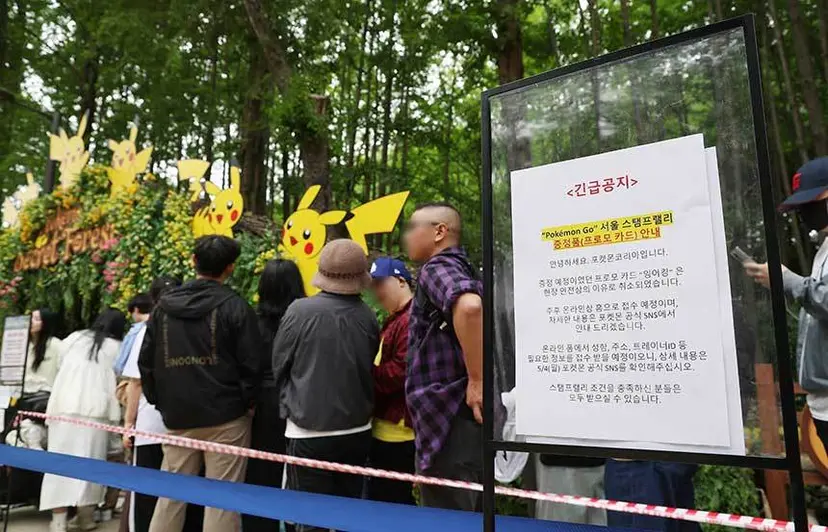
Organizing this event was a success in terms of 'fan mindset' marketing. However, the management approach had its limitations.
The organizers provided one card per 'Pokémon GO' account. Participants had to collect at least three stamps through the 'Pokémon GO' stamp rally and then claim the card at the 'Pokémon Secret Forest' information desk in Seoul Forest. Given this distribution method, the organizers seem to have focused heavily on preventing duplicate redemptions, showing signs of trying to ensure only one card could be collected on-site per person, regardless of how many accounts one held.
The appeal of receiving a Magikarp card for completing the stamp rally was high. By offering the card to on-site participants without any other restrictions, they maximized motivation. The ease of access, however, drew even larger crowds.
The problem was that only 31 management personnel were deployed. With various events taking place across the Seongsu-dong area, including Seoul Forest, that number of staff was insufficient. It wouldn't have been enough even if they had all been stationed at the Magikarp card booth. They simply didn't foresee the surge in crowds at that booth. It wasn't so much a lack of safety awareness as it was a failure to accurately analyze the fan mindset. In a sense, the fan mindset was ignored or overlooked.
The Pokémon fan mindset is a blend of two things. First, there is the pure fan sentiment. Because it was the 30th anniversary, the fan base was naturally broad across all age groups. Fans who have since become parents found it easy to participate with their children.
Next, there is the type of fan who views Pokémon cards as an investment. The value of these cards online ranges from 100,000 to as much as 300,000 KRW. Considering future value, they are even more attractive. A ‘Snap Magikarp’ card, produced in 1999, was sold at a Japanese Yahoo! Auction in January 2022 for approximately 13.65 million yen, or about 140 million KRW. The economic value created by fan sentiment is beyond imagination. As long as there are fans willing to pay high prices, a market value is formed.
Of course, there are participants who combine pure fandom with investment motives. Because the core fan sentiment is present, the items have collectible value, which in turn links to future investment potential—a win-win situation.
However, the organizers failed to grasp the true value of the cards they were distributing. Their own underestimation of the cards' worth worsened the severity of the situation.
This incident draws a comparison to BTS's performance at Gwanghwamun Square. Fearing a second Itaewon tragedy, there was an excessive police presence at Gwanghwamun Square. Yet, the organizers overlooked the fact that K-pop fandoms generally do not engage in behavior harmful to their artists, nor do they swarm specific locations purely for investment reasons. Rather, a flexible management policy was what was needed.
Conversely, for events where specific fan interests are at play and rare items are distributed, thorough crowd control and a cooperative system with authorities are mandatory. The organizers should have analyzed the fan mindset, managed the total number of people entering the site via pre-reservations, and allowed entry in an orderly, sequential manner. This lesson must be applied in the future. The important thing is to make it possible for fans to enjoy the experience together.
In ‘Fanocracy’, David Meerman Scott and Reiko Scott wrote, “Another reason to understand fans and fandom culture is that exposing yourself to people who share your interests makes your life happier. Fandom allows you to enjoy things you love with others and creates an environment where you can find your true self and live a successful life.”
Fandom activity exists to help people live happily, beyond just liking something. The business effect is secondary. Treating fans as potential threats through strict control can actually undermine the possibilities and future potential of the fandom economy. That is how love sustains its momentum.
The author, Kim Heon-sik, has been walking through and navigating the forest of pop culture phenomena since his 20s, driven by the belief that there is a way to make the world a better place through culture. He continues this same path in the 21st century, where AI and quantum computers play a prominent role.