

[비즈한국] Industry, academia, and government leaders have put their heads together to simultaneously achieve the dual goals of responding to the climate crisis and strengthening industrial competitiveness. On the 12th, the Federation of Korean Industries (FKI), in collaboration with the Institute for Future Strategy at Seoul National University, hosted the 'New Growth Engine: Korea Green Transformation (K-GX) Strategy Seminar,' featuring experts, industry representatives, and government officials. While attendees emphasized the need for "selection and concentration" to resolve key bottlenecks in the green transition, they expressed differing opinions on the methods of implementation.
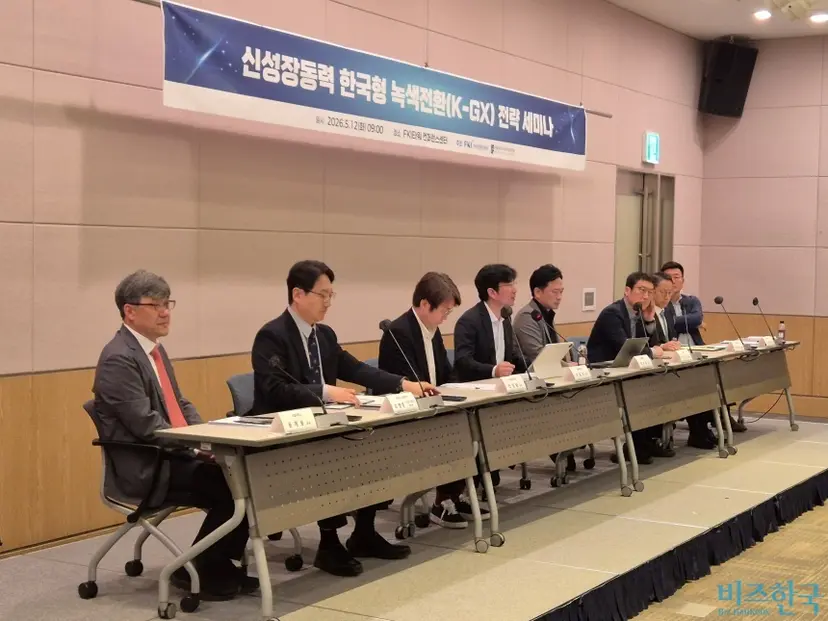
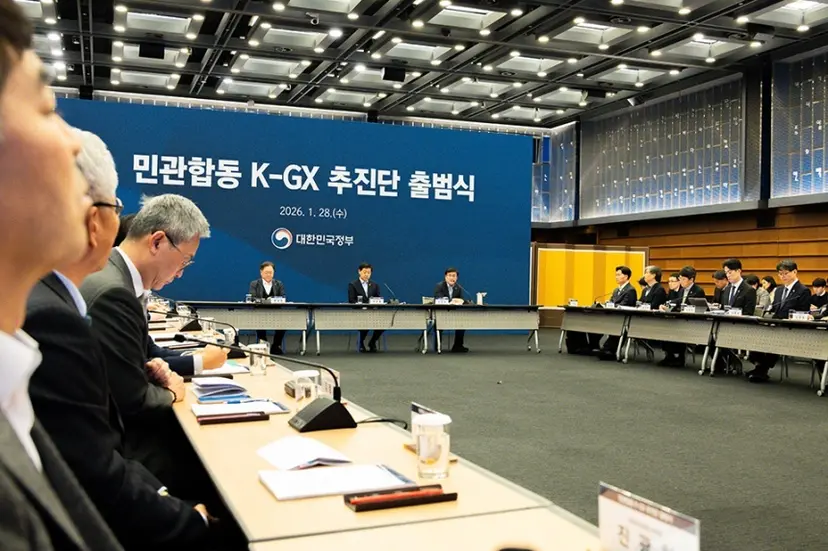
Korea Green Transformation (K-GX) is a macroeconomic national strategy aimed at simultaneously achieving South Korea's response to the climate crisis and strengthening industrial competitiveness. The government is currently developing an implementation strategy to shift the overall energy, industrial, and environmental sectors toward a carbon-neutral framework to meet the 2035 Nationally Determined Contributions (2035 NDC). The K-GX roadmap is scheduled for official announcement at the end of June.
Kim Byung-hoon, Deputy Head of the K-GX Planning Team at the Ministry of Climate, Energy, and Environment, who attended the seminar, stated, "The keyword of K-GX is finding growth engines while simultaneously decarbonizing," adding, "We plan to establish a regular cooperation channel centered around the Korea Chamber of Commerce and Industry to bridge the gap between field realities and policy."
Achieving carbon reduction targets requires 'selection and concentration'
Attendees generally emphasized the need for "selection and concentration." They pointed out the reality of having to deploy limited resources in a situation where steep carbon reduction targets must be met. Ahn Young-hwan, a professor of Climate, Environment, and Energy at Sookmyung Women's University, noted, "The K-GX draft proposal is similar to the Basic Plan for Carbon Neutrality and Green Growth," and emphasized, "K-GX should focus on the transition of power, steel, petrochemicals, and cement—all carbon-intensive sectors—and the cultivation of green industries, rather than just the issue of just transition for jobs in coal-fired power plants."
There was a consensus that "selection and concentration" of resources should be used as a strategy to resolve bottlenecks in the K-GX process. The most frequently discussed bottleneck at the seminar was the "carbon-free power supply issue." Yoon Je-yong, a professor of Chemical and Biological Engineering at Seoul National University, who gave the keynote presentation, diagnosed that the issue of the "power grid," currently constrained by system limitations, is more critical than the government's total power capacity target of securing 100GW of renewable energy by 2030.
Professor Yoon pointed out, "We need to increase renewable energy by about three times in a short period, but the current power system and infrastructure cannot keep up with this pace of deployment," adding, "Beyond expanding transmission lines, securing system flexibility resources such as ESS, High Voltage Direct Current (HVDC), and Demand Response (DR) is essential."
Jung Soo-jong, a professor at the Seoul National University Graduate School of Environmental Studies, also viewed the expansion of flexibility, rather than just total power output, as the core of renewable energy growth. He argued that the spatial imbalance—where the potential for renewable energy is concentrated in provincial areas while demand is concentrated in the metropolitan area—is a more serious problem than a lack of total electricity. Professor Jung pointed out, "This imbalance cannot be solved by grid expansion alone; we need a spatial transition of electricity demand itself, such as expanding distributed power systems and relocating regional industries."
Lee Sang-hoon, a visiting professor at the Ulsan National Institute of Science and Technology (UNIST) and former chairman of the Korea Energy Agency, addressed skeptical views regarding the 100GW renewable energy target by citing the success of China and Germany in rapidly expanding their supply. He noted as a meaningful signal that while Korea added about 4GW of renewable energy last year, it is expected to increase to 7-8GW this year.
He also expressed a positive outlook on resolving grid issues, saying, "Although grid expansion plans will be in full swing after 2030, we can connect solar power to the distribution network by utilizing current systems and regulations," and added, "We must simultaneously improve regulations for new grid infrastructure and implement policies for existing grid efficiency."
The decarbonization of carbon-intensive industries was also discussed. Professor Yoon suggested focusing on the steel industry, which currently ranks first in industrial carbon emissions, highlighting the need for selection and concentration within sectors. He cited the existence of a mid-to-long-term roadmap and the execution stage for "HyREX" (Hydrogen Reduction Steelmaking) technology as the reason. POSCO is currently set to begin construction of a 300,000-ton capacity hydrogen reduction steelmaking demonstration plant this year, with plans to operate a commercial plant starting in 2037. In contrast, the petrochemical industry has yet to enter the demonstration stage for major technologies such as electric NCC.
Can pink hydrogen be an alternative to green hydrogen?
Hydrogen supply and incentives such as subsidies and carbon credits were presented as key bottlenecks for the steel industry. Once hydrogen reduction steelmaking is commercialized after 2037, 250,000 tons of carbon-free hydrogen will be required annually. However, no concrete plans for creating hydrogen supply infrastructure have emerged yet.
Professor Yoon pointed out that the price of "green hydrogen" (carbon-free hydrogen based on renewable energy) reaching 10,000 to 20,000 won per kg lacks economic feasibility, suggesting that "pink hydrogen" (low-carbon hydrogen based on nuclear power) could be a transitional alternative. He said, "We must supply hydrogen economically in large quantities," adding, "Although it is a source of social conflict, we can consider pink hydrogen supply through nuclear power."
He also mentioned that pink hydrogen could be a way to mitigate the conflict between renewable energy and nuclear power in the energy mix. When renewable energy expands, there may be times when supply exceeds demand during the day due to intermittency. In such cases, nuclear power plants, which are rigid power sources, struggle to adjust their output, leading to concerns about the forced suspension of renewable power generation (curtailment). The idea is that producing hydrogen by utilizing excess nuclear power from the grid could balance the power grid without shutting down reactors or suppressing renewable energy adoption.
On the other hand, Park Jin-soo, CEO of Planit, raised concerns about pink hydrogen during the Q&A session. "We must review whether diverting nuclear power to hydrogen production will drive up electricity prices for industry and residential sectors," he noted. "It is also necessary to consider the possibility of WTO (World Trade Organization) complaints when supplying pink hydrogen to specific companies." He also expressed concerns that domestic pink hydrogen, estimated at 5,000 to 7,000 won per kg, could be more expensive than Chinese green hydrogen, potentially weakening export competitiveness.
Carbon credits require operational finesse
Kim Kyung-sik, head of the Go-Cheol Research Institute, emphasized in the panel discussion that low-carbon demand must be generated in the market and that incentives for steel companies should be provided through systems like subsidies or carbon credits. He proposed providing subsidies to building owners or vehicle consumers who purchase products made with low-carbon steel.
He also pointed out that under the current system, steel companies have no incentive to shut down blast furnaces early because the allocated carbon credits are reclaimed once a facility is closed. "It would be better if we allowed companies that permanently shut down steel blast furnaces to use the credits instead of reclaiming them," he said. Regarding the issue of reverse discrimination—where domestic companies are subject to strict carbon regulations while imported steel from countries with loose regulations is cheaper and more competitive—he proposed a scheme to refund carbon credits for exported products.
Conversely, Professor Ahn Young-hwan emphasized the need to stabilize carbon prices to send signals to the market, even if the total carbon credit volume is managed flexibly, while maintaining a cautious stance on credit-based incentives. "It is doubtful whether we can realistically distinguish between production reductions for the purpose of greenhouse gas reduction and other cases," he said, adding, "The idea of refunding credits upon export is good, but we should consider implementing it only after the level of paid allocation has risen sufficiently."
The petrochemical industry proposed raw material substitution to change its current fossil fuel-based structure. Nam Yi-hyun, a senior advisor at Hanwha Solutions, stated, "Naphtha is crude oil, and methane and propane are shale gas, both of which are fossil raw materials. We need support from the government and local authorities to scale up clean raw materials, such as recycled materials from waste plastic and bio-based materials."
Some expressed skepticism toward raw material substitution. Kim Ki-hyun, a visiting professor at Kangwon National University's Department of Carbon Neutrality Convergence, who observed the seminar, expressed concern: "We should talk about quantity, not just intention. To what extent can existing raw materials really be replaced by recycled and bio-based materials? I have had experience with compensation and community opposition while running palm oil plantation businesses in Indonesia."