

[비즈한국] Hanwha Aerospace is currently designing a next-generation high-altitude multi-purpose unmanned aerial vehicle (UAV) in-house. If this design leads to actual development, it would mark the first time Hanwha Aerospace possesses an aerial weapon system with its own independent IP (intellectual property). This would also make them the third domestic company to manufacture a jet-powered UAV, following Korea Aerospace Industries047810 and Korean Air003490.
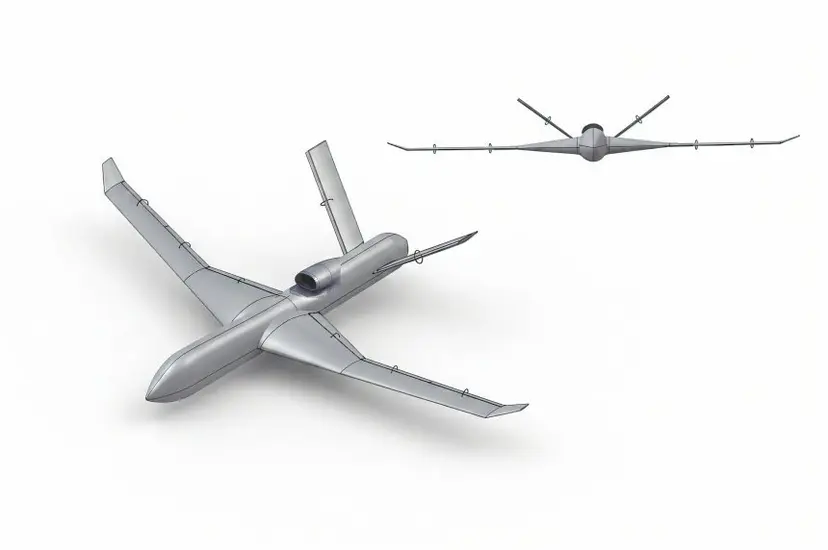
During the Aerospace System Engineering Society conference held in Busan on May 9th, Hanwha Aerospace unveiled the design of an unmanned aircraft it is researching internally under the title, 'Concept Design Study for Next-Generation High-Altitude Multi-Purpose UAV.' According to the presentation, while domestic technology has already begun mass production of medium-altitude UAVs, the high-altitude sector currently relies on the U.S.-imported RQ-4 Global Hawk. However, due to excessive maintenance costs, it remains the most expensive asset to maintain among Republic of Korea Air Force aircraft. Furthermore, while there are various alternatives for combat UAVs, such as medium-altitude derivatives and loyal wingmen, the company identified a new demand for an airframe capable of long-endurance, multi-mission operations, leading to this new concept design.
The core of Hanwha's 'multi-purpose UAV' is a multi-role aircraft capable of both long-endurance flight and performing diverse missions. While most figures are still in the early stages and subject to change, the current target specifications include a maximum altitude of 45,000 ft, a top speed of Mach 0.6, long-endurance flight of over 18 hours, and a payload capacity of over 1 ton.
To achieve this, Hanwha Aerospace adopted a design that is both similar to and distinct from existing UAVs. It combines a high aspect ratio (High AR) main wing similar to the General Atomics Avenger with a V-shaped integrated tail, and features a thickened wing root to simultaneously satisfy requirements for long-endurance flight, high-altitude performance, and stealth capabilities. Notably, the design intends to accommodate over 4 tons of fuel in the center fuselage and wing roots to facilitate long-endurance missions.
Given the lack of demand for single-purpose UAVs, Hanwha Aerospace is pushing to assign multi-purpose missions to this next-generation high-altitude UAV. When deployed for general reconnaissance (ISR/ELINT/COMINT) missions, it can collect imagery and signals intelligence with capabilities equal to or greater than the Global Hawk, while offering longer endurance. It can also be utilized as a long-range stealth penetrator by carrying multiple guided bombs or small missiles. Additionally, the company is pursuing a counter-drone (C-UAS) version equipped with tactical laser weapons and an aerial refueling capability.
Consequently, if Hanwha's multi-purpose UAV becomes operational, it is expected to significantly enhance the Air Force's operational capabilities and establish itself as a competitive new unmanned platform in the export market. While the Global Hawk is slated for early retirement due to survivability issues—highlighted by the recent downing of a similar variant (MQ-4C) during the Iran conflict—a multi-purpose high-altitude UAV with low-observable capabilities would be able to perform reconnaissance missions safely.
Its strike capabilities are also noteworthy. Although Hanwha Aerospace's high-altitude multi-purpose UAV has a similar weapons payload to the recently popular Collaborative Combat Aircraft (CCA), it offers longer endurance. This means it can perform missions in operational areas for 24 hours with fewer units, and it possesses the ability to penetrate deep into enemy territory where CCA-type drones might struggle due to range limitations.
Another point of interest is the plan to equip the UAV with the HAF4500 engine, which Hanwha Aerospace is currently developing. This engine is a next-generation drone engine that can generate 100kW of power—several times higher than current UAV jet engines. Thanks to this engine, if a laser cannon is mounted on the UAV, it could carry high-output tactical lasers in the tens-of-kW range (comparable to fighter-level systems) to engage in enemy drone interception, making it a potential game-changer in future warfare.
Hanwha Aerospace's next-generation high-altitude multi-purpose UAV is currently at the concept design stage. For full-scale development to commence, it is true that further in-house research, identification of military requirements, and investigation of export market demand are necessary. Nevertheless, it is highly encouraging that Hanwha Aerospace is not only working with government agencies to develop domestic engines but is now also focusing on creating platforms that can maximize the performance of its own next-generation engines.
In particular, it is noteworthy that Hanwha Aerospace has moved beyond the industry trend of focusing solely on fighter-shaped loyal wingmen and proposed a new concept that blends the advantages of both loyal wingmen and high-altitude UAVs, demonstrating the potential for its UAV business to become a new growth engine for the company in the future.