

[비즈한국] The Financial Supervisory Service (FSS) recently held a Sanctions Review Committee meeting for Lotte Card and resolved on a 4.5-month business suspension. If finalized, this sanction is expected to deal a significant blow to Lotte Card's performance. The company had seen its performance decline for several years before managing a rebound in the first quarter of this year. Its largest shareholder, MBK Partners, is currently pushing for the sale of Lotte Card, but if the sanctions are confirmed, the sale process is expected to face difficulties.
According to the financial sector, the FSS held its second sanctions review meeting on April 30 and resolved to impose a 4.5-month business suspension and a 5 billion won fine on Lotte Card. This follows the personal data breach incident that occurred at Lotte Card last September. The results of the FSS sanctions review will be finalized at a regular meeting of the Financial Services Commission (FSC). There is room for the level of sanctions to be reduced during the FSC's regular meeting.
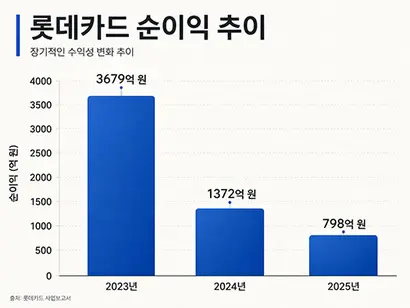
This is a variable that could have a negative impact on Lotte Card's performance. Even excluding the business suspension, there is an assessment that uncertainty surrounding its performance remains high. Lotte Card's net profit decreased from 367.9 billion won in 2023, to 137.2 billion won in 2024, and to 79.8 billion won in 2025. Its debt-to-equity ratio reached 585.05% as of the end of last year. However, it did manage to record a net profit of 22.2 billion won in the first quarter of this year, an increase from the 14.3 billion won net profit recorded in the first quarter of last year.
Although it succeeded in a performance rebound in the first quarter of this year, the outlook for Lotte Card remains grim. Oh Ji-min, a senior analyst at Korea Investors Service, stated, "Across the industry, card profits are declining due to the decrease in card loan balances and reductions in merchant fee rates. Furthermore, the possibility of borrowers' repayment ability weakening is increasing, and insolvency risks are rising, particularly for loan assets with large execution amounts per transaction." She added, "Under this unfavorable environment, key points for evaluation include whether the company can improve profitability through stronger risk management, loss provision management, and cost efficiency."
If Lotte Card receives the business suspension order, its performance will inevitably deteriorate further. Analyst Oh Ji-min added, "With the possibility of sanctions such as a business suspension still remaining, it is necessary to monitor the potential reduction in business linked to affiliates and changes in the stability of the business base due to customer attrition."
Analysts suggest that the presence of the largest shareholder, MBK Partners, has also contributed to Lotte Card's uncertainty. Representative Lee In-young of the Democratic Party of Korea pointed out on social media in April, "Lotte Card's 79.3 billion won in receivables related to Homeplus has been classified entirely as estimated losses, which simply means Lotte Card has absorbed the debt that Homeplus could not repay," adding, "If a private equity fund acquires a company and then manages funds and risks by rotating them within affiliates, the damage will inevitably spread to the market and consumers."
In response, Lotte Card countered, "Those receivables are assets that have a possibility of recovery depending on the future results of Homeplus's rehabilitation," and "This is a decision made to enhance financial transparency by preparing for risks and setting aside provisions, not because the insolvency of the assets has been finalized."
If the business suspension is finalized, it will be difficult to expect strong performance this year. For Lotte Card, avoiding the suspension is crucial, but for now, there are no clear signs of a turnaround.
This could also affect MBK's sale of Lotte Card. MBK has been pushing for the sale of Lotte Card for several years without success. While it was once reported that they wanted a sale price of 3 trillion won, the desired price is now said to be in the 2 trillion won range. Even with a lower asking price, there is no visible progress in the sale of Lotte Card.
The MBK Partners consortium acquired an approximately 80% stake in Lotte Card for 1.38 trillion won. While the industry mentions a sale price of around 2 trillion won for Lotte Card, there are no interested buyers, raising the possibility that the price could drop even further. However, since MBK Partners also needs to generate profits from the sale, it seems difficult for them to lower the price too much. It is reported that Lotte Card plans to make efforts to have the level of sanctions reduced at the FSC's regular meeting. The company has not issued an official statement regarding this matter.