

[비즈한국] The most notable change in the apartment market within regulated areas (adjustment target areas and speculative zones) this year has been the increase in transactions for mid-to-low-priced apartments. While the overall apartment transaction volume has decreased compared to last year, the number of transactions for apartments under 900 million won has actually risen. Conversely, transactions for ultra-high-end apartments priced at 3 billion won or more have dropped by more than half, showing a clear divergence in market trends by price range even within the same regulated areas.

According to an exhaustive analysis of real apartment transaction records in regulated areas conducted by Biz Hankook on the 10th, the transaction volume for apartments in regulated areas from January 1 to May 9 this year was 36,737 units, a decrease of 3,037 units (8%) compared to the same period last year. The total transaction value was 37.3535 trillion won, down 9.5295 trillion won (20%) from the same period last year. Since the reporting deadline for real estate transactions is 30 days from the contract date, these recent figures may be subject to change.
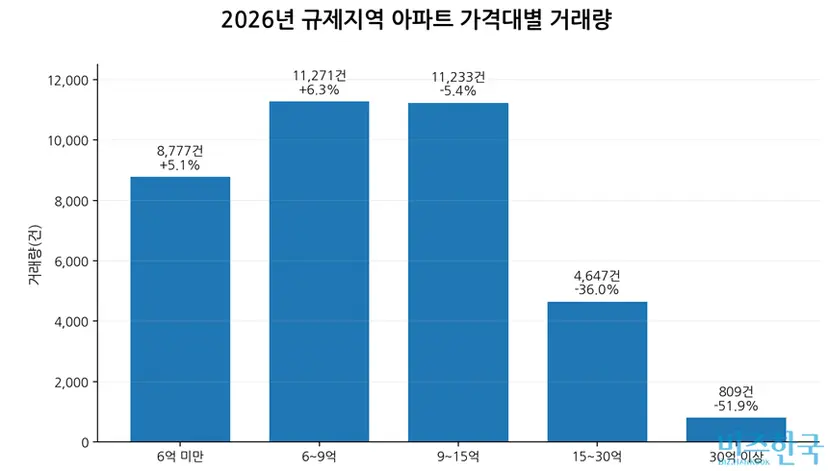
The price range that saw an increase in transactions was the mid-to-low segment. Across all regulated areas, apartments sold for under 900 million won increased by 1,092 units (6%), from 18,956 units in 2025 to 20,048 units in 2026. Transactions for apartments priced between 600 million won and 900 million won rose by 665 units (6%) to 11,271, and those under 600 million won rose by 427 units (5%) to 8,777. This contrasts with the 8% decline in overall apartment transaction volume.
On the other hand, transactions for high-end apartments fell significantly. Apartments sold for 900 million won or more in regulated areas decreased by 4,129 units (20%), from 20,818 units in 2025 to 16,689 units in 2026. Transactions for those between 900 million won and 1.5 billion won dropped by 645 units (5%) to 11,233, and those between 1.5 billion won and 3 billion won dropped by 2,611 units (36%) to 4,647. Notably, transactions for properties priced at 3 billion won or more fell by 873 units (52%), from 1,682 to 809.
Transaction volumes by region also reflect this trend. This year, apartment transaction volume in Nowon-gu, Seoul, reached 2,856 units, an increase of 1,257 units (79%) compared to the same period last year, marking the largest increase among regulated areas. Other areas with significant increases include Yeongtong-gu, Suwon (Gyeonggi Province) with 2,249 units (up 609, 37%), Eunpyeong-gu, Seoul with 1,224 units (up 466, 62%), Jungnang-gu, Seoul with 981 units (up 414, 73%), and Paldal-gu, Suwon (Gyeonggi Province) with 971 units (up 413, 74%).
Meanwhile, transaction volumes in areas considered barometers for Seoul housing prices dropped sharply. Seongdong-gu, Seoul, saw 512 transactions, a decrease of 1,038 units (67%) compared to the same period last year, the steepest decline among regulated areas. Other notable decreases include Gangnam-gu, Seoul (773 units, down 1,029 or 57%), Seocho-gu, Seoul (538 units, down 950 or 64%), Mapo-gu, Seoul (570 units, down 925 or 62%), and Songpa-gu, Seoul (1,238 units, down 891 or 42%).
On October 15 last year, the government announced a housing market stabilization plan that designated all of Seoul and 12 regions in Gyeonggi Province as regulated areas and land transaction permit zones. Previously limited to Gangnam-gu, Seocho-gu, Songpa-gu, and Yongsan-gu, the regulated zones were expanded to include all of Seoul, as well as Gwacheon, Gwangmyeong, Seongnam (Bundang, Sujeong, and Jungwon-gu), Suwon (Yeongtong, Jangan, and Paldal-gu), Anyang (Dongan-gu), Yongin (Suji-gu), Uiwang, and Hanam. Within these regulated areas, financial restrictions, such as limits on mortgage loans, were tightened.
The increase in mid-to-low-priced apartment transactions is interpreted as a result of the interplay between loan regulations and the end of the grace period for capital gains tax surcharges on multi-home owners. In regulated areas, high-end apartments require larger amounts of personal capital for purchase and face greater burdens from loan and transaction regulations, limiting the buyer pool. Conversely, mid-to-low-priced apartments have a relatively lower financial burden, attracting real users and those looking to trade up. Furthermore, the incentive for sellers to close deals before the May 9 expiration of the capital gains tax surcharge grace period for multi-home owners appears to have boosted transactions in this price range.