

[비즈한국] Getting a distribution payout in your account every month is an attractive prospect. For retirees whose salaries have stopped, FIRE (Financial Independence, Retire Early) aspirants, and even office workers just starting to build their assets, there are few motivators as powerful as the idea that “money comes in even if I do nothing.”
The explosive growth of monthly dividend and covered-call ETFs in the domestic ETF market recently is due precisely to this appeal. The ‘TIGER Dividend Covered Call Active ETF’ from Mirae Asset Global Investments saw its net assets grow from 240 billion won at the beginning of the year to over 1 trillion won in just four months. This rapid inflow of capital followed its payment of monthly special distributions of up to 2% in the first half of this year. New products combining covered-call strategies with semiconductor stocks are also being listed one after another. However, where exactly is this monthly income coming from? And what are we giving up in exchange for receiving that money?
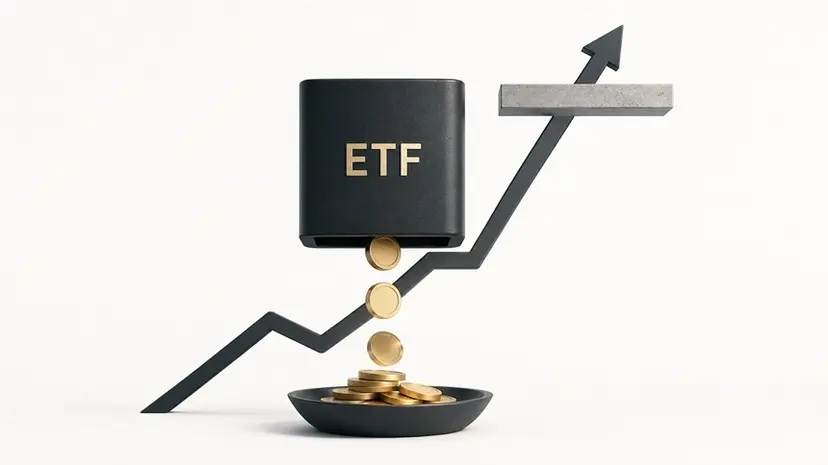
First, products commonly grouped as 'monthly dividend ETFs' actually fall into two categories. The first is traditional dividend ETFs that hold high-dividend stocks and pass on the dividends companies pay to their shareholders directly to investors. In this case, the source of the distribution is a portion of the profit earned by the companies. The second is the currently popular covered-call ETF. This product uses a strategy of buying stocks while simultaneously selling call options on those stocks to collect option premiums. The core source of the money entering your account each month is the option premium earned from selling call options. While actual distributions may also reflect dividends from the stocks held, trading profits, and operational performance, it is more accurate to say that while general dividend ETFs are a structure of sharing profits earned by companies, covered-call ETFs are a structure where you sell the 'future upside potential' of your stocks to the market in exchange for cash.
To use an analogy, it's like lending your house to someone and promising to sell it to them at a certain price if it rises above a specific level within a year, while receiving a set amount of money each month in exchange for that promise. As long as the house price moves below that promised price, I keep the house while collecting the rent. However, the moment the house price significantly exceeds that promised price, I have to give up the excess gain. This is why covered-call ETFs cannot track a bull market as effectively as general index ETFs. Distributions are not created out of thin air; they are essentially cash received in advance by trading away a portion of the upside potential.
Looking at the numbers makes it clearer what you gain and what you lose. The ‘TIGER Dividend Covered Call Active ETF’ recorded a return of 32.85% in the second half of last year, outperforming its benchmark, the KOSPI 200 Covered Call 5% OTM Index. Based on this performance, it demonstrated tangible results with a distribution yield of 1.93% in January and 2.05% in March. This was possible thanks to active management, which adjusted the ratio of option sales in line with market conditions. However, in the period of increased volatility since March of this year, this ETF could not avoid negative returns. While it did cushion the blow to some extent while the KOSPI 200 recorded a double-digit decline, receiving a distribution does not mean that the principal loss itself disappears. Even if a 2% monthly distribution looks attractive, if the underlying assets drop significantly in the meantime, you are ultimately at a loss in terms of total return including distributions. Distributions can be a cushion that partially buffers losses, but they are not a shield that protects the principal.
Another point easily overlooked is taxes. Distributions from domestic listed ETFs are generally classified as dividend income and are subject to a 15.4% withholding tax. Up to this point, it is the same as general dividends, but if total financial income such as interest and dividends exceeds 20 million won per year, it becomes subject to the global financial income tax, meaning a progressive tax rate is applied in combination with other income. Even if it looks good to have distributions hitting your account every month, once your assets exceed a certain level, your after-tax yield drops faster than you might think. Using tax-advantaged accounts like an ISA, pension savings, or IRP can provide room to delay the taxation timing or lower the tax burden. However, since the limits and taxation methods differ by account, the order of operations is to organize which account you will use before choosing a product.
Does this mean you shouldn't buy monthly dividend ETFs? Not necessarily. The key is to recognize that this product is a 'cash flow tool,' not an 'asset appreciation tool.' It is a reasonable option for people who need a steady living expense after retirement, or for those who, in a situation where earned income has stopped or decreased, need regular income without having to sell off parts of their portfolio. Compared to keeping the KOSPI 200 as is and selling parts of the ETF every month to cover living expenses, the former is psychologically much more comfortable because it doesn't feel like you are eating into your assets.
Conversely, it is worth reconsidering for office workers in their 30s and 40s whose goal is asset growth to put a large portion of their core assets into monthly dividend ETFs. To enjoy the full effects of compounding over the long term, you need to be able to follow the upside in a bull market, but covered-call ETFs are products that have capped that upside. If the monthly distributions are consumed rather than reinvested, the compounding effect becomes even weaker.
Ultimately, when choosing a monthly dividend ETF, it is not just the distribution yield number that you should check. You must also look at whether the source of the distribution is corporate dividends or option premiums, how the option selling ratio and strike price are set, how the management firm secures the source of distribution and whether that policy is sustainable, what the total expense ratio is, and which account you will hold the product in.
The money coming in every month is clearly attractive. However, you must remember that the essence of a monthly dividend ETF is not 'free dividends,' but a strategy that trades volatility and upside potential for cash flow. Deciding whether you need cash flow or the growth of the asset itself is the first step in staying grounded amidst this frenzy.