

[비즈한국] There are countless stars in the universe today. However, it was not always this way. In the primordial universe, there were neither stars nor galaxies. There was only a very small, faint chaos occurring at the quantum mechanical scale. Slowly, light began to fill a universe that had once been filled with nothing but tedious darkness.
Certainly, in the history of the universe, there must have been the very first stars that broke the darkness. In astronomy, these stars are called Population III (Pop III) stars. While the first generation of stars must have existed throughout cosmic history, they are so far in the distant past that we have never seen them directly. Or so we thought. Perhaps we have already been staring at the light of the Pop III stars we so desperately sought in a very famous location.
In astronomy, stellar generations are broadly divided into Pop I and II. The Sun and nearby young stars are Pop I stars. Stars older than the Sun, about 10 billion years old, are Pop II stars. Stellar generations are classified by the content of heavy elements (metals) they contain. As generations pass, stars leave behind heavier elements in the universe. Older stars born when there were not many heavy elements contain very little, while young stars born later, after heavy elements were spread throughout the universe, contain significantly more.
Pop II stars are abundant in globular clusters that can be observed today. However, these are not the first stars in the universe. There was a true first generation that preceded them. Hence, they are called Pop III stars. These stars would have been born immediately after the Big Bang, at a time when there were absolutely no heavy elements other than hydrogen and helium. In other words, their heavy element content should be exactly zero.
So far, no such star has been confirmed through actual observation. Unfortunately, Pop III stars are so massive that their stable lifetimes are incredibly short. It is highly likely they shone briefly for a fraction of time compared to the age of the universe and then disappeared. No matter how far we search the universe now, the chances of seeing a living Pop III star are very slim.
Recently, pure stars comparable to Pop III have occasionally been discovered. But at best, they are merely stars with relatively low heavy element content. We have yet to find a true Pop III star containing no heavy elements at all. Even if one existed, it would likely be so far away that seeing the light from an individual star would be difficult. If so, could we expect to see the first galaxy, which would be composed solely of Pop III stars?
There is a representative galaxy discovered at the edge of the universe called GN-z11. It is one of the most distant galaxies observed by the Hubble Space Telescope, and the James Webb Space Telescope (JWST) has recently conducted more detailed observations. This galaxy retains a very young appearance, as it existed when the universe was only 400 million years old after the Big Bang. It sits on the edge of the so-called Dark Ages, a time when no stars or galaxies shone in the universe.
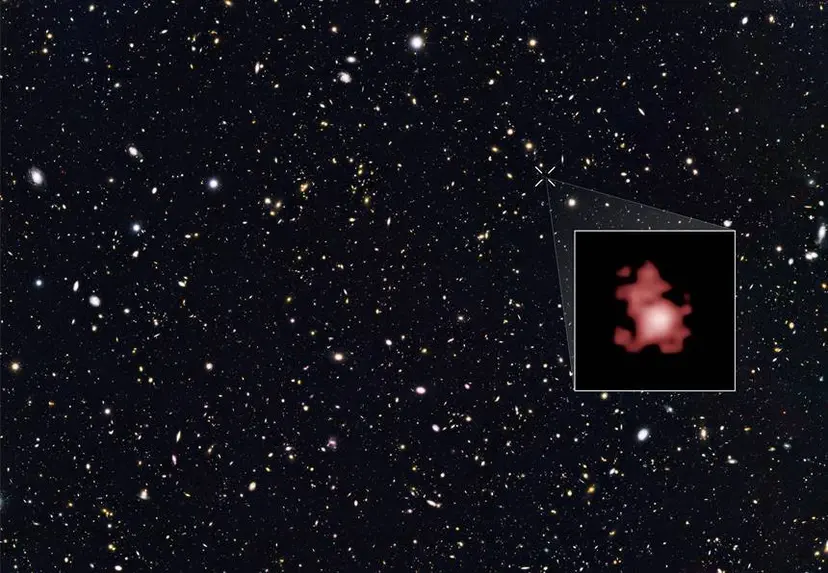
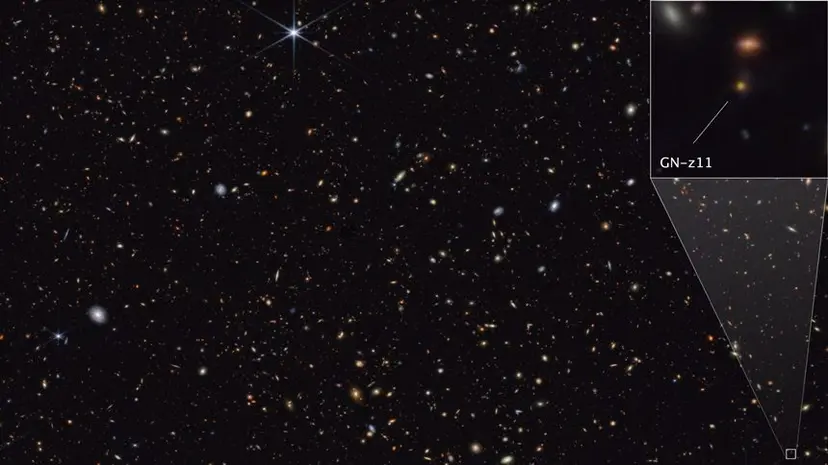
However, a surprising presence was hidden at this site. A tiny smudge, so faint it was easy to miss, appeared right next to the GN-z11 galaxy. It was only revealed because the James Webb observed infrared light, which has a longer wavelength than visible light. This small smudge shows no trace of metal lines, which should be present if any metallic components existed. Instead, it displays very strong helium II emission lines. This means there are almost no metals like carbon or nitrogen, but an abundance of ionized helium. For helium to ionize, the temperature must be extremely hot. This suggests the temperature here exceeds at least 100,000 K, causing the helium to ionize all at once. Being filled with such pure, hot, ionized helium perfectly matches the characteristics expected from the light of Pop III stars.
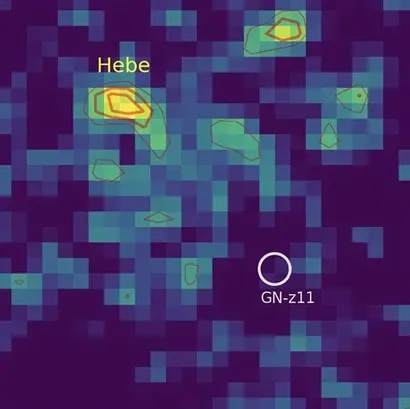
That is not all. In subsequent observations, traces of hydrogen were detected in the exact same smudge, in addition to the ionized helium. This means the observation wasn't a mistake; there is indeed a location that contains only hydrogen and helium with absolutely no traces of metals. The possibility of Pop III stars becomes much higher. If this suspicious site is indeed at a similar distance to the adjacent GN-z11 galaxy, this smudge is estimated to be about 3,000 light-years away from the central galaxy.
Looking closer, the smudge is divided into two main regions, identified as C1 and C2. C1 appears to be a mass of very pure hydrogen and helium, showing absolutely no traces of any metallic elements. It may be a region where very pure Pop III stars are concentrated. C2, on the other hand, appears to be slightly contaminated by heavier elements, which could be the result of a supernova explosion that occurred just prior.
In summary, this smudge can be seen as a site where a cluster consisting purely of Pop III stars exists, and where, due to a nearby recent supernova explosion and subsequent metal contamination, the next generation of Pop II stars is beginning to form. It could be the first case of a generational shift in the universe, transitioning from the first generation of stars to the next! Astronomers have nicknamed this smudge 'Hebe' after the goddess who symbolizes youth in Greek mythology.
The GN-z11 galaxy is a galaxy from the early universe, but it hosts a black hole at its center. However, the energy from the black hole alone cannot perfectly explain why GN-z11 appears too bright for its size. It is likely because the galaxy contains a mixture of massive, bright stars that are nearing the end of their evolutionary stages. If that were the case, clear traces of metals should have appeared, but they did not. The only explanation that can resolve this contradiction is that the GN-z11 galaxy also contains a significant number of pure, dazzling Pop III stars.
Analysis of the light from the faint yet intense smudge of Hebe suggests that there is a higher concentration of massive stars, generally between 10 and 100 times the mass of the Sun. To explain the observed spectrum and characteristics of Hebe, there must be more massive stars compared to lighter ones. This is consistent with what we expect from Pop III stars. The stars of the primordial universe become much more massive than those today, and naturally, their lifespans become very short.
Such intense primordial starlight would have instantaneously ionized the hydrogen clouds in the surrounding space. The ionized hydrogen and helium emission lines appearing in the Hebe smudge prove such a possibility. As the universe was ionized in its entirety, all atoms were broken down, and the universe went through a period of transparency. This period is called the Epoch of Reionization, occurring shortly after the Big Bang. If the Hebe smudge discovered this time is indeed a cluster from the first generation of the universe consisting only of Pop III stars, it would be the first instance of directly observing that very period of reionization. Literally, we have seen the dawn of the universe, the threshold when the darkness of the cosmos ended and the era of light began.
As we gaze at the stars shining above, I would like to introduce a new book, 'To Earthlings, From the Stars', which helps us reminisce about cosmic time. When we think of familiar stars visible to the naked eye—Betelgeuse in Orion or Antares in Scorpius—we often think of constellations and mythology. However, astronomers are not particularly interested in such stories. Instead, they think of the cosmic secrets contained within the starlight, the great discoveries of dreamers, and the inspiration and traces that starlight has left on our history.
Some have used starlight to deceive kings, while others have looked at it and dreamed of a great migration toward freedom. Stars that served as guides for sailors navigating the seas long ago now guide spacecraft leaving our solar system.
Why do we look at starlight? What meaning does it hold? A few years ago, in an interview, I was asked why we should look at the stars, and I answered, "If the starlight that has traveled hundreds or thousands of light-years cannot reach anyone's eyes, how sad would that light feel?" Perhaps understanding is just that.
Galileo, the first astronomer in history to look at the stars through a telescope and approach the secrets of the universe, gave his book containing his discoveries a wonderful title: 'Sidereus Nuncius', which literally means "Starry Messenger." Looking at starlight and listening to the sky is exactly what this means. 'To Earthlings, From the Stars' is a letter sent by the stars to us. A letter sent by the stars, and received by us. I hope you will unfold the story of the 13.8 billion-year-old letter sent by the twelve brightest stars in the night sky.
References
https://ui.adsabs.harvard.edu/abs/2026arXiv260320362M/abstract
https://ui.adsabs.harvard.edu/abs/2026arXiv260320363R/abstract
About the author Ji Woong-bae: Loves cats and the universe. After watching 'Galaxy Express 999' as a child, he dreamed of sharing the beauty of the universe. Currently an assistant professor in the Faculty of Liberal Arts at Sejong University, he engages in various science communication activities including lectures and writing. He has authored books such as 'A Piece of the Universe Every Day', 'Scientists of the Starry Universe', 'Cannot Go, But Know', and 'Strange Questions That Come to Mind When Looking at the Universe', and translated books such as 'The Hitchhiker's Guide to the Real Universe', 'How I Killed Pluto', 'Quantum Life', and 'Cosmigraphics'.