

[비즈한국] The global pharmaceutical and biotechnology industry is enthusiastic about the rosy future of cell therapies, which promise a cure with a single administration. However, the barrier to commercialization—generating profit in the market—is higher than overcoming technical hurdles to secure drug approval. This is because it is difficult to escape the constraints of strict regulatory approvals, the limitations of a narrow non-reimbursable market, and a fragile supply chain for consumables. We take an objective look at the reality of commercialization faced by the cell therapy industry.
Last month, on the 19th, at 8:40 PM at the Suwon World Cup Stadium, former national soccer player Park Ji-sung stepped onto the pitch as part of the OGFC, a team composed of Manchester United FC legends. He was substituted into the 'OGFC: THE LEGENDS ARE BACK' legend match against the Suwon Samsung Bluewings legends and played for about 8 minutes.
Park had undergone two knee surgeries during his playing career. Toward the end of his career, he lived with chronic knee pain, often confined to bed for three days after playing just one game. After playing about 55 minutes in the 'Icon Match' charity tournament held at the Seoul World Cup Stadium on September 14 last year, he said, "I'll have to limp around for about two weeks." His knees were damaged to the point where even daily life was a struggle.
However, it is reported that this year, after finishing the match, Park's knee did not swell like it did last year. The secret that allowed him to run again was regenerative medicine using cell therapy. Prior to this match, Park visited a hospital in Spain—where former FC Barcelona captain and defender Carles Puyol had undergone surgery and rehabilitation—to receive stem cell injections in the inner and outer meniscus of his knee, followed by rehabilitation. Beyond merely alleviating symptoms, cell therapies that fundamentally repair damaged tissue are attracting attention as one of humanity's most powerful weapons to conquer not only sports-related injuries but also cancer and rare diseases.

From Stem Cells to CAR-T… Curing Diseases with Cells
Currently, the biopharmaceutical market is led by antibody therapies. Moving past the toxic side effects of first-generation chemical anticancer drugs that destroy even healthy cells, they have become the mainstream by prioritizing precision targeting that strikes only specific cancer cells or disease causes.
Cell therapies are receiving global attention as third-generation treatments that will succeed antibody therapies.
Cell therapies are personalized medicines in which living cells are cultured or genetically manipulated outside the body and then re-administered to the patient. Unlike antibody therapies, which require continuous administration to suppress disease factors, the greatest strength of cell therapy is that it can potentially achieve a cure with a single administration, as the cells proliferate on their own in the body to identify and eliminate the root cause of the disease.
Cell therapies include stem cell therapies and immune cell therapies such as CAR-T (chimeric antigen receptor T-cell) and NK (natural killer) cell therapies. Stem cell therapies are specialized in regenerating damaged cartilage or tissue, as in Park Ji-sung's treatment, while immune cell therapies are characterized by their direct attack on cancer cells. Among them, CAR-T therapies are designed to equip a patient's immune T-cells with genes modified to target only cancer cells, ensuring they selectively kill them. Because a single administration can nearly cure terminal cancer patients, they are also called 'miracle anticancer drugs.'
A 23 Trillion Won Market by 2030… Growing at an Annual Average of 18%
The cell therapy market is expected to grow rapidly. According to the global market research firm Grand View Research, the cell therapy market is projected to grow from $6.54 billion (9.606 trillion KRW) in 2024 to $17.46 billion (25.6452 trillion KRW) in 2030, at a compound annual growth rate (CAGR) of over 17.8%. This significantly exceeds the 8.5% annual growth rate of biopharmaceuticals and 5.6% of synthetic drugs. It is also higher than the 10.49% annual growth rate of ADC (antibody-drug conjugate) therapies, currently the hottest modality in the world, suggesting that the next-generation pharmaceutical industry paradigm is shifting toward cell therapy.
The battle for dominance among global big pharma companies looking to capture the market is also fierce. Last year, the No. 1 cell therapy by revenue was Johnson & Johnson (J&J) and Legend Biotech’s multiple myeloma treatment 'Carvykti,' with approximately $1.9 billion (2.7902 trillion KRW). Gilead Sciences' large B-cell lymphoma (LBCL) treatment 'Yescarta' followed with approximately $1.5 billion (2.2025 trillion KRW), and Bristol Myers Squibb's (BMS) LBCL treatment 'Breyanzi' with $1.358 billion (1.9942 trillion KRW). Although they have been commercialized for less than 10 years, the cell therapy market is so highly regarded that many products have reached the ranks of global blockbuster drugs (annual sales of over $1 billion).
As the reach of cell therapy rapidly expands from existing blood cancers to solid tumors and autoimmune diseases, the pace of market expansion is expected to accelerate further in the future. Until now, cell therapies were only used for blood cancers—which account for only about 10% of all cancer patients—due to the difficulty of breaking through the solid, robust defense mechanisms characteristic of solid tumors. However, in February 2024, Iovance's 'Amtagvi' received approval from the U.S. Food and Drug Administration (FDA) as a treatment for advanced melanoma, a type of skin cancer, earning the title of the first solid tumor cell therapy. Since then, research to develop treatments for solid tumors such as stomach and pancreatic cancer has become active.
Furthermore, in 2022, cases reported in international medical journals like 'Nature Medicine' showed that patients with severe systemic lupus erythematosus (SLE) who were treated with CAR-T therapy had their symptoms completely disappear within months. This has proven the potential for cell therapies to be developed as treatments for autoimmune diseases, making it an emerging key battleground for the global pharmaceutical and biotech industry.
Arrival of the First Domestic CAR-T Therapy, First Approval of Advanced Regenerative Medicine Treatment Plan
The efforts of domestic companies to capture the global market are also accelerating. Kolon TissueGene is finalizing global phase 3 clinical trials targeting knee osteoarthritis, while Medipost, NatureCell, and others are preparing for global phase 3 trials, entering the final stages of commercialization. Artiva, a U.S. affiliate founded based on GC Cell's NK cell manufacturing technology, is also speeding up its entry into the global market with the goal of starting patient administration through phase 3 clinical trials in the second half of this year and applying for new drug approval in 2029.
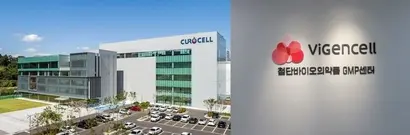
The speed of domestic commercialization is also increasing. Last month, Curocell's CAR-T therapy 'Rimkato' received formal product approval from the Ministry of Food and Drug Safety and is currently in the stage of insurance benefit and drug price negotiations. It is expected to be launched as early as the second half of this year. Domestic patients, who previously relied on treatments from global pharmaceutical companies such as Novartis' 'Kymriah,' can now use a 'one-shot' treatment made with domestic technology.
In addition, institutional support for industry promotion is boosting the commercialization of cell therapies. A representative example is the first approved advanced regenerative medicine treatment plan following the amendment of the Act on the Safety and Support for Advanced Regenerative Medicine and Advanced Biopharmaceuticals (Advanced Regenerative Bio Act), which took effect in February last year. Last month, The Catholic University of Korea Yeouido St. Mary's Hospital announced it would treat 15 patients with EBV (Epstein-Barr virus)-positive lymphoma using Vycell's cell therapy 'VT-EBV-N' through this treatment plan approval, even before formal product approval. With the treatment cost per patient set at approximately 76.2 million KRW, a path has been opened to generate revenue, albeit in a limited way, even before full drug approval.
Expectations for personalized cell therapies that promise a one-shot curative effect are expected to continue to rise. However, to establish a firm industrial footing, a business model that continuously generates profit is necessary. The still-high regulatory hurdles and difficulties in manufacturing processes are cited as prerequisites that must be overcome. Now, the pharmaceutical and biotech industry faces a realistic testing ground: not just 'how to cure,' but 'how to survive.'