

[비즈한국] The stock price outlooks for Samsung Electronics005930 and SK Hynix000660 are setting new records day after day. Recently, securities firms have presented aggressive target prices of 500,000 won for Samsung Electronics and 3 million won for SK Hynix. The reasoning is that expanded AI server investment, increased HBM demand, and rising DRAM/NAND prices are boosting earnings estimates. Furthermore, recent supply-demand effects, with ETF capital concentrating on these two stocks, have added to the momentum. By the end of this month, single-stock leverage ETFs based on Samsung Electronics and SK Hynix are also scheduled to be listed.
As of the closing price on the 8th, Samsung Electronics closed at 268,500 won, and SK Hynix closed at 1,648,000 won. Although both stocks saw a slight decline from the previous day, they are maintaining a strong trend near their all-time highs. SK Hynix reached a new all-time closing high on May 7th, the day before, at 1,654,000 won. While the trends for both stocks are similar, there are differences. Samsung Electronics is benefiting from rising memory prices and expectations for HBM4, but the key to its future remains the recovery of its HBM competitiveness and the resolution of labor conflicts. SK Hynix is experiencing even stronger stock momentum based on its leadership in HBM and demand for AI server memory.
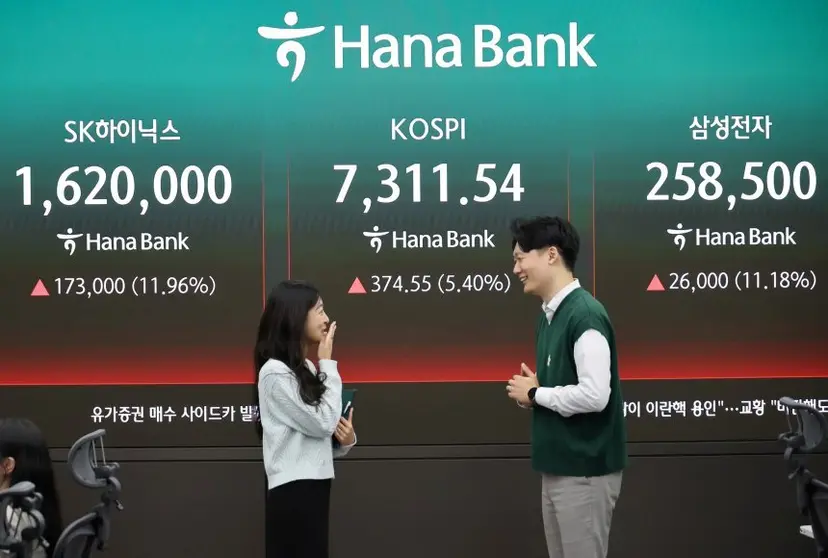
Raising the Bar for Target Prices... SK Securities: "Samsung Electronics 500,000 Won, SK Hynix 3 Million Won"
In a report on May 7th, analyst Han Dong-hee of SK Securities raised the target price for Samsung Electronics from 400,000 won to 500,000 won, and for SK Hynix from 2 million won to 3 million won. This reflects the return of target P/E ratios to previous levels, which had been lowered due to concerns over the U.S.-Iran conflict, by applying 13x and 10x respectively, which are the upper bounds of their P/E ratios since 2025.
Analyst Han stated, "The revaluation of memory is still just in its early stages," citing top-tier profit and profitability among global AI-related stocks, improved structural earnings stability, and the expansion of the buyer base for Korean memory as the reasons. The core logic is clear: AI investment is not a temporary theme but is solidifying into data center infrastructure investment, and in this process, the profit contribution of high-performance memory is growing. In particular, as discussions for long-term supply agreements (LTA) spanning 3 to 5 years spread, the memory market is diversifying into a long-term contract market and a market exposed to spot price fluctuations, which is presented as evidence of earnings stability.
Samsung Electronics still has a strong character of 'recovery expectation.' The rise in prices for general-purpose DRAM and NAND supports earnings improvement. Added to this, the view is that if expectations for expanded HBM4 supply and entry into the AI semiconductor ecosystem are met, a stock revaluation is possible. However, in the case of Samsung Electronics, the image of being a latecomer in the HBM market compared to SK Hynix remains. Ultimately, for the stock to rise beyond the 300,000 won range and move higher, it must prove its HBM competitiveness through numbers, going beyond a simple industry recovery.
SK Hynix is already a stock to which the market has granted an HBM premium. As the demand for AI accelerators grows, the bargaining power of companies with HBM supply capacity increases. SK Hynix is evaluated as the most direct beneficiary in this segment. Thus, the securities industry's target price increases for SK Hynix are more aggressive than for Samsung Electronics. However, as the stock has already risen significantly, the speed of actual profit growth will become more important than expectations going forward. HBM supply volume, customer diversification, and server memory price trends are all gateway factors for the next stage of the stock price.
The 'Samsung-Hynix' Supply-Demand Created by ETFs… A Structure Where Buying Semiconductors Means Buying Both Stocks
Another pillar of the recent stock price rise is ETFs. A variety of products, including semiconductor ETFs, AI semiconductor ETFs, KOSPI 200 ETFs, large-cap stock ETFs, and value stock ETFs, include Samsung Electronics and SK Hynix as core constituent stocks. Even if an investor does not directly buy individual stocks, a structure exists where money flows into both companies the moment they buy an ETF. As the ETF market grows, the supply-demand base for Samsung Electronics and SK Hynix grows along with it.
This concentration is becoming increasingly blatant. In particular, for semiconductor leverage ETFs, there are products where the weight of SK Hynix alone reaches the 40% range. Buying a semiconductor leverage ETF is, in effect, similar to betting heavily on SK Hynix and Samsung Electronics.
This trend becomes a powerful tailwind during periods of rising stock prices. As stock prices rise, ETF performance improves, and money flows into the ETFs. ETF managers then buy Samsung Electronics and SK Hynix in line with the underlying index. This once again attracts favorable supply-demand to the stock price. It is a structure where earnings improvement expectations and passive capital inflows reinforce each other. Conversely, in a market correction, the same structure can increase volatility. This is because if ETF redemptions and rebalancing of leverage products coincide, downward pressure can also increase.
Single-Stock Leverage ETFs Are a Variable… A Growth Driver or a Volatility Mechanism?
As early as May 22nd, single-stock leverage and inverse ETFs based on Samsung Electronics and SK Hynix are scheduled to be listed on the domestic stock market. The Financial Services Commission approved the relevant amendment to the Enforcement Decree of the Capital Markets Act at a cabinet meeting on April 21st, and currently, these two companies are the only ones that meet the requirements such as market capitalization, trading volume, and derivatives market basis. However, depending on the listing review schedule, the actual listing may be slightly delayed to the end of May.
The product is structured to track twice the daily return. Researcher Yoon Jae-hong of Mirae Asset Securities estimated that between 1.7 trillion won (conservative scenario) and 5.3 trillion won (active scenario) of funds could flow in. A caveat was also added that the pure stock price boost would be smaller than that, as the sale of common stocks and the purchase of new ETF spot goods would occur simultaneously. Overseas cases have already shown their explosive potential. The CSOP SK Hynix 2x Leverage ETF listed on the Hong Kong Stock Exchange has a cumulative return of about 750%, surpassing Tesla leverage products to become the No. 1 global single-stock leverage product. If the leverage demand that has been flowing overseas is redirected to the domestic market, the supply-demand structure for both stocks could become even more elastic.
However, the risks are clear. Since leverage ETFs are structured to track twice the daily return, if the process of the stock price rising and falling is repeated, a so-called negative compounding effect occurs. While they increase returns in a rising market, losses also grow rapidly in a sideways or correcting market. Some point out that rebalancing demand just before market close could increase volatility in closing prices.
The next phase for Samsung Electronics and SK Hynix stock prices is likely to be determined by three forces: the speed at which AI server investment and HBM demand translate into actual profits, whether memory semiconductors can continue to be revalued as key assets for AI infrastructure, and the supply-demand power created by ETFs and single-stock leverage products. These two stocks are no longer just large semiconductor stocks; they are representatives of the AI cycle, central axes of the ETF market, and new underlying assets for leverage products. While the earnings logic still leaves room for growth, the supply-demand factor simultaneously carries the potential for short-term overheating. Future stock prices depend on which of these two forces acts more strongly.