

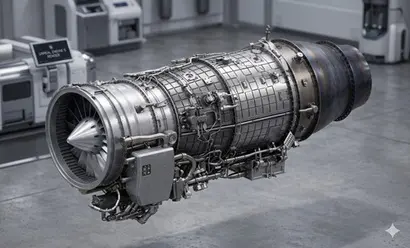
[비즈한국] On April 26, it was confirmed that the first unit of the 'KTF5500' jet engine, led by the Agency for Defense Development (ADD), was successfully assembled at the Hanwha Aerospace012450 plant in Changwon. This achievement is significant as it marks the first time a long-life jet engine, which had previously been entirely dependent on imports, has been completed using domestic technology. Building on this success, the domestic jet engine industry has secured an important foothold to expand beyond drones into the market for military aircraft like the KF-21 and business jets.
Jet engines are generally categorized into short-life and long-life types. Since a jet engine requires its fan to rotate at high speeds and endure high-temperature combustion gases, the key is how high a temperature it can withstand and for how long. Short-life engines, with a lifespan of only a few dozen hours, are only used for "disposable" weapon systems such as missiles and cannot be installed on drones or manned aircraft that require long-duration flights.
Until now, most engines designed by ADD and Hanwha Aerospace were short-life engines. The barrier to entry for long-life jet engine technology is extremely high, with only countries like the U.S., Russia, China, the U.K., France, Japan, and Ukraine having commercialized it. Ukraine has lost a significant portion of its engine development capability due to the war, and while Turkey is attempting similar challenges, it is evaluated as lacking substance compared to its external promotions.
The KTF5500, which has now finished assembly, is a long-life jet engine that can be mounted on drones. It is the result of a long-term project that began in December 2019 and is scheduled to continue through the end of 2027. Led by ADD, numerous domestic defense companies, including Hanwha Aerospace and MNC Solution, are participating in system integration, component manufacturing, and the production of accessory systems. With a thrust of 5,500 lbs, it is similar to Ukraine's AI-222 engine and is suitable for small trainer aircraft or unmanned aerial vehicles. While its exact lifespan has not been disclosed, it is understood to be capable of operating for over 2,000 hours.
The completion of the KTF5500 signifies the conquest of the final frontier for the South Korean defense industry and the securing of strong export competitiveness. In fact, ground weapon systems like the K2 tank and K9 self-propelled howitzer previously faced difficulties due to engine export license (E/L) issues but successfully opened new markets, including Egypt, by adopting domestically produced power packs. Recently, concerns have been consistently raised that the KF-21 Boramae fighter, an aerial weapon system nearing deployment, currently uses the American GE F414 engine, which could potentially become a bottleneck regarding engine export approvals when entering the global market.
Furthermore, during the long development process, securing a low Specific Fuel Consumption (SFC) and high power generation capacity—core indicators for the latest drone engines—remains a task that the engine for the future Collaborative Combat Aircraft (CCA) must achieve.
Therefore, it appears necessary to proceed with the test and evaluation of the KTF5500 promptly while simultaneously developing next-generation engines for small drones, such as Hanwha Aerospace's HAF4500, which maximizes export competitiveness. Additionally, a policy evolution is needed to transfer the KTF5500 development know-how to the private aerospace industry, shifting from a research institute-centered development system to an industry-led one. Such a virtuous cycle must be established to provide momentum for the development of the 16,000 lb-class advanced engine project targeted for 2040.