

[비즈한국] A special act supporting the construction of data centers, the core infrastructure of the artificial intelligence (AI) industry, crossed the National Assembly threshold on the 7th. It includes drastic deregulation measures—such as a 'timeout system' that allows for automatic approval of permits and exemptions from power grid impact assessments for non-capital regions—under the guise of strengthening industrial competitiveness. The clause for 'LNG direct power purchase agreements (PPA),' which was criticized for encouraging the use of fossil fuels, was deleted at the last minute. However, civil society and some political figures are protesting, arguing that the 'promotion-only' legislation, which lacks even minimal environmental regulations such as mandatory renewable energy, passes safety and environmental costs onto future generations.
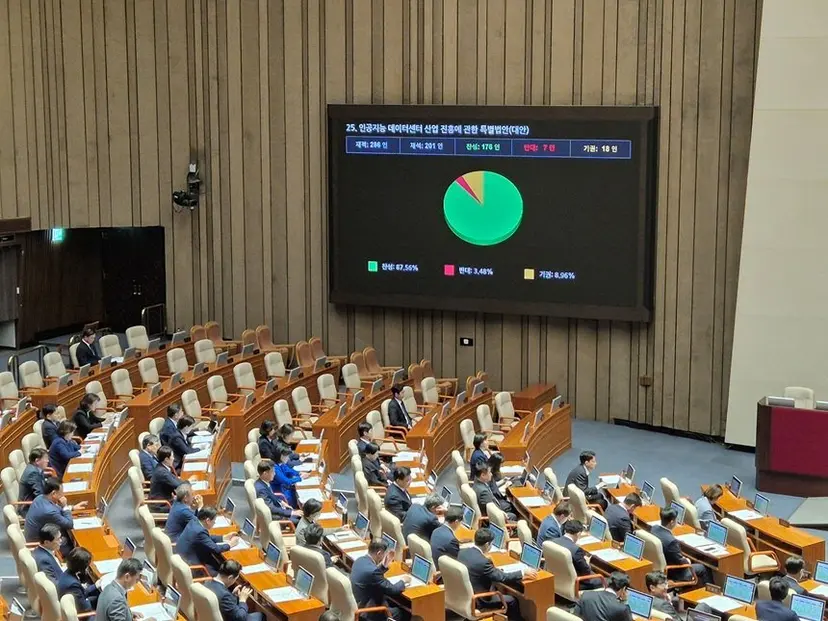
On the 7th, the National Assembly held a plenary session and passed the 'Special Act on the Promotion of the AI Data Center Industry.' This act was enacted to resolve administrative and institutional bottlenecks hindering private investment in AI data center infrastructure, thereby supporting the rapid construction and operation of such centers. The existing 'Framework Act on Intelligent Informatization' only contained regulations for general data centers, making it difficult to provide specialized support for AI data centers. Furthermore, complex permit procedures and unstable power supply were cited as major factors stifling private investment.
Drastic Special Provisions... Only Minimal Safeguards Remain
The special act includes numerous drastic special provisions to ensure that AI data centers are built promptly. It covers comprehensive support ranging from site acquisition to power supply and permit procedures.
Article 18 of the bill defines a system that allows AI data center operators to apply for integrated permits to the Minister of Science and ICT. Notably, it introduces a 'timeout system (deemed approval).' If the head of the relevant agency does not notify of a rejection within the statutory period, the permit is considered granted the day after the period expires. The goal is to prevent project setbacks caused by administrative delays.
Article 19 of the bill grants special exemptions for AI data centers built or expanded in non-capital regions, waiving the power grid impact assessment required under the 'Special Act on the Promotion of Distributed Energy.' The power grid impact assessment is a system that analyzes and manages the impact of large power-consuming facilities on the grid in advance. This exemption is expected to act as an incentive to disperse data centers currently concentrated in the capital area to regional areas.
It also provides a basis for designating AI data center special zones in non-capital regions. Companies moving into these zones are eligible for various exemptions, including charges for forest resource creation, farmland preservation, and traffic congestion, as well as financial support for installing infrastructure and priority guarantees from the Korea Credit Guarantee Fund. Notably, it allows for priority support for land acquisition or partial construction costs to help build infrastructure. Construction and zoning regulations are also relaxed.
The 'LNG direct power purchase agreement (PPA)' clause, which was the biggest issue and the focus of conflict during the legislative process, was finally deleted during the review process. The original bill included a special provision allowing non-capital data center operators to purchase electricity directly from LNG power plants without going through the electricity market, in addition to renewable energy. However, it was criticized because legally encouraging the use of LNG, a fossil fuel, contradicts greenhouse gas reduction goals and could slow the transition to renewable energy.
However, the 'timeout system' clause for simplifying administrative procedures was maintained. To address criticism that it was a 'poisonous clause,' a procedural safeguard was added during the Legislation and Judiciary Committee review process, requiring the deliberation and resolution of the 'National AI Strategy Committee' when reviewing applications for batch processing. This is intended to prevent the indiscriminate issuing of permits and ensure a government-wide review.
Civil Society Expresses Concerns Over Deregulated Promotion
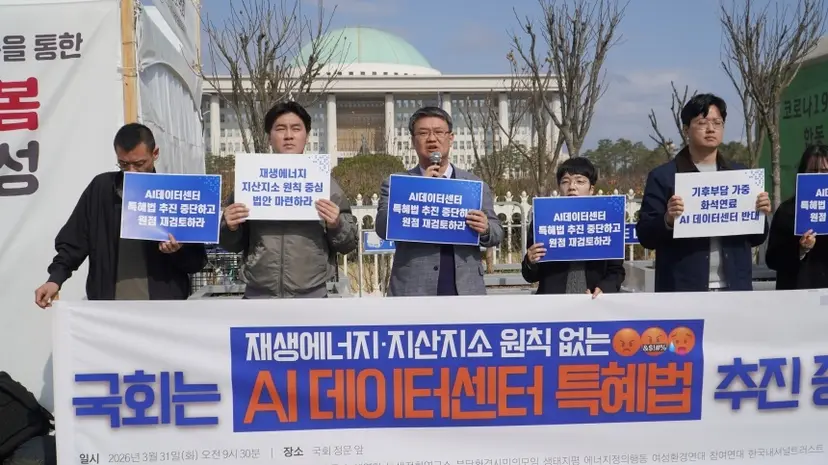
Even though the special act passed the National Assembly plenary session, civil society and progressive political circles warn that this legislation, fixated solely on 'industrial promotion and speed,' will shift enormous environmental and social costs to future generations. Representative Jung Hye-kyung of the Progressive Party, who spoke in opposition during the plenary session, stated, "The current bill shifts the costs and risks of large corporate data centers onto the public. What we need now is a social consensus on how much electricity and water AI data centers will use and how to reduce it, and how to share the burden with local communities."
At a forum titled 'Diagnosing the Problems of the AI Data Center Special Act and Seeking Alternatives,' hosted by civic groups such as the Green Transition Institute, People's Solidarity for Participatory Democracy, and Environmental Justice on April 30, the side effects of the special provisions and areas requiring supplementation were discussed.
The forum pointed out that introducing the timeout system carries a high risk of making permit matters directly related to safety a formality. In particular, considering that fires at data centers using high-voltage batteries can cause massive loss of life and property, applying the timeout system to building permit consents under the Fire Safety Act could threaten public safety. Lee Sun-mi, a planning team leader at People's Solidarity for Participatory Democracy, said, "The timeout system will inevitably force relevant agencies to process items without sufficient review, or risk an influx of permits after being stuck for a few days due to administrative burdens."
Exempting power grid impact assessments sparked concerns that it could threaten the stability of the power grid, specifically by neutralizing the management system that examines self-generation plans or energy efficiency measures in advance. Kim Chul-hyun, a senior research fellow at the Korea Energy Economics Institute, noted, "Currently, domestic power is not lacking in total quantity, but transmission constraints in the capital region are the problem. Using this as an excuse to give excessive privileges to non-capital regions is inappropriate. If a business fails while using public grids cheaply without mandatory self-generation, the issue of 'privatization of profits, socialization of costs' could arise, where society as a whole bears the risk."
There is also criticism that the legal design to increase local resident acceptance is insufficient. The provision for collecting resident opinions in Article 16 of the special act is merely discretionary, using the phrase 'may,' making it difficult to guarantee substantive resident participation and conflict resolution.
Overseas Markets Mandate Renewable Energy... Korea Lacks 'Environmental Standards'
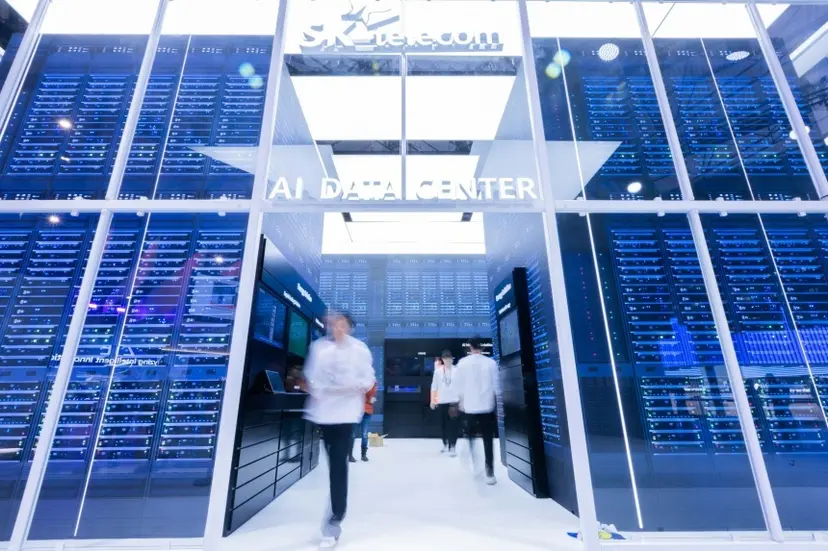
In Virginia, USA, complaints about massive power consumption and noise pollution are constant, and there are frequent cases where data center construction is halted due to resident opposition. In Chile and Uruguay, amidst severe droughts, Google had to change its design to air-cooled methods that use less water after facing lawsuits and public opposition from residents and local governments when attempting to build a data center that would use large amounts of water.
Domestically, noise generated by the operation of numerous servers and cooling equipment in data centers, concerns about electromagnetic waves due to high-voltage transmission lines, and rising ambient temperatures caused by equipment heat dissipation (heat island effect) are fueling resident rejection. This is why arguments are being made that the special act needs provisions that consider resident acceptance.
Civil society states that the special act needs to mandate renewable energy use and energy efficiency regulations. They point out that this contrasts with major developed countries that transparently disclose energy consumption information of data centers and force the use of renewable energy.
Germany, through its Energy Efficiency Act (EnEfG), mandated that new and large-scale data centers use 50% renewable energy from 2024 and 100% renewable energy by 2027. Singapore imposed a 3-year moratorium on data center construction due to concerns over power and water consumption. Currently, it only allows construction under the condition of linking to low-carbon infrastructure such as renewable energy. Ireland also adopts the principle of data center development that can prove decarbonization and renewable energy additionality from the design stage.
There is also an opinion that minimum Power Usage Effectiveness (PUE) or Water Usage Effectiveness (WUE) standards that data centers must comply with should be established. They argue that related standards should be legalized, while simultaneously providing incentives such as priority in power grid access and extra points in permits for companies that relocate data centers to non-capital regions or use renewable energy.
At the forum, Kim Byung-kwon, director of the Green Transition Institute, pointed out, "The core problem of the special act is the point that it only has promotion and zero regulation. Since AI must also exist within the limits allowed by the climate or environment, mandatory renewable energy use and transparent information disclosure are necessary."