

[비즈한국] "If language models were originally conceived only as text-based implementations, at the stage where multimodality is perfected, they can produce results in various forms—such as generating new images or creating natural, human-like voices—beyond just text."
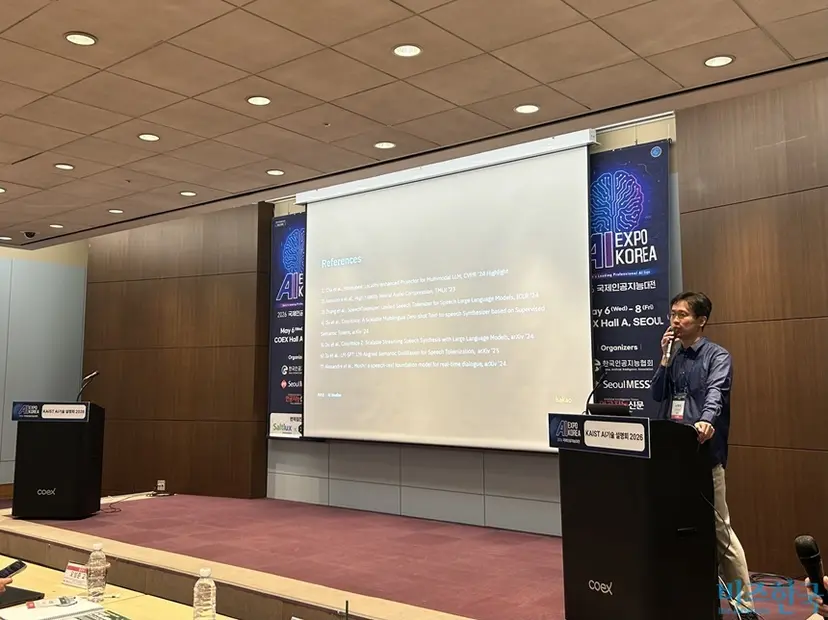
Noh Byung-seok, Leader of the Unified Foundation Model Studio at Kakao035720, made this remark while introducing Kakao’s latest multimodal AI development trends during a keynote speech at the ‘KAIST AI Technology Briefing 2026’ held at COEX in Seoul on the 7th. As the generative AI race moves beyond the text-centric stage into a multimodal era where systems simultaneously understand and respond to visual and auditory information, Kakao appears to be accelerating the advancement of its proprietary integrated AI model.
The Combination of 'V' and 'A'… Implementing Real-Time Multimodal AI
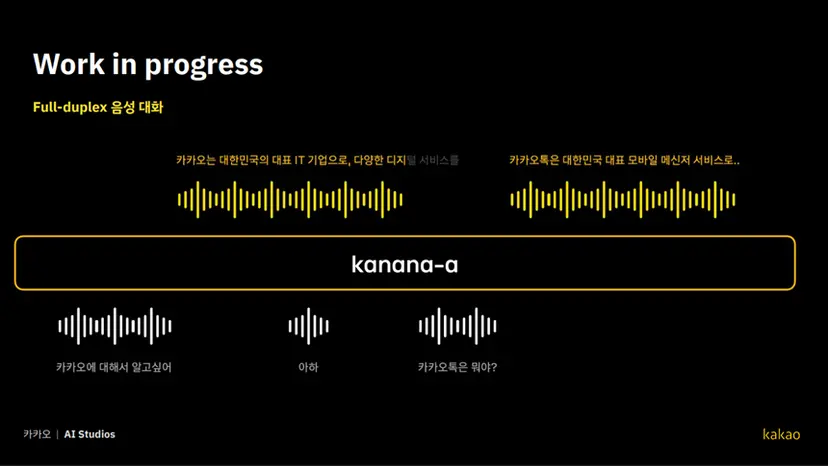
‘Kanana-o’, currently being developed by Kakao, is an integrated multimodal language model capable of simultaneously understanding and responding to text, audio, and images. It is a fusion of the existing image-specialized model ‘Kanana-v’ and the audio understanding/generation model ‘Kanana-a’.
Leader Noh explained, "We had been developing a vision model that understands text and images, and a model that understands and generates audio, separately. Since both models share the same LLM-based architecture, we were able to efficiently integrate them through model merging."
Kakao has been enhancing the model's technical maturity through a Closed Beta Test (CBT) of the Kanana-o API, which has been running for three months since February 27th. In particular, the team focused on reducing the latency experienced by users during voice responses. Leader Noh stated, "In the previous method, the entire response had to be generated before it could be heard as audio, forcing the user to wait. By switching to a streaming method, we reduced the waiting time to hear the first sound from 1.5 seconds to 0.5 seconds, a three-fold improvement."
Proprietary technology to increase voice generation efficiency was also introduced. Kakao has developed and applied ‘LMSPT’, its own tokenizer technology that compresses and converts audio into units that are easy for AI to process. The company claims this technology has boosted voice generation speed by approximately six times compared to previous versions.
The lecture also touched upon the image processing method of the multimodal model. Typically, when AI models process high-resolution images, they reduce the image size or divide it into multiple segments, which can lead to a loss of detail. Kakao revealed it is developing a ‘native resolution’ approach that processes images while maintaining their original resolution, thereby improving performance in understanding detailed visual information such as documents and charts.
Co-hosted by the KAIST Kim Jaechul Graduate School of AI, the Seongnam Industry Promotion Agency, and the Seoul Metropolitan Government, this technology briefing was held on the second day of the three-day ‘AI Expo Korea’ which began on the 6th. The event showcased major AI research achievements and the latest artificial intelligence technologies spreading into industrial fields to both the industry and the general public.
Becoming the Sensory Organs of ‘Agentic AI’
Kakao’s multimodal technology is expected to become one of the core foundations of its future AI strategy. Based on its proprietary ‘Kanana’ AI model, Kakao is not only expanding various AI features within KakaoTalk but is also seeking to evolve beyond a messenger into an ‘Agentic AI platform.’ Earlier that morning, during Kakao’s Q1 earnings conference call, Kakao CEO Jung Shin-a also announced, "We plan to unveil ‘Kanana 2.5’, a model optimized for Agentic AI."
Agentic AI refers to AI that goes beyond simple Q&A to understand user intent and autonomously perform various tasks. Analysts suggest that Kanana-o will effectively act as the ‘sensory organs’ for this strategy.
Because it can simultaneously perceive text, audio, and images, it has high potential for expansion into features such as AI mates, conversational search, content recommendations, and real-time summarization or interpretation. If visual and auditory information can be processed in real-time, the AI can perceive and respond to the user’s environment in a more multi-dimensional way. Multimodal capabilities are becoming increasingly critical, especially given the growing proportion of voice and image-based interactions in mobile messenger environments.
Leader Noh remarked, "We are conducting training in a way that utilizes integrated data, including images and audio, to comprehensively process and respond while navigating between different types of sensory information."
"AI Understands Hodori, Too": Emphasis on Korean Culture and Sentiment
Kakao is also emphasizing its understanding of Korean culture and sentiment as a key differentiator from global models. Recently, global AI companies have been evolving toward providing information tailored to local contexts rather than avoiding sensitive national or cultural topics.
At the event, a case of generating a podcast scenario on the topic of Dokdo was demonstrated. Kanana-o constructed a podcast-style conversation by reflecting the historical and cultural significance of Dokdo in Korean society and its symbolic value regarding territorial sovereignty.
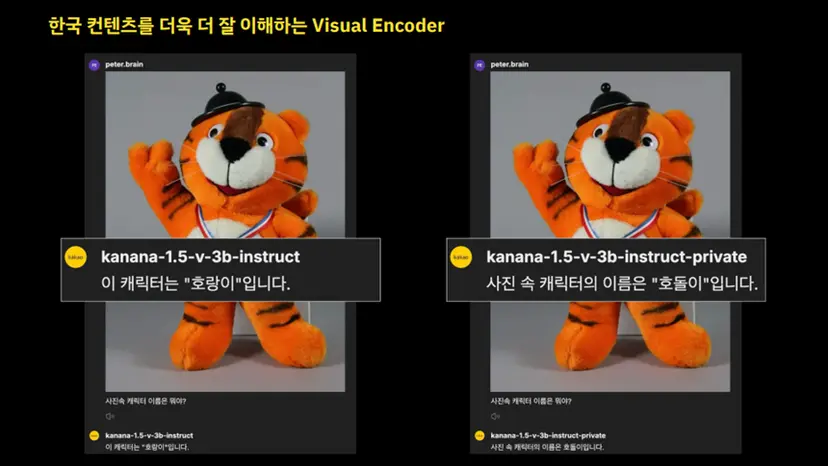
Leader Noh cited an example, saying, "In the past, vision models (visual intelligence) remained at the level of recognizing an image of Hodori as just a 'tiger.' However, by training the model further on Korean content, it can now understand the specific name 'Hodori' and its cultural context." He added, "We intend to develop this into a true, integrated multimodal AI capable of freely understanding and expressing the various forms of data that exist in the world."
During the morning keynote, Professor Shin Jin-woo and Associate Professor Oh Sung-jun from the KAIST Kim Jaechul Graduate School of AI delivered presentations on Robot Foundation Models and Personalized AI, respectively. Jung Song, Dean of the KAIST Kim Jaechul Graduate School of AI, stated, "As the competition for AI technology intensifies globally, we host this event every year to allow domestic industries and research institutions to share technical trends and seek opportunities for collaboration," adding, "We are committed to contributing to the development of the domestic AI ecosystem."