

[비즈한국] There is an award often referred to as a barometer for the Nobel Prize: the Breakthrough Prize. Silicon Valley executives present this award, along with a generous cash prize, to scientists who have contributed to the advancement of science. It is said that winning this award is a precursor to winning a Nobel Prize within a few years.
This year, the award was given to the physicists who led the so-called Muon g-2 experiment at the Large Hadron Collider. Fermi National Accelerator Laboratory (Fermilab), where Professor Young-Kee Kim of the University of Chicago served as director, was also recognized. This is wonderful news.
The chaos occurring in the incredibly small microscopic world may be an unexpected hint toward dark matter, a long-unsolved mystery of the universe. The unsolved secrets of the vast macro-cosmos might be hidden within this tiny micro-cosmos. Every time we step beyond the cosmos, we encounter a strange, new cosmos at an entirely different scale. So, what secrets are hidden within the Muon g-2 experiment, the star of this year's Breakthrough Prize?
After the discovery of the Higgs boson, many thought, "Have we found almost all the really important particles?" The Standard Model fits so perfectly, and experiments are becoming increasingly precise, yet no new particles appear. Perhaps the era of great discoveries in particle physics has ended. However, in 2021, one tiny particle excited physicists around the world once again. The particle's name is the muon.
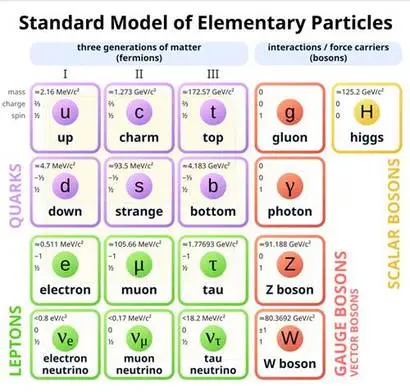
The muon is like a heavy cousin to the electron. It shares the same charge and spin as the electron, and many of its properties are very similar. Crucially, however, it is much heavier—about 200 times heavier than an electron. It is also highly unstable. A muon does not live forever; it exists for only about one-millionth of a second before decaying into other particles.
Muons are also created naturally in space. When high-energy particles called cosmic rays collide with the Earth's atmosphere, muons are produced in the process. At this very moment, countless muons are being created and disappearing in our atmosphere. They simply appear and vanish suddenly because their lifespan is too short. At first glance, they might seem like insignificant particles. So why are scientists so obsessed with particles that disappear so quickly? It is because the muon is a particle that is highly sensitive to the empty space of the universe.
The empty space we usually think of is a vacuum with nothing in it. However, from the perspective of quantum mechanics, a vacuum is never truly empty. A vacuum is like an invisible quantum soup. Within it, particles and antiparticles are constantly popping in and out of existence for a fleeting moment. Electrons and positrons can appear and vanish, photons can appear and disappear, and more complexly, quark-antiquark pairs can momentarily emerge and annihilate. The muon passes through this quantum soup and is affected by it. Electrons are also affected, but since muons are much heavier than electrons, they are more sensitive. Thus, the muon acts like a probe that tells us what ingredients are inside that invisible soup.
Particles like electrons or muons possess a quantum mechanical property called spin. Spin does not mean the particle is literally spinning like a top, but it creates an effect similar to a small rotation. When a charged particle has spin, it acts like a tiny bar magnet; in other words, it has a magnetic moment. To put it crudely, a muon is a tiny magnet. Therefore, when placed in a strong magnetic field, the direction of that tiny magnet wobbles. If you spin a top, you can see the axis wobbling slowly rather than standing perfectly straight. This is called precession. The muon wobbles similarly within a magnetic field. The value representing this level of wobbling is called 'g'.
According to Dirac's theory from the 1930s, the g-value of a spin-1/2 particle like an electron or muon should be exactly 2. At the time, the theory predicted the magnetic properties of fundamental particles with charge and spin as a clean number of 2, without assuming complex internal structures. However, the cosmos always exceeds our expectations. In 1948, scientists measured the electron's g-value with great precision. The result was not exactly 2; it was about 2.00238. It was slightly larger than 2. The difference was only about 0.1 percent, but in physics, it is a difference that cannot be dismissed as an error. This is where Quantum Electrodynamics (QED) enters the picture.
According to QED, an electron is not alone. The vacuum around the electron is surrounded by a cloud of particles that momentarily pop in and out of existence. The electric field near an electron is very strong, and that energy can create particle-antiparticle pairs for a brief moment. Electron-positron pairs appear and vanish, and photons are emitted and reabsorbed. In the subatomic world, the space around an electron or muon can look like a forest flickering with fireflies. Particles appear and disappear, and their brief existence slightly alters the original particle's magnetic properties. That is why 'g' is not exactly 2. It is slightly larger.
Scientists call this small excess the 'anomalous magnetic moment.' In mathematical terms, it is usually written as a=(g-2)/2. It is literally the value of g minus 2, divided by 2. This is where the name 'Muon g-2' comes from. How much g deviates from 2 shows how the muon interacts with the surrounding quantum vacuum. And that quantum vacuum contains the effects of all particles included in the Standard Model. Photons, electrons, positrons, W bosons, Z bosons, quarks, and gluons all contribute slightly.
The Brookhaven National Laboratory measured the muon's g-2 value with great precision in the 1990s and early 2000s. It was almost perfectly consistent with Standard Model calculations; almost every digit matched. However, there was a difference at the very bottom, around the eighth or ninth decimal place. In daily life, this is an absurdly small difference—comparable to a difference of 10-30 cm when predicting the circumference of the Earth. But in particle physics, such a difference cannot be ignored.
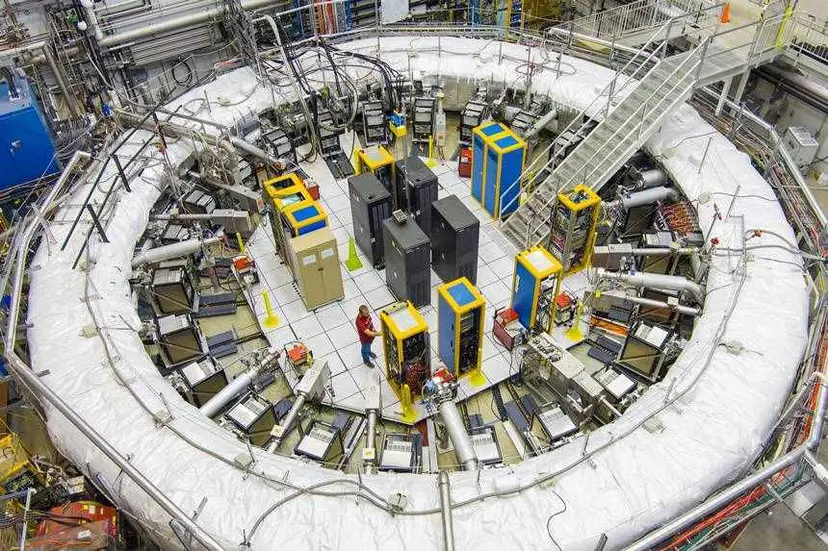
Fermilab's experiment reused the massive magnetic storage ring from Brookhaven. This ring is a huge circular device 50 feet, or about 15 meters, in diameter. To move this device from Brookhaven National Laboratory on Long Island to Fermilab in Batavia, Illinois, researchers did not travel directly overland because the equipment was too large and sensitive. Instead, it was transported by sea and river, and finally carried to Fermilab on a giant truck.

Fermilab creates high-energy muons and injects them into a circular ring with a strong magnetic field. As the muons circle the ring, they wobble due to the magnetic field. The frequency of this wobble, or the precession speed, reveals the muon's magnetic moment. However, muons do not live long; they decay after about one-millionth of a second. Although they can circle the ring hundreds of times in that short time, they eventually decay into particles like electrons or positrons. Detectors around the experimental device measure the energy and direction of the particles coming from these decays, and then use that information to infer how the original muon wobbled.
This experiment must be extremely precise. Even a tiny difference in the magnetic field won't do. Even the slightest jitter in the detector's time measurement won't do. The shape of the muon beam, electric field corrections, vertical oscillations, and systematic errors must all be controlled. That is why the Muon g-2 experiment at Fermilab was conducted in a blind manner.
Fermilab's first results in 2021 were well in line with the Brookhaven results. Both the Fermilab and Brookhaven results showed a difference of about 4.2 sigma compared to the representative theoretical values of the Standard Model at the time! While it was not the 5-sigma required to be recognized as a new discovery, the difference was clearly too significant to ignore. What does this unresolved gap mean?
Another interesting concept emerges here: the leptoquark. Usually, leptons and quarks are considered different types of particles. Electrons and muons are leptons, fundamental particles not affected by the strong nuclear force. Quarks are fundamental particles that make up protons and neutrons. However, a leptoquark is a hypothetical particle that possesses the properties of both simultaneously. The quantum revolution, which made the distinction between particle and wave meaningless, is once again attempting to blur the boundaries between leptons and quarks within the Standard Model. It is a thought that makes one shudder to imagine what other bizarre entities might be hidden beyond this cosmos. If this hypothetical particle truly exists, it could treat electrons and muons somewhat unfairly during the decay process.
In the Standard Model, there is a principle called 'lepton universality.' It is the idea that while electrons, muons, and taus have different masses, their fundamental interaction methods should be the same. Therefore, excluding specific mass effects, the ratio of a process going toward electron pairs should be the same as the ratio toward muon pairs. However, the analysis of LHCb data from the Large Hadron Collider unexpectedly showed an imbalance. There were fewer decays into muons than electrons. It was not 1 to 1; the decay into muons was about 0.8.
If this is true, it means that for some reason, the universe treats electrons and muons differently. It should prefer favoring electrons and creating more of them. But this is difficult to understand within the existing Standard Model. Therefore, interpretations have even emerged suggesting it could be due to another 'fifth force' that transcends the existing four fundamental forces.
It is already known that the Standard Model is not complete. The Standard Model cannot explain dark matter. It also cannot explain why there is so much matter and almost no antimatter in the universe. Why the Higgs boson is so light also remains a deep mystery. We do not yet fully know how forces are unified at high energies. That is why physicists believe that new physics must exist somewhere. They just don't know where or in what form it will be revealed. The Muon g-2 experiment was an experiment that opened one door to that possibility.
Reference
https://muon-g-2.fnal.gov/
About the author: Ji Woong-bae loves cats and the universe. After watching 'Galaxy Express 999' as a child, he dreamt of sharing the beauty of the universe. He is currently an assistant professor at the College of Liberal Arts at Sejong University, participating in various science communication activities such as lectures and writing. He has authored books such as 'A Piece of the Universe Every Day', 'Scientists in the Starry Universe', 'Cannot Go But Can Know', and 'Strange Questions That Come to Mind When Looking at the Universe', and translated books including 'The Hitchhiker's Guide to the Real Universe', 'How I Killed Pluto', 'Quantum Life', and 'Cosmigraphics'.