

[비즈한국] The leading domestic bio-health industry convention, ‘BIO KOREA 2026,’ successfully concluded at COEX in Seoul on the 30th of last month. This year’s event was bustling with industry professionals looking to gauge the future of the pharmaceutical and bio-industry, including AI drug discovery, lab automation, and next-generation cell therapies. Amid intense global technical competition and the emergence of drug development speed and efficiency as core industrial challenges, visitor interest in the technologies and platforms presented by domestic companies was higher than ever.
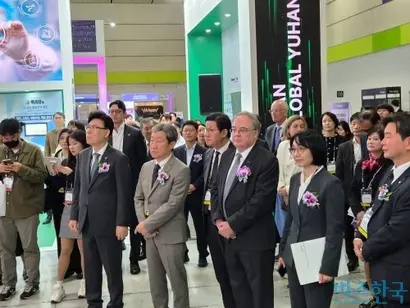
Notably, the VIP tour during the opening ceremony saw visits not only to major domestic pharmaceutical and bio-companies such as Yuhan000100 and ST Pharm237690, but also to technology-based bio-ventures like Arontier, Able Labs, and Lucas Bio. These companies drew attention at the site by spearheading key topics in the pharmaceutical bio-industry: AI drug discovery, lab automation, and universal cell therapy. Bizhankook examined the competitiveness and future vision of these three companies as identified at BIO KOREA 2026.
Arontier: “Expanding domains including small molecules, antibodies, ADC, and mRNA through multi-modality strategy”
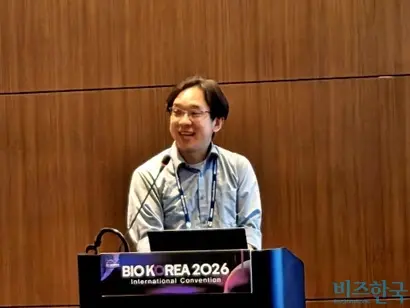
To solve the data scarcity problem always faced when developing new drugs with new strategies, Arontier is developing an AI-based drug discovery platform that iteratively fuses actual experimental data after applying classical computational chemistry and physical calculations. The company is accumulating design capabilities to handle various modalities, ranging from small-molecule compounds to antibodies, peptides, ADCs (Antibody-Drug Conjugates), and mRNA (messenger RNA). Arontier is actively collaborating with hospitals like Seoul National University Hospital, Asan Medical Center, and Samsung Medical Center, as well as companies such as Celltrion068270, Huons243070, Dongkook Pharmaceutical086450, Samjin Pharmaceutical, Neuracle Science, Theragen Bio, and HLB Panagene.
Ko Jun-soo, CEO of Arontier, emphasized that the future of AI drug discovery companies should extend beyond merely predicting the binding affinity of drug candidates to more comprehensive multi-modal applications. CEO Ko explained, “As an AI drug discovery company, we determined that supporting the drug development strategies of our partners is more important than just designing and verifying drugs ourselves. From that perspective, we are introducing 2-3 AI models necessary for developing diverse platforms every year.”
Arontier supports its partners by building an AI platform that covers the entire drug discovery process, from target identification to drug design and biomarker discovery. It operates ‘REMEDY,’ which explores new targets and drug candidates using multi-omics technology; ‘DRUG DESIGNER,’ for fast and accurate small-molecule compound design; and ‘PATH,’ an AI biomarker platform that classifies tumor microenvironments based on pathology images. Additionally, it features ‘PROTEIN DESIGNER,’ which assists in antibody, peptide, and artificial protein design, and ‘mRNA DESIGNER,’ which supports the design of personalized neoantigen cancer vaccines.
Able Labs: “Boosting productivity by 30%… Participating in national project to build AI autonomous labs with Arontier”
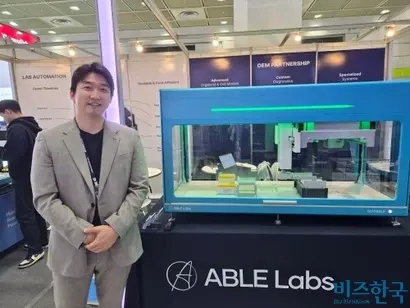
Able Labs is at the forefront of breaking through bottlenecks in the traditional, manual-heavy drug development process through automation technology. The company’s equipment automates tricky pre-treatment processes that are most prone to human error. It is being recognized as a leader in lab automation with its liquid handling automation robots ‘Notable’ and ‘Suitable,’ which precisely aspirate and dispense micro-liter (μL) units of liquid used in bio-experiments.
Meeting at the event, Shin Sang, CEO of Able Labs, expressed confidence in the innovation that automated equipment will bring to pharmaceutical R&D. CEO Shin stated, “Through the automation of research processes, the time and cost required for research can be reduced by about 30-40%, and overall research productivity can be boosted by more than 30%.”
Able Labs has already built a reference base by supplying automated equipment to over 40 major domestic pharmaceutical and bio-companies. CEO Shin revealed, “Automated robot infrastructure is serving as the hardware layer for physical AI, and we have also proven our control layer technology that precisely manages it. We are now self-developing an ‘AI brain’ capable of controlling and making judgments,” forecasting the company's evolution into an intelligent robot company that builds physical AI.
Notably, Able Labs has teamed up with Arontier to build an AI autonomous lab ecosystem. The two companies are participating in the Ministry of Trade, Industry and Energy’s ‘AI-based Target-Specific Drug Manufacturing Autonomous Lab Technology Development Project,’ hosted by the Osong Medical Innovation Foundation. This project, which will run until 2029, aims to develop an AI autonomous lab system and secure the competitiveness of domestic companies in manufacturing next-generation modality drugs through manufacturing verification. The project is planned to proceed by having Arontier’s AI precisely design the optimal ADC drug candidate for the purpose, while Able Labs’ intelligent robots automatically perform precision verification experiments around the clock without breaks.
Lucas Bio: “Developing mass-producible T-cell therapies with the goal of responding to the next pandemic”
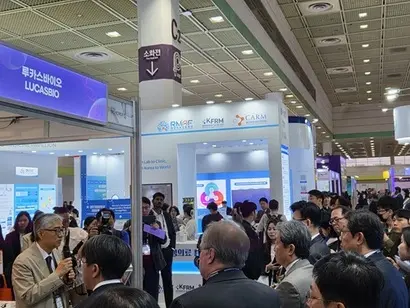
Next-generation cell therapy specialist Lucas Bio is taking on the challenge of building a universal, off-the-shelf therapy system that can be mass-produced using cells from healthy individuals. Because CAR-T (Chimeric Antigen Receptor T-cell) therapies, which are customized for individual patients, are produced through genetic modification, annual treatment costs reach hundreds of millions of won.
Cho Seok-gu, CEO of Lucas Bio, expressed his ambition to lead the popularization of cell therapies by simplifying manufacturing processes and building a low-cost, high-efficiency production system through multi-antigen virus-specific cell therapies. CEO Cho stated, “While many new drugs have emerged recently, there is a problem with frequent viral infections in the elderly with significantly weakened immunity. We recognized that memory T-cell therapy targeting these viral infectious diseases is important.”
Lucas Bio possesses three platforms: LB-DTK, LB-CIK, and LB-DSC. Among them, LB-DTK is a platform that can be applied to mutant viruses, immunocompromised patients, and the treatment of intractable infectious diseases. By manufacturing T-cells to have an immune response to two or more viral antigens, clinical trials are currently underway for diseases such as CMV retinitis (autologous), BKV hemorrhagic cystitis (allogeneic), BKV nephropathy (autologous), EBV lymphoproliferative disease (autologous), and COVID-19.
A Lucas Bio representative emphasized, “While CAR-T and iPSC (induced pluripotent stem cells) are mainly mentioned as cell therapies recently, we will definitively solve the unmet needs of rare and intractable diseases, such as cancer patients experiencing fatal viral infections during chemotherapy or pediatric patients suffering from hemorrhagic cystitis, through our multi-antigen specific platform capable of targeting multiple viruses at once.”
The LB-DTK platform is also gathering expectations as a weapon to respond to a potential next pandemic. A Lucas Bio representative revealed, “Since memory T-cells react within the body for 3-5 years once injected, we expect them to even function as vaccines. We are currently conducting research targeting animal influenza, mutant coronaviruses, and SFTS (Severe Fever with Thrombocytopenia Syndrome) virus, which are considered candidates for the next pandemic.”