

[비즈한국] Something strange is happening all over downtown Seoul. In large apartment complexes with over 1,000 households, there is not a single Jeonse (lump-sum housing lease) listing. The same goes for monthly rentals. The rental boards that would have displayed dozens of listings in the past are now completely empty. If this were a temporary phenomenon, it might be manageable. However, the seriousness of the issue lies in the fact that this 'void' is becoming structurally solidified.
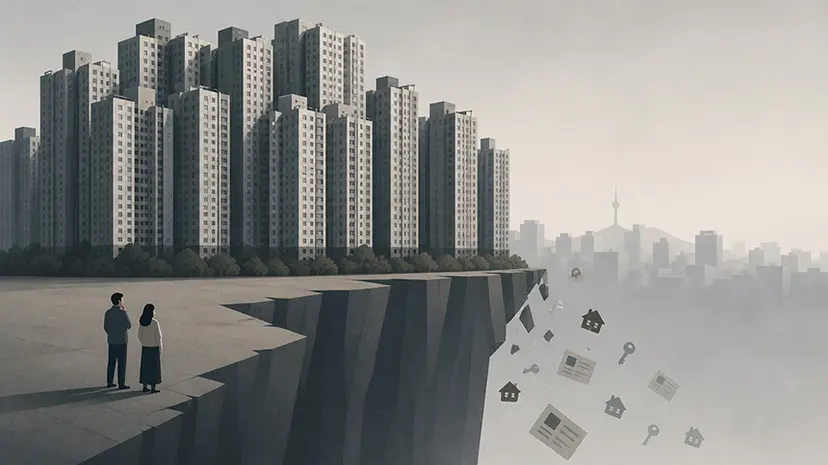
Listings are evaporating
No matter which real estate information platform you open, the scene is the same. Jeonse and monthly rental listings are disappearing from large apartment complexes in major areas of Seoul. In the past, there were times when an influx of new residents led to a surplus of Jeonse listings, making it difficult for landlords to find tenants. It feels as if those days were only a few years ago. Now, it is the opposite. Tenants cannot find properties to rent.
The statistics are cold. The volume of Jeonse transactions in the Seoul metropolitan area is showing a clear downward trend. It is not that supply has decreased; it is that the properties themselves are not appearing on the market. Why? Because structural causes are working in tandem.
First, the expansion of Land Transaction Permit Zones. The government and the Seoul Metropolitan Government have steadily expanded these zones under the pretext of curbing speculation. If you purchase an apartment within these zones, you are obligated to reside in it yourself. In other words, if you buy a house, you must live in it. You cannot lease it out. It is a structure where every time a trade occurs, one potential rental property is removed from the market. The more active the sales market becomes, the faster the rental market shrinks. An ironic situation is unfolding where regulations are choking the market.
Second, the sharp decline in new move-in supplies. The rapid rise in interest rates from 2021 to 2022 led to a sharp decrease in building permits, and that impact is now materializing as a decline in move-in supplies. Construction companies are hesitant to even break ground due to high interest rates and rising raw material costs. There is a continuous stream of sites where units were sold but construction has not started, or construction has started but completion is delayed. Since new apartments are not being supplied, there is no exit for the demand from the existing rental market to disperse.
Third, structural changes during the process of contracts with exhausted renewal claims returning to the market. Following the implementation of the three laws on leasehold, the time has come for a large number of tenants who have used their one-time renewal claim to conclude their contracts. Landlords are using this timing to either switch to personal occupancy or increase the proportion of conversions to monthly rent. A double void is emerging where Jeonse listings are decreasing and monthly rental listings are not being sufficiently supplied.
The structural extinction of Jeonse and the counterattack of monthly rent
Jeonse is a unique Korean form of leasehold. This method, where a tenant entrusts a large sum of money to the landlord and obtains residence rights instead of paying interest, was a rational choice for both landlords and tenants during the era of high growth. As house prices rose, landlords used Jeonse deposits like 'interest-free loans,' and tenants could settle their housing needs without monthly out-of-pocket expenses.
However, this structure is faltering. In an era of low interest rates, landlords who had no suitable way to manage Jeonse deposits began to prefer monthly rent. Conversely, in a high-interest environment, tenants facing the burden of Jeonse loan interest are tending to choose monthly rent. The position of Jeonse is shrinking from both the demand and supply sides.
Jeonse was a Korean-style housing ladder. That ladder is breaking. The stepping stone for non-homeowners who cannot afford to buy a house is disappearing.
The acceleration of conversion to monthly rent does not solve the problem. The burden of monthly rent means an increase in living costs. Survey results show that the monthly rent burden for office workers in the metropolitan area is nearing 30–40% of their income. If housing costs exceed this level, disposable income disappears, which becomes a cause for giving up on marriage and childbirth. It has long been common knowledge among experts that the low birth rate issue is directly linked to housing instability. Yet, policies are failing to keep up.
The illusion of 1.27 million units, the phantom supply of 2030
The government ambitiously announced a supply plan for 1.27 million units in the metropolitan area. If you only look at the numbers, it looks like a massive supply. However, looking at the reality of this plan leads to a sense of futility. The target for starting construction is 2030. It means that they will only 'start digging the ground' four years from now. It will take several more years after that for completion.
For tenants who have to pack up and leave in the current Jeonse and monthly rental market, a 2030 groundbreaking means nothing. For people worried about contract renewals next year or the year after, telling them they can 'move into a new apartment in 2035' is more like mockery than comfort.
There is a more fundamental problem. It is doubtful whether the 1.27 million units can be supplied as planned. Urban renewal projects are becoming increasingly difficult. For reconstruction and redevelopment projects, the average project period has long exceeded 10 years due to conflicts between union members, disputes over contractor selection, delays in permits, and the burden of relocation costs. The number of canceled renewal project zones is also increasing. In areas without profitability, the private sector does not step in.
New renewal methods like 'Sintong Planning' (Rapid Integrated Planning) and 'Moa Town' are being introduced, but these also take time. While the goal is to shorten administrative procedures and complete projects within 5–7 years, in reality, even this is rarely smooth. The target years for construction starts are rarely met according to plan.
The same applies to public housing site supplies. In the case of the 3rd new towns, it took over 10 years from announcement to move-in. New towns without complete transportation networks fail to be chosen by demanders. No matter how large the supply numbers are, if they are not 'work-housing proximity urban homes' that real users want, it is difficult to fill the supply void in the market.
The problem with policy orientation: demand suppression vs. supply expansion
A chronic disease of Korean real estate policy is the 'bias toward demand suppression.' When house prices rise, all kinds of taxes and regulations are poured out under the pretense of blocking speculative demand. They tighten loans, raise acquisition taxes, strengthen capital gains taxes, and designate Land Transaction Permit Zones. It is politically effective. This is because the message of 'hitting speculators' resonates with public opinion.
However, the side effects of demand suppression measures have always appeared in the rental market. When landlords choose to switch to personal residency or withdraw listings, it is the tenants without homes who suffer. If multi-homeowners are squeezed, rental supply decreases. During periods of rising house prices, landlords raise Jeonse deposits. Either way, tenants must share the pain. The paradox that demand suppression policies do not protect tenants, but rather make them more vulnerable, has been repeated.
The more they tried to control house prices through regulations, the more the damage returned to the homeless. The current government is repeating this mistake that previous administrations have made repeatedly.
That supply expansion is the answer has now become a common perception among experts regardless of their political stance. The problem is that it is just talk. For supply expansion, deregulation, ensuring profitability, and improving the speed of permits must follow. However, concerns that lifting regulations could create other side effects, the logic of protecting vested interests, and administrative convenience are intertwined, making substantial reform sluggish.
Take the relaxation of floor-area ratio regulations, for example. In 1st generation new town reconstructions, significantly increasing the floor-area ratio would increase new housing supply and improve profitability for existing residents. However, counter-arguments such as "scenery will be ruined if the number of floors increases" and controversy over fairness like "aren't only existing residents benefiting?" become tangled. In the end, they compromise in the middle, and the supply effect is halved.
The future of the rental market: three scenarios
If the current situation continues, what will the future of the rental market look like? We can assume three paths.
The first is the 'fixation of holding out' scenario. In a situation where supply shortages continue and Jeonse/monthly rent prices steadily rise. Demanders are forced to move to further outskirts, bear excessive housing costs, or lower their standard of living. The overall quality of life in society declines, and the number of areas experiencing accelerated population outflow increases. This scenario is the most likely given the current trend.
The second is the 'Jeonse extinction, monthly rent normalization' scenario. The Jeonse system effectively disappears and the rental market is reorganized around monthly rent. It is a structure where monthly rent settles as the general form of leasehold, like in Europe or Japan. In this case, a shock of significantly increased housing cost burdens is inevitable in the short term. For the monthly rental market to stabilize, sufficient rental housing supply must be a prerequisite, and the extinction of Jeonse without that guarantee leads directly to housing instability.
The third is the 'policy shift and market normalization' scenario. The government substantially commits to supply expansion, moves away from regulation-only policies, and changes its stance to restore incentives for rental businesses. This leads to the recovery of rental listings, stabilization of Jeonse prices, and increased housing mobility. However, for this scenario to be realized, political decision-making is needed. Policies that look to the future must emerge, not policies conscious of votes.
Things that must be done right now
The market does not have the luxury to find a solution on its own. The government must move, and it must move right now.
The criteria for designating Land Transaction Permit Zones must be reviewed. The current method, which recklessly maintains zones where the anti-speculation effect has not been verified while only killing off rental listings, needs to be corrected. At a minimum, the method of applying residency obligations to newly purchased homes must be operated flexibly.
Tax incentives for private rental supply must be restored. Since the rental business registration system effectively became meaningless, the foundation for private rental supply has been shaking. The system needs to be overhauled to provide tax benefits on the condition of maintaining rentals for a certain period and to design appropriate compensation for contract renewals.
The speed of permitting for renewal projects must be dramatically increased. The current administrative system, which takes years just for document review, must be reformed. The fast-track system must be operated in reality, not just in form. If the project period can be shortened, construction cost burdens can be reduced, and pre-sale prices can also be lowered.
Public rental supply must also run in parallel. The public sector must fill the shortfall in private rental supply. However, the location and quality are key for public rental. Public rentals on the outskirts with inconvenient transportation and lack of living infrastructure are shunned by users. Creative plans are needed to increase public rental supply within the downtown area. Complex development of existing public buildings and the expansion of small-scale public rentals near subway stations should be actively considered.
Policy is also responsible
The collapse of the Jeonse and monthly rental market is not a disaster that arrived suddenly. It is a foretold crisis. Experts have been warning about it for years. That if the decrease in move-in supplies, expansion of Land Transaction Permit Zones, damage to the rental business system, and delays in renewal projects were combined, this situation would inevitably occur. The result of ignoring those warnings is the '0 Jeonse, 0 monthly rent' complexes of today.
Policies are not judged by intentions alone. They are judged by results. No matter how noble the intention to catch speculation, if tenants have to pay higher monthly rents and live in poorer conditions, that policy is a failure. No matter how flashy the slogans about stabilizing housing for the working class are, if there are no properties on the market, it is nothing more than empty words.
The government must face reality even now. The rental market is currently in an emergency state. Behind the numbers, there are people staying in tiny rooms because they cannot find a home, and families looking for a place to move because they don't have the capacity to raise the Jeonse deposit. If policy does not respond to their pain, it is a dereliction of duty.
Supply takes time. But the decision to change the course can be made today. The longer that decision is delayed, the more the damage remains solely the tenants' burden.
A country where there isn't a single Jeonse listing in a large complex of 1,000 households. This is the current reality of the rental market in South Korea.
※ Kim Hak-ryeol, the head of the Smart Tube Real Estate Research Institute, famous for his pen name 'Pashong', served as a team leader at the Gallup Korea Real Estate Research Center. He operates and hosts the Naver blog 'Pashong's World Exploration' and the YouTube channel 'Stew TV'. His books include '3040 Real Estate Beginners First Real Estate Investment (2026)', 'South Korea Real Estate User Manual (2025)', 'The Power of Gyeonggi Real Estate (2024)', 'Absolute Principles of Seoul Real Estate (2023)', 'The Future of Incheon Real Estate (2022)', 'Kim Hak-ryeol's Absolute Principles of Real Estate Investment (2022)', 'Future Map of South Korean Real Estate (2021)', and 'From Now On, Only Places That Rise Will Rise (2020)'.