

[비즈한국] A post on the financial structure by Kim Yong-beom, Policy Chief of the Presidential Office, on his personal social media is garnering significant attention. As he directly highlights the concept of 'cruel finance,' market observers are focused on the possibility that this may lead to strengthened policy responses from financial authorities. While inclusive finance and the expansion of mid-interest rate loans are already being pursued, the banking sector is expected to become even busier in its response to these upcoming policies.
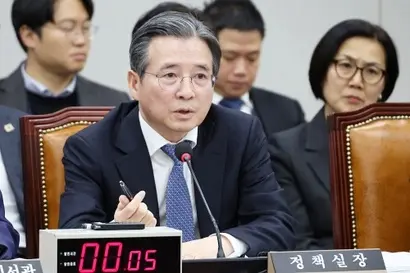
The market's attention is focused on the post about financial structure shared by Kim Yong-beom, Policy Chief of the Presidential Office, on his personal social media. From the 2nd to the 3rd, Chief Kim posted three consecutive articles on Facebook reflecting on the financial structure and criticizing current credit evaluation methods.
In the first post titled, 'Why is Korean finance so cruel: The imperfect science of credit ratings,' Chief Kim began by stating, "The President repeatedly asked, 'Why must the most well-off enjoy low interest rates while those in the most desperate need pay the highest interest?' At first, I let out a hollow laugh," before adding, "I am one of the people who designed, operated, and justified this cruel system. I am a clear accomplice."
In subsequent posts, Chief Kim remarked, "Those responsible for causing financial crises often survive through the logic of 'too big to fail' or hide behind the excuse of restructuring, but the backlash is directed at those with low to medium credit. While top-tier ratings enjoy stable funding at low rates, a high-interest cliff awaits those below them," comparing the financial market to a 'donut' with no middle ground.
He criticized, "For banks, the middle ground is a segment that lacks cost-effectiveness. I thought this structure would break with the arrival of fintech, but the instinct for 'avoidance' did not change. Risks are continuous, but finance cuts them off mercilessly. Those pushed outside this boundary wander outside the market, bearing higher costs. This is no coincidence. It is a carefully neglected structural contradiction."
In his final post, Chief Kim proposed three alternatives to change the existing structure. He said, "The purpose of these posts is not to destroy the credit order or argue for irresponsible debt forgiveness. It is to more accurately evaluate the people whom institutional finance has not sufficiently considered," adding, "I may have posed the questions, but the solutions must be provided by financial authorities and the commercial banks, internet banks, and retail financial institutions that have been granted the privilege of a license."
He proposed three ways to change the financial structure: changing banks' loan compositions, innovating credit evaluation, and redefining retail financial institutions. He suggested that if the loan composition—which avoids the middle ground and relies on high-credit individuals—leaves a certain segment empty, it should be changed so that growth becomes difficult under that model. He emphasized that internet-only banks should lead the way in broadening the framework of credit evaluation by utilizing non-financial data, and that retail financial institutions must go beyond relationship-based models to adapt to modern society.
Considered a skilled economic official, Chief Kim Yong-beom is the first Policy Chief of the Presidential Office under the Lee Jae-myung administration and previously served as the First Vice Minister of Economy and Finance under the Moon Jae-in administration. At the Financial Services Commission, he served as Director General of the Capital Markets Bureau, Director General of the Financial Policy Bureau, Secretary General, and the 7th Vice Chairman. After leaving public office in 2022, he served as the CEO of Hashed Open Research, building expertise in the blockchain and virtual asset sectors.
President Lee Jae-myung's remarks on 'cruel finance' date back to a cabinet meeting in September 2025. While receiving a report on retail financial support plans from Deputy Prime Minister and Minister of Economy and Finance Koo Yoon-cheol, President Lee criticized the situation, stating, "Interest for the most desperate is more expensive," and asked, "How can you call this 'retail finance'? Finance seems to be the cruelest area."
A month later, at a policy meeting titled 'People's Voices Become Policy' held in Dongdaemun-gu, Seoul, President Lee pointed out, "Finance categorizes groups with a high probability of default by credit rating and makes them pay higher interest. Finance is too cruel," and demanded improvement measures from Financial Services Commission Chairman Lee Eok-won and Chief Kim.
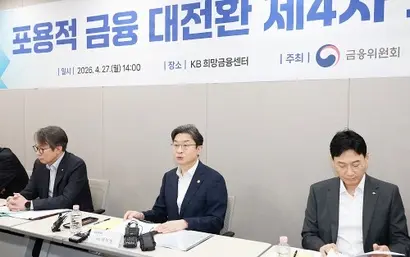
Debate has followed Chief Kim's posts. Above all, with the Lee Jae-myung administration setting inclusive finance and productive finance as core agendas for the financial sector since its inauguration, it is expected that financial authorities will focus on policies related to inclusive finance and mid-interest rate loans. On April 27, the Financial Services Commission held the 4th Inclusive Finance Great Transition Meeting at the KB Finance Hope Center in Dongjak-gu, Seoul, and announced the 'Plan to Revitalize Mid-Interest Rate Loans,' which includes improvements to the 'Saitdol' loan and private mid-interest rate loan systems.
In response to the government's demands, the banking sector is also introducing various inclusive finance measures. At the aforementioned FSC meeting, KB Financial Group presented its 'Inclusive Finance Implementation Plan.' KB Financial will contribute an additional 100 billion won to the KB Miso Finance Foundation to support youth, regional residents, and vulnerable groups, and will expand loan supplies to youth. The plan also includes supply measures for mid-interest rate loans using alternative information and debt adjustment for daily recovery of overdue debtors. KB Financial also stated that as of the first quarter of 2026, the social value it generated, calculated in monetary terms, reached 828.6 billion won. KB Financial stated, "We will faithfully fulfill our role as a financial institution that grows together with the people through continuous social contribution."