

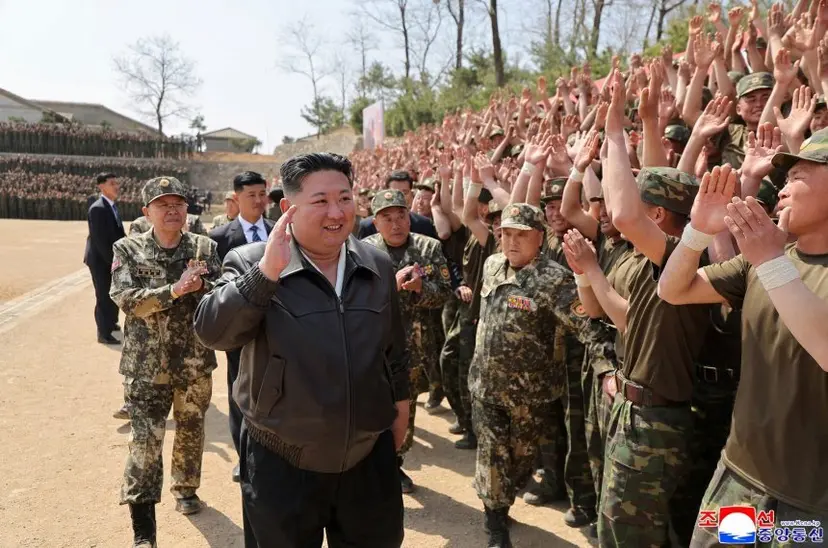
[비즈한국] On April 26, Kim Jong-un attended the opening ceremony of a memorial hall in Pyongyang dedicated to North Korean soldiers who died on the Ukrainian front. The event was attended not only by bereaved families but also by the Russian Minister of Defense and the Speaker of the State Duma. At the ceremony, Kim Jong-un praised the heroes who chose self-destruction and suicide attacks on the front lines without hesitation, calling them the 'pinnacle of our military's loyalty.'
This statement can be considered the first time North Korea has effectively and publicly acknowledged the so-called 'orders for North Korean soldiers to commit suicide,' which intelligence authorities in Ukraine, South Korea, and the United States have been tracking.
Kim Jong-un's remarks bring to mind the shocking testimony of a North Korean prisoner of war that appeared in a documentary titled 'The Russia-Ukraine War and the North Korean Military,' aired by a broadcasting station on January 20. At the time, the prisoner testified that his comrades chose suicide when faced with enemy attacks and no chance of victory, and that Russian and North Korean troops even directly executed wounded soldiers who were at risk of being captured. This once unbelievable testimony has effectively been confirmed by Kim Jong-un's own words.
This incident does not simply mean that North Korean troops possess a strong fighting spirit. Rather, it is a case that demonstrates how solid the 'cognitive barrier of fear' planted in the minds of soldiers by the Pyongyang authorities truly is. The 'gyokusai' (shattered jewel) suicide charges of the Japanese military during the Pacific War are being recreated in the unfamiliar land of Ukraine, now combined with modern technology.
At the base of the suicide acts shown by North Korean deployed units lies extreme brainwashing conducted under the name of an 'indomitable spirit.' Even before deployment, North Korea instills fear in its soldiers, claiming that 'if captured, you will be cruelly tortured and killed, or your families remaining in the homeland will be dragged to political prison camps.' As a result, suicide is transformed for the soldiers not into a choice, but into a final 'military duty' to protect their families left behind.
This phenomenon is structurally identical to the imperial Japanese military's past imposition of the 'Senjinkun' (Field Service Code), which demanded that soldiers 'not suffer the disgrace of being captured alive.' The only difference is that the current North Korean military is experiencing this medieval cognitive control in the middle of a modern war filled with smartphones and drones. This is why Western military experts, including those from the U.S., are shocked, calling them 'Human Landmines.'
Then, how should we interpret these actions by the North Korean military? From the perspective of 'Cognitive Warfare,' which has emerged as a new domain of modern war, this is a battle the Pyongyang authorities have already won. The goal of cognitive warfare is to use the enemy's brain as a battlefield to cloud their judgment or compel specific actions. North Korea has successfully implanted the algorithm that 'capture = destruction' into the brains of its soldiers.
In fact, even when drones on the Ukrainian battlefield broadcast messages encouraging surrender, North Korean soldiers refuse and choose to commit suicide, which means their cognitive systems are closed off to receiving any external 'truth.' This goes beyond simple psychological warfare (PsyOps); it is a state where a 'Cognitive Shield' is in operation.
However, there are no easy countermeasures for such 'extreme cognitive shields' of the enemy. Because this behavior of the North Korean military is not just the result of simple training, but rather a product of 'Lifetime Ideological Control' designed over decades, it is extremely rigid. Furthermore, the internal pressure is significant due to a strong 'Peer Surveillance' system. Moreover, our psychological warfare strategies have so far been separated from the concept of cognitive warfare. Without the means to fundamentally change the enemy's cognitive systems and perceptions, we remain at the level of delivering surrender recommendations and information on the benefits of being captured through conventional media like leaflets or loudspeakers.
An even greater problem is that if our own soldiers directly witness unethical behaviors by North Korean troops, such as suicide charges or the execution of wounded personnel, it could lead to a decline in combat effectiveness due to the shock and tension of real-world combat. In fact, even the U.S. Army War College has pointed out that the critical thinking and individualistic tendencies of today's youth pose a serious challenge to traditional troop education.
So, what should we do? Fortunately, technology and experience are offering new opportunities.
The first opportunity is the growing possibility of piercing the North Korean military's 'cognitive shield.' Contrary to common stereotypes, smartphones have become popular in North Korea, and it has been revealed in the Ukraine war that North Korean troops, imitating Russian forces, use Telegram for command and control or communicate via smartphones. It is worth considering 'precision strike cognitive warfare' technology that utilizes 'multi-domain cognitive warfare'—a combination of cognitive, psychological, and cyber warfare—to infiltrate personal smartphones and deliver customized information. If we develop 'AI-based cyber cognitive warfare' capabilities that analyze and utilize public protocols like 'AirDrop' or 'Quick Share' to collect target personal data and inject AI-processed, customized materials, it would be highly effective.
The second opportunity is to learn lessons from the U.S., which has faced similar enemies. The U.S. has suffered great damage from enemies exhibiting irrational behavior, such as Japanese suicide charges in WWII, the Chinese 'human wave tactics' in the Korean War, and 'suicide terrorism' in the Vietnam War and the War on Terror. In this process, the U.S. military has consistently studied frames for how troops can psychologically respond to such enemies.
The core frame derived by the U.S. military throughout history is 'Tactical Manageability.' They have trained soldiers to understand that an enemy engaging in irrational and fanatical behavior, such as throwing away their own lives, is not an unknown entity but rather a tactical action with predictable patterns that can be countered with firepower and operations.
Additionally, various social psychology studies by the U.S. military have shown that it is effective to logically make it clear that the enemy's suicide charges are not 'noble acts' but evidence of the regime's despair and exploitation, and to introduce the concept of 'Unit Cohesion' when dealing with such enemies. A sense of stability and belonging, derived from a trusting relationship where comrades need each other and can help each other, provides the strength to endure shocking and terrifying enemy actions or crisis situations. This can be implemented not only in wartime but also in peacetime through 'organizational culture improvement,' such as ensuring rationality in unit operations and the swift identification and transparent resolution of problems within units.
As Pyongyang's politics of terror uses the lives of soldiers to stage 'suicide shows' in Ukraine, our path forward is clear. Just as we need a shield to block the enemy's blades, we need a precise scalpel to excise the madness implanted in the enemy's brains. The history of past wars and the technology of the future suggest the possibility of creating a new weapon: the 'combination of psychological warfare and cognitive warfare.' If our military pursues this now, it will become a force as powerful as hypersonic missiles or nuclear submarines.