

[비즈한국] Paradoxically, the semiconductor super-cycle has brought unprecedented tension to the labor-management relations at Samsung Electronics005930. A majority union gained strength while dissatisfaction stemming from compensation gaps compared to competitors exceeded a critical threshold. Having secured the legal status of an employee representative, the union pursues a pragmatic approach, aiming to protect the rights and interests of employees without relying on higher-level labor organizations. Amid record-breaking performance, skepticism regarding compensation principles and the emergence of a new, benefit-oriented union—where will this strike lead as Samsung traverses a path it has never traveled before?
Following the end of Samsung’s 'no-union management' principle that lasted over 50 years, the Samsung Electronics labor union is embarking on its second strike. While the strike in July 2024 held symbolic significance as the first general strike in company history, actual participation was limited to about 5,000 people. The union, which has highlighted profit-sharing and fair compensation between labor and management, says, "This time is different." The current conflict, which erupted during the semiconductor super-cycle, goes beyond a simple labor-management dispute, posing the question to the market and society: "Who should get how much, and how much should they take?"
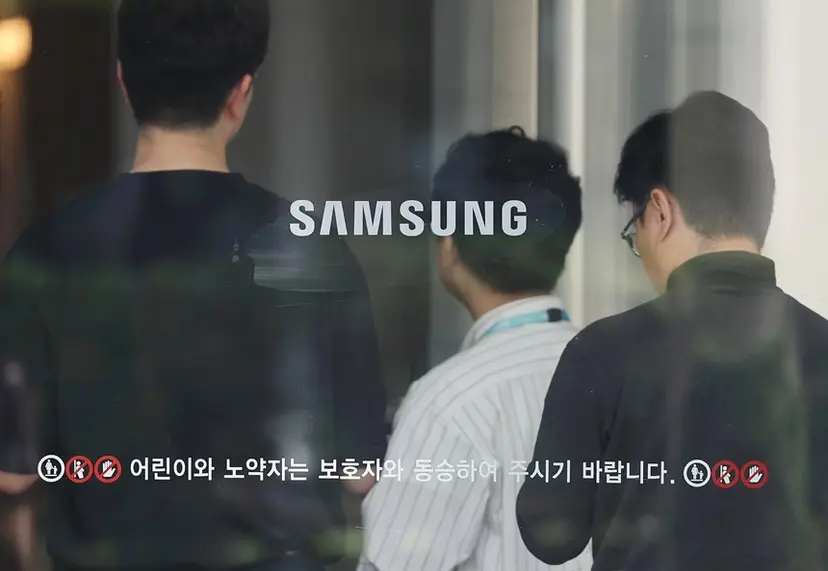
The Rebellion of the 'Perennial No. 2' and Loss of 'Comparative Advantage' are Causes of Conflict
It is assessed that the spark of this conflict began with the moves of its 'rival,' SK Hynix000660. In September last year, SK Hynix's labor and management agreed to use 10% of operating profit as the source for Profit Sharing (PS) and unexpectedly abolished the payment cap, which had previously been fixed at 1000% of the basic salary.
The semiconductor market is a field where an all-out war for talent acquisition takes place on a global scale. While hiring remained stagnant at maintenance levels during the downturn, competition for talent intensified around 2024 due to the surge in demand for High Bandwidth Memory (HBM). Amidst this, when SK Hynix, which secured the lead in the HBM market, announced an unconventional compensation plan, the sense of comparison within Samsung Electronics turned into deprivation. A union member in the Memory Business Division confessed, "In the past, we endured with the pride that 'Samsung is still the best,' but there is a sense of crisis that we have fallen behind in technical prowess and compensation. It is a matter of how our value is assessed in the market."
As rumors spread that SK Hynix's performance bonuses could reach up to 700 million won in line with the semiconductor boom, this atmosphere spread rapidly within Samsung Electronics. Choi Seung-ho, Chairman of the Samsung Group's super-enterprise union Samsung Electronics branch, said, "The main driving force behind members supporting the union is distrust in the compensation system and a sense of deprivation compared to competitors. The perception has built up that even when they achieve results, they are not fairly compensated." The minutes of the first negotiation session in December last year also included the union's statement, "If the performance bonus payment formula is not changed, this year's bonus could end up being only one-eighth of that of our competitors."
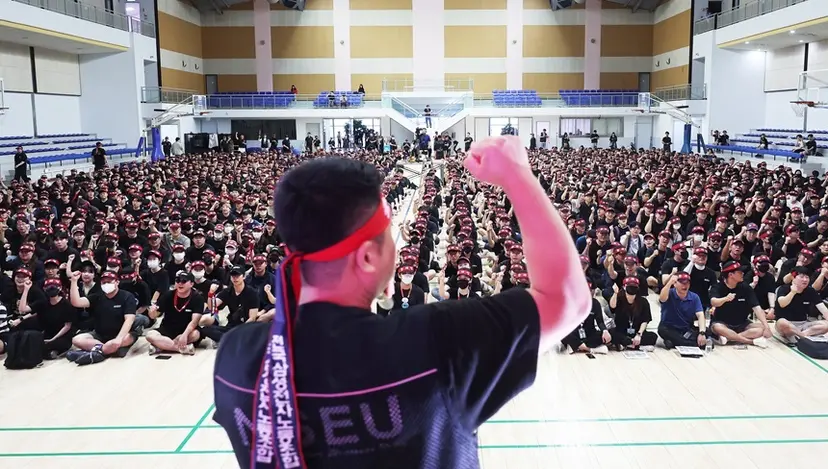
There are also voices saying that the foundation of the conflict is the fact that even after the first strike, the company does not view the union as a substantial dialogue partner. The argument is that the company treats the 'sacrifice' of workers who work in three shifts on semiconductor lines that operate 24/7, 365 days a year, and cannot even use their annual leave freely, as merely a cost.
In negotiations, the union rejected proposals by the management, such as the 'Guinness Condition,' which is only paid when record-breaking operating profits are achieved, or stock-based payment plans. Chairman Choi argued, "The plan to differentiate compensation by rank was judged as an attempt to divide the members. At the last negotiation, they cited this year's operating profit at less than 200 trillion won, which is less than two-thirds of the market forecast of 300 trillion won. It is clearly 'fraudulent negotiation' aimed at lowering the figures to reduce the scale of compensation."
Gap Between Internal Divisions, Alienation of Partners, and Public Sentiment
Amidst the 'strong vs. strong' standoff between labor and management, subtle differences in positions are detected within the organization and the overall industrial ecosystem. Even within Samsung Electronics, the perceived temperature differs between business divisions. The profitability and standing gap between the DS (Semiconductor) division and non-DS divisions is widening, and there is a view that the union's composition and demands are too concentrated on the DS division, failing to generate sufficient consensus. A section chief-level employee in the DX division said, "As the company's overall performance relies heavily on the semiconductor boom, it is true that adjustments to the method of profit distribution are needed," but added, "There is a need for persuasiveness regarding what strategy exists for other business groups going forward."
The gap with external perspectives is also difficult to ignore. The reaction of general office workers looking at the strike of Samsung Electronics employees, who belong to the upper-income bracket among domestic workers, is not entirely favorable. Employee 'B', who works at a mid-sized company, said, "I understand the demand for compensation based on performance, but isn't it a move only possible for Samsung Electronics, a key domestic conglomerate, and specifically its backbone, the semiconductor line? If the result is a performance bonus of hundreds of millions of won per year, it would not be easy to get sympathy from office workers receiving a standard salary."

However, there are also counterarguments that this should not simply be dismissed as selfishness. A 30-something employee at one of the top 20 domestic conglomerates said, "There is a side where the overall wage standards of the industry rise only when the compensation levels at top-tier companies increase. It is not an issue to be viewed simply as 'excessive demands'."
The lower structure of the semiconductor ecosystem is also within the sphere of influence of this strike. Approximately 1,000 primary partners are connected to Samsung Electronics' semiconductor production network, and over 1,700 companies when including secondary and tertiary partners. A representative of a Samsung Electronics partner company pointed out, "If the original equipment manufacturer's production stops, the ones hit first are the partners and their employees. Samsung Electronics' achievements are partially shared with partners. Questions regarding a structure where discussions remain only within the original manufacturer could grow."
Unprecedented Tension Ahead of the Strike… Are There Any Alternatives?
The notice of this strike is creating a sense of crisis on a different level from the temporary strike in 2024, in which about 5,000 people participated. The union expects a large-scale turnout of 30,000 to 40,000 people this time. Foreign media outlets such as Bloomberg are also reporting on Samsung Electronics' profit-sharing conflict, noting what conclusion the demand for large-scale profit-sharing will reach between securing future investment resources and enhancing shareholder value.
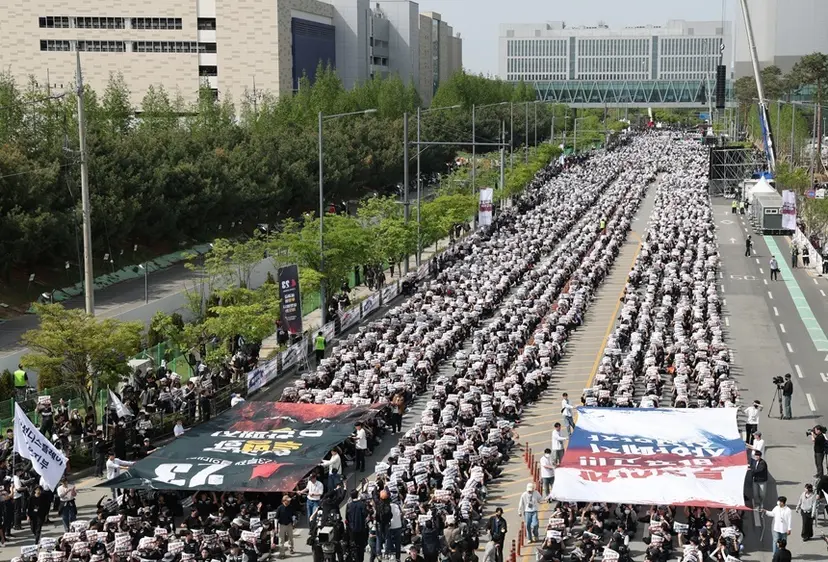
Experts agree that beyond emotional confrontation, the 'systematization' of the compensation system is urgent. Song Heon-jae, a professor of economics at Sejong University, diagnosed, "The sense of crisis from this strike notice is much greater than in 2024. It must be approached as a 'system issue' for Korean semiconductors to survive amidst global hegemony competition."
Professor Song suggested as alternatives: objectifying performance bonus calculation criteria, a 'segment-based profit-sharing system (Cap, Floor, Clawback)' that shares risks when business performance worsens, and the institutionalization of an 'independent arbitration committee' involving labor, management, and external experts. He continued, "Establishing a virtuous cycle where companies do not stop innovating and workers justly enjoy the results is the only way for the Republic of Korea's economy to overcome the waves."
Samsung Electronics stated in its Q1 earnings conference call on the 30th, "We will pursue a smooth resolution with dialogue with the union as a priority," but added, "We are preparing through dedicated organizations and response systems to ensure no production disruptions occur." This is interpreted as keeping the door to dialogue open while signaling the activation of Business Continuity Plans (BCP) in preparation for the realization of the strike. However, there are not a few opinions in the field that "due to the nature of clean room processes, it is realistically difficult to completely fill the void of skilled personnel."
The union is strongly protesting against the pressure from the government and management. Regarding the remarks of Minister of Trade, Industry and Energy Kim Jeong-gwan on the 27th, the union submitted a protest letter stating, "Improving the treatment of semiconductor talent is national interest. The government should discard double standards and engage in forward-looking investment and environment creation to secure talent leadership." Previously, Minister Kim expressed concern about the strike in a press conference, saying, "Semiconductors are a structure that cannot survive unless large-scale investments are continued."
![[Deconstructing the Samsung Strike] ① Samsung Electronics and Bio Performance Bonus Strikes: What are the Decisive Issues?](https://s.bizhankook.com/attachments_thumb/2026/05/98301_thumb.webp)
![[In-depth Analysis of Samsung Strikes] ② Samsung Biologics Union Rally Features Pop Songs and Selfies: "Trust Over Performance Bonuses"](https://s.bizhankook.com/attachments_thumb/2026/05/98306_thumb.webp)
![[In-depth Analysis of Samsung Strike] ③ [On the Scene] The 'Giant' Ball Set in Motion by Hynix Shakes Samsung](https://s.bizhankook.com/attachments_thumb/2026/05/98335_thumb.webp)
![[In-depth Analysis of Samsung Strike] ④ The Shockwaves the Strike Will Bring to the Semiconductor Market During the 'HBM4 Golden Time'](https://s.bizhankook.com/attachments_thumb/2026/05/98412_thumb.webp)
![[Samsung Strike Analysis] ⑤ The Root of 'Relative Deprivation' Felt by Six-Figure Earners](https://s.bizhankook.com/attachments_thumb/2026/05/98425_thumb.webp)