

[비즈한국] A thrilling scene has recently unfolded in the history of human lunar exploration. For the first time in a very long time, a spacecraft carrying humans has flown beyond the Moon and returned safely to Earth. A new era of manned lunar exploration, which had been quiet for half a century, has truly begun. However, behind the success of the Artemis II mission, there remains a critical dilemma that continues to unsettle scientists and engineers. Going back to the Moon is undoubtedly a great challenge for humanity, but it is not simply a repeat of the glory of the Apollo era. Artemis has thrown much more complex, larger, and riskier homework at us than Apollo ever did.
The biggest difference between the Apollo and Artemis missions lies in the duration of the stay on the Moon. Apollo was a relatively short exploration where astronauts landed on the Moon, stayed for one to three days, collected rocks, planted a flag, left footprints, and returned. While that was an unprecedented achievement in human history, the nature of the mission was closer to a ‘visit’.
In contrast, Artemis was designed from the start with a long-term presence on the Moon in mind. The goal of Artemis is not just to pay a short visit, but to establish a foundation where humans can live and work sustainably on the Moon. What NASA officially calls a long-term ‘lunar presence’—the sustainable existence of humans on the Moon—is the core of this plan.
In this grand vision, the Lunar Gateway was once considered the most important pillar. The Lunar Gateway is a small space station orbiting the Moon. It is an ambitious plan to serve as an intermediate hub that orbits the Moon to connect Earth, the lunar surface, and further into deep space. According to the original plan, the Gateway was to orbit the Moon along a very unique path called a ‘near-rectilinear halo orbit’, or NRHO for short. In this orbit, the Gateway would approach as close as 1,500 km to the lunar surface at its periapsis and move as far as 70,000 km away at its apoapsis. It is a method of orbiting in a highly elongated, elliptical halo orbit with a period of approximately one week.
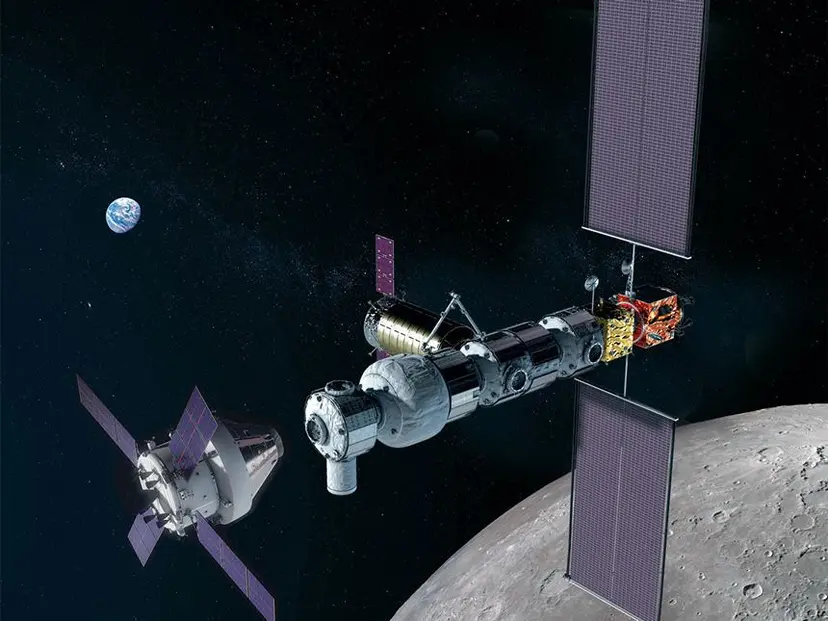
The reason for choosing such a strange orbit was clear. First, it is advantageous for accessing the lunar south pole, which has been the focus of recent lunar exploration. Also, it allows for stable communication as the view of Earth is not completely blocked while orbiting the Moon. It also requires relatively less fuel to maintain the orbit in the long term by utilizing the gravity of both the Moon and Earth. At first glance, the NRHO seems like a very clever choice for long-term lunar exploration.
However, such an extreme elliptical orbit also has fatal drawbacks. A significant amount of orbital maneuvering capability is required to shuttle between the Gateway orbit and the lunar surface whenever a landing is desired. In particular, the velocity is highest at the segment where the Gateway approaches the Moon most closely. At this time, if a lander is to take off from the lunar surface to rendezvous and dock with the Gateway, high-level technology is required. In other words, while the Gateway is a clever way to keep astronauts near the Moon for a long time, it also increases the difficulty of the lunar landing itself.
Ultimately, ahead of the Artemis II launch in March 2026, NASA significantly revised this plan. The Gateway project was essentially put on hold. Instead, the strategy shifted toward landing directly on the lunar surface to build a lunar base. In short, rather than building a station near the Moon first as a base, the plan is to leave footprints on the lunar surface and lay down infrastructure immediately.
This approach could accelerate the pace of pioneering the Moon as an outpost. However, the relatively safe intermediate buffer zone disappears as a result. Originally, the Gateway was intended to serve as a logistics hub, a safe shelter, and a maintenance depot for spacecraft. Skipping that step and building a base on the lunar surface from the start can be a much rougher and riskier choice. This major change in plans could become the biggest risk for the subsequent Artemis missions.
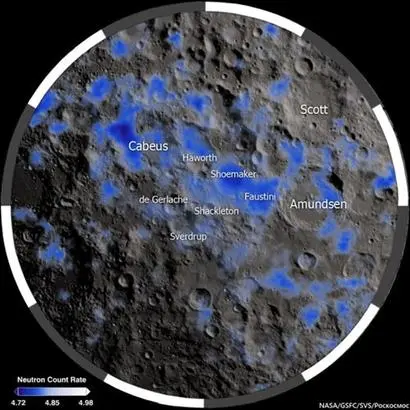
Then why is humanity trying to head to the lunar south pole, rather than the equator or other regions? It is because that is where the ‘prime real estate’ of the Moon is located.
Near the lunar south pole, there are permanently shadowed regions—places that have received almost no sunlight for billions of years. Such places can trap volatile substances left by comets or asteroids, especially water ice, for a long time. NASA has recently confirmed through LRO data analysis that ice may be distributed more widely in these areas than previously thought. If this ice can be melted into water, it can be used for astronauts to drink. Water can also be decomposed into hydrogen for rocket fuel and oxygen as an oxidizer. Water is also used as a radiation shielding material. This is why the areas around the Shackleton Crater and the Aitken Basin on the lunar south pole are receiving so much attention.
However, that very fact creates another problem. The presence of ice means a lack of sunlight. Even if there is water, it is a very disadvantageous environment for solar power generation. Therefore, along with the recent lunar base concept, NASA is also reviewing a bold plan that includes power infrastructure on the lunar surface, effectively including the construction of a nuclear power plant. The idea of staying and living on the Moon does not just mean sending one lander. It means establishing a single living sphere equipped with power plants, warehouses, communication facilities, and repair spaces.
At this point, the Artemis mission becomes a massive plan on a completely different scale from Apollo. This is not a project to send a few astronauts. Artemis is effectively like moving house to the Moon. It is impossible to do it the way Apollo did—carrying a few people, a little equipment, and some packed lunches. Long-term stays are only possible after transporting cargo multiple times, laying down infrastructure first, expanding power, and stabilizing the surface work environment.
For this reason, NASA has recently been strengthening its partnerships with various private companies. The problem is that the private landers appear excessively massive and bold. The SpaceX Starship-based lunar lander concept involves landing a super-large spacecraft almost as-is on the Moon. The landers proposed by Blue Origin and Northrop Grumman are also large structures reaching 10 meters in height. In particular, the massive lunar lander envisioned by SpaceX reaches several tens of meters in height, and even proposes a method where astronauts move between the top and the bottom using an elevator. Of course, lunar gravity is much weaker than Earth's. But even so, the movement of people and equipment from such a high lander still presents realistic safety challenges.
Perhaps in the future, lunar rovers made by companies like Toyota or General Motors will be rolling across the lunar surface. An era of major space advertising might open, with numerous corporate logos plastered all over the lunar base. Humanity's return to the Moon is becoming a project that is both a state-led scientific exploration and one increasingly dependent on the technology and capital of private companies. Whether this is an efficient choice or an excessively risky reliance is something that needs to be scrutinized more carefully.
Another important homework is the return. It is difficult to send people to the Moon, build a base, and have them live there, but technology to safely return the astronauts to Earth after their mission is essential. The process of returning to Earth remains highly dangerous. The Orion capsule of the Artemis mission enters the upper atmosphere at a speed of nearly Mach 35 when returning to Earth. The moment it touches the atmosphere, the crew experiences a maximum gravitational acceleration of about 3.9g. Plasma reaching thousands of degrees surrounds the capsule, and communication is cut off for about 6 minutes.
As the spacecraft reduces its speed by colliding with the atmosphere, the ship's massive kinetic energy is converted into thermal energy through shockwaves and compressive heating. People often think of atmospheric reentry as simple friction with air, but it is actually much more complex. The air in front of the spacecraft is compressed at incredible speeds, causing the surroundings to reach a plasma state. This is precisely why the reentry capsule requires a heat shield capable of withstanding extreme temperatures.
However, there are still concerns and limitations regarding the Orion capsule's heat shield technology. The Orion's heat shield is not just an insulating plate to block heat. It is almost the opposite. The heat shield is a defensive barrier that protects the spacecraft by sacrificing itself, as parts of it burn and decompose. Both Orion and the past Apollo missions used a material called Avcoat. When this material is strongly heated, chemical decomposition occurs internally, releasing a large amount of gas. As the gas escapes to the surface, it creates a kind of protective shield, and the carbonized layer remaining on the outside prevents additional heat from entering the capsule. In other words, the Orion's heat shield is not a device that simply endures heat, but a structure that prevents more heat from penetrating by burning itself away.
During the last Artemis I mission, a fatal problem was revealed in this heat shield method. Artemis I used a so-called ‘skip entry’ method. Instead of entering deeply into the upper atmosphere directly, it grazes the atmosphere like skipping a stone on water, pops back up slightly, and then performs a final reentry. This method is advantageous for precisely controlling the landing point in the ocean. However, the problem occurred in that intermediate segment.
The heat shield was already heated to a very high temperature during the first entry. Gas was continuously being released from the inside. But as the capsule rose back slightly out of the atmosphere, the carbonized layer on the heat shield's surface could not open sufficiently, leading to a situation where internal gas pressure only built up. Ultimately, the internal pressure continued to rise, and that pressure pushed out the weaker parts of the heat shield, causing cracks and delamination here and there. In a nutshell, it was not so much a problem caused by being too hot, but rather a problem that occurred because the conditions for the internal gas to escape were not properly formed while passing through a moderately hot segment.
Therefore, Artemis II attempted reentry following a slightly different trajectory. The method chosen by Artemis II is called ‘lofted reentry’. It is a more direct and simpler method than skip entry. The key is to minimize the time for gas pressure to accumulate inside the heat shield. By reducing the time spent rising back out of the atmosphere, it aims to avoid a situation where internal pressure builds up dangerously. Thanks to this change in approach, the heat shield was able to hold up more stably during Artemis II.
NASA ultimately hopes to recycle even the Artemis return capsules multiple times. This is to reduce costs and travel to the Moon more frequently and safely. However, to reuse a spacecraft, the durability and safety of the heat shield must improve significantly beyond what they are now. How uniformly the manufacturing quality of the heat shield can be maintained and how stably it can be reused after an actual reentry remain important tasks left to solve.
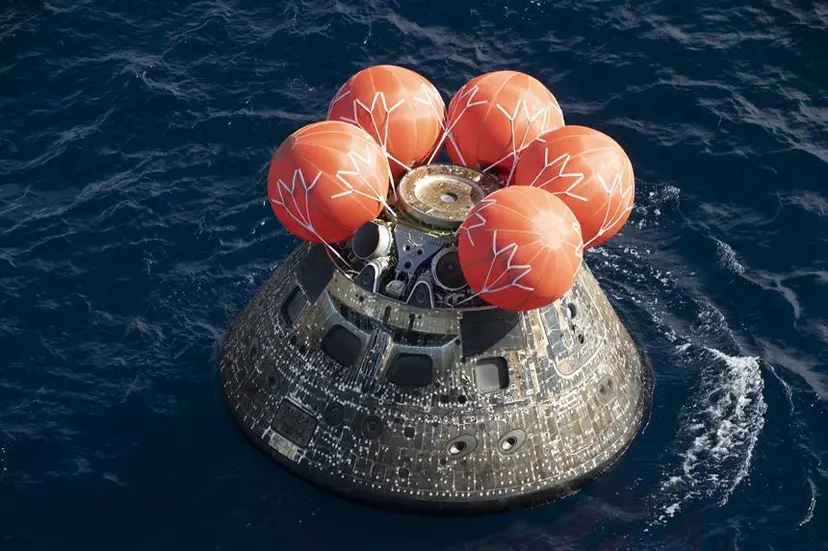
The return capsule must be a boat as well as a spacecraft. It is a spacecraft in outer space, an aircraft while passing quickly through Earth's atmosphere, and finally a boat when it splashdowns in the ocean. In the Apollo era, NASA actually conducted experiments where they left astronauts in a capsule floating in the Gulf of Mexico for two days. This is because in case of a delayed rescue, the capsule might have to drift in the sea with the crew inside for up to two days. Sometimes the capsule might flip over. In such cases, airbags must be deployed to upright it. The hatch must open properly on the choppy sea, and the crew must be able to endure safely amidst seasickness and heat.
The Artemis mission shows a future where humans will visit the Moon again and even stay to live there in the near future. However, it also clearly reveals what we still need to solve and what we need to contemplate more carefully. Can we stably supply power at the lunar south pole where not even sunlight reaches? How can we fill the void left by the Lunar Gateway, which was intended to act as an intermediate hub? Is a strategy that is overly dependent on private companies really the right choice? If we send more crew members to the Moon more frequently, will the return capsules and landers be able to withstand it? When returning to Earth, how safely can humans pass through the hell of that hot compression and plasma?
These questions are by no means trivial. The road back to the Moon is a path toward the brilliant future of humanity, but it is also a path of cold reality where technology, safety, costs, and strategy are all intertwined. How much will our methods of going to the Moon change in the future? How prosperous will the lives of astronauts living on the Moon become? The fate of the Artemis mission is becoming a critical testing ground that determines not just the success of space exploration, but how humanity will settle in space.
About the author, Ji Ung-bae? He loves cats and the universe. After watching ‘Galaxy Express 999’ in his childhood, he dreamed of sharing the beauty of the universe. He is currently an assistant professor in the Division of Interdisciplinary Studies at Sejong University, participating in various science communication activities such as lectures and writing. He has written books such as ‘Everyday a Piece of the Universe’, ‘Scientists of the Starry Universe’, ‘Can't Go But Can Know’, and ‘Strange Questions That Come to Mind When Looking at the Universe’, and has translated works such as ‘The Hitchhiker’s Guide to the Galaxy’, ‘How I Killed Pluto’, ‘Quantum Life’, and ‘Cosmigraphic’.