

[비즈한국] When I decided to write about the meals (soul food) of deadline-driven cartoonists, Jo Gwan-je, Chairman of the Korea Manhwa Contents Agency, came to mind first. I wanted to hear the story of a man who spent his whole life trying to bring comics, once considered “sub-table culture,” onto the dinner table.
“Living through times when just surviving was hard, who had time to seek out special food? Let's just grab a bowl of jjamppong (spicy seafood noodle soup).”
When I asked about the ‘soul food’ he seeks after a grueling deadline, he insisted there was no such thing and suggested we just head to a nearby Chinese restaurant. Oh no. We had underestimated the generation that lived through the ‘barley hump’ (the famine years). Not wanting to cancel the interview, I braced myself to squeeze memories as fragrant as sesame oil out of a bowl of jjamppong as we headed to a Chinese restaurant in Beombak-dong, Bucheon, Gyeonggi-do.
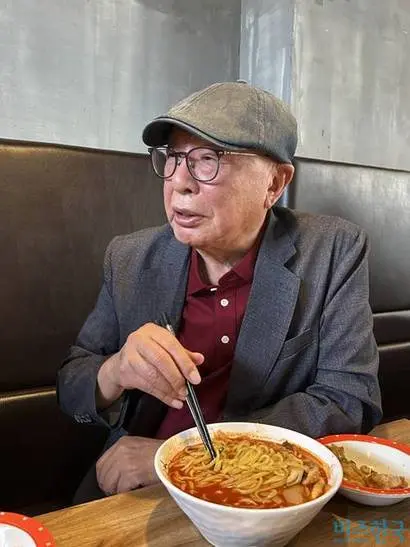
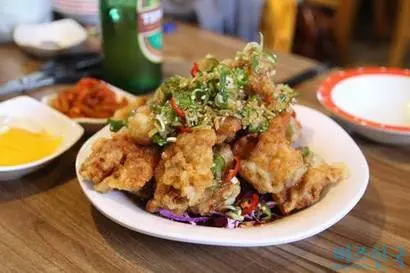
Arriving at the restaurant, pickled like zhacai (pickled mustard greens) from the early spring heat, I found the master waiting for me before our scheduled time. Approaching eighty, he stood remarkably upright. He said he had been visiting since a couple from the overseas Chinese community first opened the place, and as he recommended jjamppong, jajangmyeon, and yuringi (deep-fried chicken), I promptly added beer to the order.
Faint Memories of Udon, and Jajangmyeon as a Matchmaker
Just as even the tone-deaf has one favorite song in their heart, he may not have known the joys of gastronomy due to his impoverished youth, but his memories of food were not entirely blank. Even after half a century, the scent of udon from a local neighborhood Chinese restaurant—where he ran errands to entertain visiting relatives—still lingers in the nose of the man who was once that boy.
In Chae Man-sik’s novel ‘Taepyeongcheonha’ (Peace Under Heaven), the Chinese restaurant udon that soothed the hungry stomachs of Mr. Yoon and Chun-sim is a representative Korean-Chinese dish that arrived during the Japanese colonial period. While Chinese restaurants serving udon are disappearing one by one these days, udon was immensely popular alongside jajangmyeon until red jjamppong appeared in the 1970s. Since special occasions like graduations or treating special guests were usually held at ‘Cheongyoritjib’ (Chinese restaurants), it was impossible for even someone who didn't pay much attention to food to have no memories of them.
While working at the monthly comic magazine ‘Manhwa Wangguk’ (Comic Kingdom), the master used to soothe the fatigue of meeting deadlines with a bowl of ganjajang (dry-style jajangmyeon) topped with a fried egg and a glass of baek-al (kaoliang liquor). He even married a new employee with whom he shared those modest pleasures at a Chinese restaurant in Chungmuro, making the restaurant his ‘matchmaker’ (Wolha Bingin).
The Dawn Alleyways Flowing with ‘Night Fog’ and Cream Bread
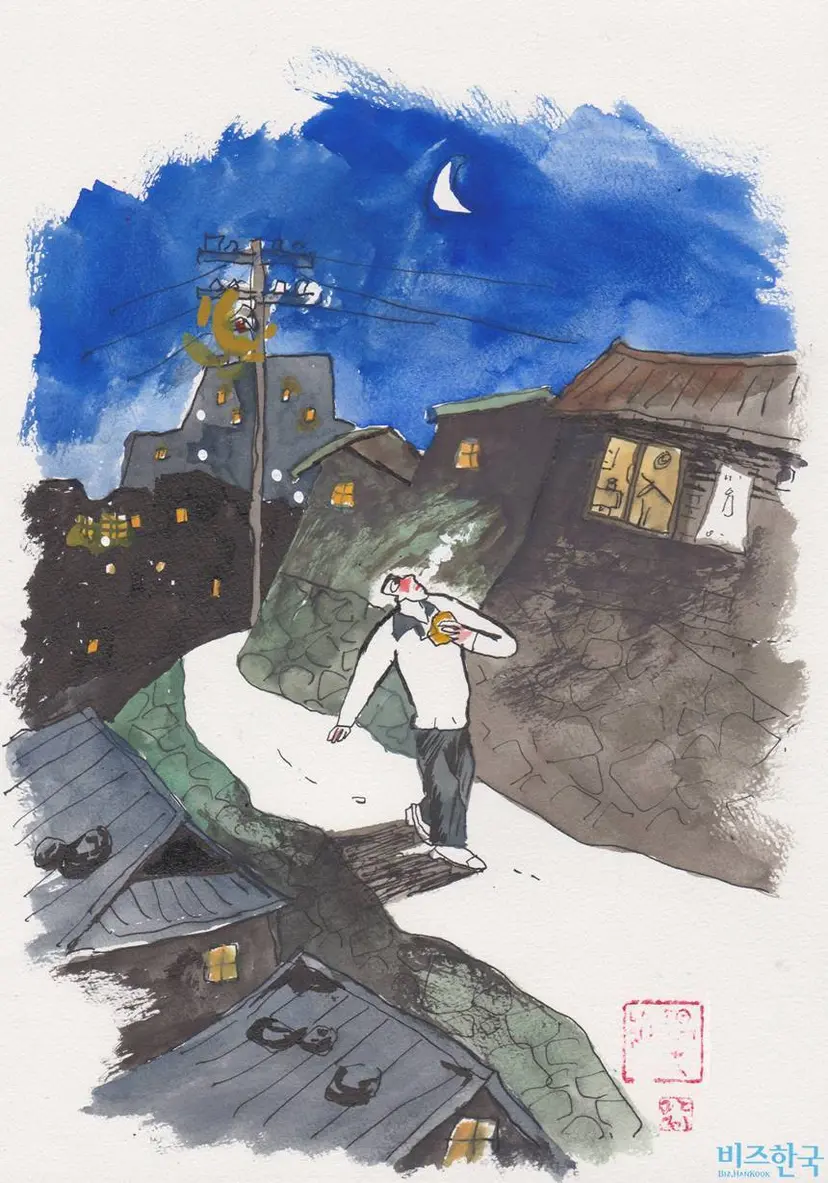
Recalling the dawn alleyways of Eungam-dong, where he arrived in Seoul after high school with nothing but the dream of becoming a cartoonist, despite the hunger and uncertain future, the master brought up the topic of cream bread. Feeling his foundations were lacking, he would practice drawing for an hour more while fellow apprentices slept, and fill the hunger of dawn with cream bread. It was a cream bread released by a bread factory in 1964.
In the midwinter dawn alleyway, walking barefoot in slippers while holding a cream bread bought at a local corner store, singer Hyun-mi’s ‘Night Fog’ would drift from small, struggling garment factories. “Night fog, the lonely night street full of fog. All night long, the indifferent night fog. My heart wanders searching for shadows, thinking of you. All night long, I go on aimlessly.”
Recalling the young Jo Gwan-je, who, like the narrator of ‘Night Fog,’ went out searching for his dreams “all night long,” he said, “I couldn't be certain about my future, but it had been my dream since childhood. Compared to that, I’m a billionaire now, but I think that time, filled with hope that life would improve, was when I was the richest.”
The Meaning of Living Together
In October 2007, his cartoon solo exhibition ‘Chwisaengmongsa’ (Drunken Life, Dreamy Death) held in Insa-dong, Seoul, featured a piece titled ‘Sig-gu’ (Family/Family-to-Eat-With). The piece, which depicted various generations gathered together holding chopsticks and bowls, woven together as if one body, showed the literal meaning of the word ‘Sig-gu’ with a warm yet clear style. Although he could not afford to be greedy for food because he was poor, the meaning of eating, which binds individuals together, could never be light for someone who lived his whole life as the eldest son of five siblings, a head of a household, and a leader of an organization. Thus, he filled his cartoons with compassion, affection, and responsibility for those he lived alongside during those hard times.
The master mentioned he misses the hand-cut noodles with soybean powder made by his grandmother. For her young grandson, left at the grandmother’s house in midsummer while she was busy with farm work, she would roll out the dough with a pin and boil the noodles. The grandson, who would linger by her side and get scraps of dough to grill on the furnace, would say he was full and put down his bowl, but she would say, “Noodles digest quickly even if you just walk to the gate, so eat some more.” Her generous heart remains for the master as the warmth of that era, and for us, as his cartoons.
“I Still Want to Draw Well”
By the time the bottle of beer was empty, a small regret flickered at the bottom of his glass. He said he was truly sorry for his lack of formal education. Being the eldest son of a poor family, he spent his whole life busy with comics, so he regrets not learning a musical instrument or a foreign language, but he also feels his drawings are still lacking because he couldn't study art properly. Even when his eldest daughter (Jo Hee-yoon, CEO of Cartoon Campus), who entered the comics field following her father, complains, “Why do you try so hard to draw well at your age? You can draw comfortably now,” as an artist who speaks through his work, he says he still wants to draw well.
Did Lu Xun say, “The old warrior holds a spear?” The twilight cartoonist, who still doesn't put down his pen and “doodles” every day, awakens his complacent juniors and adds, “Let’s have one more drink.”
Waiting for the ‘Autobiography of Jo Gwan-je’
In his “doodle book,” which he writes like a daily diary, he draws pictures and also notes down ideas to revive the fading cartoon scene. Having served as Chairman of the Korea Cartoonists Association, the Korea Cartoon Association, and the Korea Manhwa Contents Agency, he has already proposed many policies, but he said there are many ideas he has yet to unfold. Due to his ingrained habits, he has already collected several volumes of notes and memo pads. I requested that he compile them into an autobiography for his juniors.
It is a time when his own story, which was omitted from his book ‘Jo Gwan-je’s Manbo (Casual Strolls)’ documenting veteran cartoonists, is needed more than ever. I raised my glass, hoping that his record, lived like walking a thousand ri in small steps as an artist and administrator, would remain as a faithful memory of the past and infinite inspiration for the new. “Cheers.”
Cartoonist Jo Gwan-je was born in Daegu in 1947 as the eldest of five siblings. Drawing on the back of calendars to soothe his siblings' boredom became his lifelong profession. Having grown up watching ‘Gobau Yeonggam’, ‘Dduggeobi’ (Toad), and ‘Walsun-ajimae’, he boarded a local train to Seoul after high school, dreaming of becoming a political cartoonist who could influence society. Because the train he took was a local line, he wandered back to Daegu, to local newspapers, and to painting signs for the ‘Academy Theater’. Though he didn't make much money, he kept drawing comics. After working at ‘Sonyeon Dduggeobi’ (Boy Toad) founded by Ahn Ui-seop, he worked at ‘Manhwa Wangguk’ in 1969, drawing both dramatic and comedic comics. At the time he drew ‘Soedongi’, his name was ‘Seok Il-eon’.
He stood tall under his own name in 1973 with ‘Dad’s First Love’, published in ‘Hakwon’. He went on to draw ‘Rose Girl Rose’, ‘Dohwagol Lady’, and more.
For a time, he worked as an art director for the monthly women's magazine ‘Jubu Saenghwal’ (Housewife’s Life), the KBS Cultural Business Group, and as the founding editor-in-chief of the monthly ‘KBS TV Kindergarten’, balancing editing and cartoon creation. In 1998, he participated in the establishment of the Bucheon Cartoon Information Center, serving as its director and solidifying Bucheon's position as a city of comics. He served as chairman of the Korea Cartoonists Association and the Korea Cartoon Association, and in 2023, he was appointed Chairman of the Korea Manhwa Contents Agency, a position he currently holds.
Even past the age of sixty, he has continued his activities by publishing cartoon collections such as ‘Chwisaengmongsa’ (2007), ‘Harodongseon’ (2009), ‘Saekjeuksikong’ (2010), ‘Sul’ (Alcohol) (2010), ‘Cartoonist Jo Gwan-je’s Manbo’ (2021), and ‘Still Breathing Thanks to Love Today’ (2021).
Author Seo Chan-hwi is a comics columnist who has explored and organized the flows and connections of comics and surrounding cultures in a historical context. Since 1998, he has operated the comic information community ‘Manhwain’ and has written for various media outlets including the Hankyoreh, Ilyo Shinmun, Incheon Ilbo, and Kookbang Ilbo. Author Song Ha-won is the CEO of the Public Culture Development Center UrArt and operates the alternative comic bookstore ‘Homtong’. He is a cultural planner, comics researcher, an adjunct professor in the Department of Media and Communication at Sungkonghoe University, and a director of the Geumcheon Cultural Foundation.
The two aim to delve into the lives and work of Korea’s leading cartoonists through the food they love in ‘Cartoonist’s Soul Food’.”} Food’s Soul Food’.”} Food’.
![[Cartoonist’s Soul Food] The Cream Bread of That Dawn, Sustained by Dreams](https://s.bizhankook.com/attachments_thumb/2026/05/98392_thumb.webp)
![[Cartoonist's Soul Food] Art is in the 'Hand-taste', Food is in the Joy of Eating Together](https://s.bizhankook.com/attachments_thumb/2026/05/98652_thumb.webp)
![[Cartoonist's Soul Food] 'Kkadegi' author Lee Jong-cheol's 'Mother's Kimchi Jjigae'](https://s.bizhankook.com/attachments_thumb/2026/06/106516_thumb_1a338228.webp)
![[Cartoonist's Soul Food] 'Ghost Teacher' Author Nam Dong-yoon: "Undoubtedly, Sundae-guk"](https://s.bizhankook.com/attachments/2026/07/e57a933e6fe0_36ef77a3.jpg)
![[Cartoonist's Soul Food] Artist Park Kun-woong, Whose Knife-Cut Noodles Soothe the Knots of History](https://s.bizhankook.com/attachments/2026/07/9f3485391c47_2d2281a7.jpg)
![[Cartoonist's Soul Food] "A Red Bean a Day": A Visit with Manga Writer and Film Director Lee Dong-eun](https://s.bizhankook.com/attachments_webp_no_wm/2026/07/134567_no_wm_0b8d2928.webp)