

[비즈한국] Amazing Brewing Company, a first-generation domestic craft beer brand, has finally gone bankrupt. While concerns about a crisis in the craft beer market are spreading rapidly, industry insiders are distancing themselves from the view that the strategic failures of a few specific companies reflect a crisis for the entire market.

Excessive Facility Investment Proved 'Poisonous'
On the 21st, the Seoul Rehabilitation Court declared bankruptcy for Amazing Brewing Company. The company had filed for rehabilitation last August due to severe financial difficulties. It subsequently sought an M&A process through a stalking-horse bid before the approval of a rehabilitation plan, but failed to secure a buyer. Even after switching to a public competitive bidding process, the situation did not improve. Ultimately, the court decided to terminate the rehabilitation procedure this January and issued a final bankruptcy declaration this month.
Following the bankruptcy of Amazing Brewing Company, its affiliates also filed for bankruptcy in succession. On the 23rd, Amazing Splash International, responsible for distribution and wholesale, went bankrupt, and on the 24th, Nolraun Maekju (Amazing Beer), which operated the Icheon production facility, was also declared bankrupt by the court.
Amazing Brewing Company started as a pub in Seongsu-dong, Seongdong-gu, Seoul, and gained recognition through beers like 'First Love,' 'Seoul Forest Craft Lager,' and 'Jin Lager.' In 2017, it attracted attention as the first domestic craft beer company to secure Silicon Valley capital, receiving investments from Altos Ventures and BonAngels Venture Partners.
The industry points to financial burdens stemming from aggressive facility investment as the primary cause of this situation. Amazing Brewing Company completed a mass-production brewery in Icheon, Gyeonggi-do, in 2019, and accelerated facility expansion after securing approximately 8 billion KRW in Series B funding in 2021. It further increased its production capacity by completing a second brewery in 2022.
The problem was that the market trend shifted during the expansion phase. Despite building a mass-production system through massive investment, demand for craft beer plummeted as alcohol consumption trends moved toward whiskey and highballs. With demand shrinking, the burden of fixed costs from facility investments exacerbated financial pressure.
Recently, the craft beer industry has been facing continuous difficulties, with several companies suffering from poor performance or scaling down operations. Hanul & Jeju (formerly Jeju Beer276730) is grappling with management burdens amid a continuous deficit structure, and Sevenbrau has also entered rehabilitation, showing signs of widespread distress across the industry.
Profitability Worsened by Excessive Convenience Store Expansion
Some in the industry view this trend as a predictable result. Since the expansion into convenience store distribution began, it has been consistently pointed out that a structure where craft beer competes in the same market as major conglomerate beer brands is difficult to sustain. Major beer companies can lower costs and secure price competitiveness based on mass production and nationwide distribution networks, whereas craft beer, characterized by small-scale production and freshness, has inherent limits in competing the same way.
An industry insider explained, "During the COVID-19 pandemic, coupled with the aftermath of the 'No-Japan' movement, convenience stores needed new products to replace Japanese imported beers. At the same time, some craft beer companies that had secured large-scale investments needed indicators to prove external growth. These conflicting interests aligned, leading to the rapid influx of craft beer into convenience store channels."
They further noted, "However, craft beer is a product based on freshness and flavor, and its structure is not suitable for long-term distribution or mass sales. The process of modifying sterilization and packaging methods to fit nationwide distribution networks weakened the taste and aroma, eventually leading to lower product competitiveness and decreased demand."
The pricing structure also compounded the problem. To compete with the convenience store discount pricing of 'four cans for 10,000 KRW,' cost-cutting became inevitable, which led to a reduction in high-quality raw materials and a decline in overall quality. In addition, various commissions and promotional/marketing costs incurred during the convenience store entry process further eroded profitability—a structure analysts say is impossible for small and medium-sized breweries to sustain.
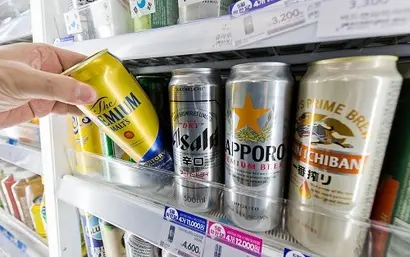
Industry experts point out that the convenience store distribution strategy of some firms has led to a distorted perception of craft beer. As consumers primarily encountered craft beer through convenience store products, a 'low-price, low-quality' image spread, negatively impacting even those breweries that had focused on quality.
A representative from a small brewery added, "While there are about 170 small breweries in Korea, only five or six participated in convenience store distribution. However, as the failures of a few are highlighted, it is perceived as if the entire craft beer industry is in a slump. Among consumers who encountered craft beer in convenience stores, the assessment that 'craft beer is tasteless' spread, and because of this, breweries that have quietly maintained their product competitiveness are suffering as well."
There are even claims in the market that the term 'craft beer' itself should be changed. As convenience store products have become the representative image of the genre, voices are growing that the market should be redefined with new standards and terms such as 'Craft Beer' (in English usage to distinguish from the mass-produced label).
An official in the alcoholic beverage industry stated, "Craft beer is not a market for mass distribution, but a market that meets consumers who understand its taste and aroma. The current craft beer market is entering a phase of restructuring. As some companies that pursued excessive expansion strategies are cleared from the market, we expect that breweries that have maintained their quality and identity will be properly re-evaluated in the future."