

[비즈한국] With high oil prices, demand for electric vehicles (EVs) is surging again. Along with it, a 'fire phobia' regarding lithium-ion batteries has re-emerged. The biggest weakness of lithium battery fires is that thermal runaway, where internal temperatures instantly soar above 1000℃, makes extinguishing them virtually impossible with conventional methods. This poses a high risk of large-scale disasters. In fact, the 'KakaoTalk outage' caused by the Pangyo Data Center fire in October 2022 and the 'Incheon Cheongna apartment underground parking lot EV fire' in August 2024 vividly demonstrated how battery fires can escalate into national and social disasters.
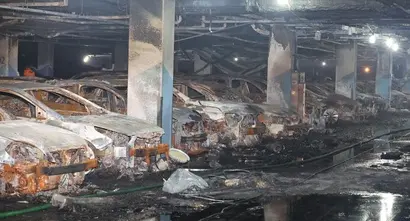
Currently, the fire authorities' EV fire suppression manual is limited to physical methods such as covering the vehicle with a smothering fire blanket and assembling a portable water tank to submerge the battery. This is why experts point out the urgent need for fundamental countermeasures to secure the initial 'golden time.' Although fire extinguishers labeled 'EV-specific' are flooding the market, many are prioritizing marketing terms without clear performance verification.
The Korea Fire Institute (KFI) established 'Certification Standards for Fire Extinguishing Performance of Small Lithium-ion Battery Fires' in December 2024. However, it is merely a 'voluntary certification' limited to small batteries under 1000Wh and lacks legal enforcement. It is essentially a regulatory blind spot where manufacturers face no restrictions on sales even if they do not obtain certification.
Such a regulatory gap is not unique to Korea. Major developed nations like the U.S. and Europe, which lead the distribution of EVs, have yet to establish a single international standardized fire extinguisher specification targeting large-capacity lithium-ion battery fires. Nevertheless, the U.S. and Europe manage products through fire performance tests and safety standards based on traditional fire classifications (Class A for general, B for oil, C for electrical, D for metal). In particular, regarding the safety of the EV battery itself or the prevention of thermal runaway spread, relevant standards are applied in a multi-layered and fragmented manner, such as UL 2580 (EV battery safety standard) and UL 9540A (ESS thermal runaway fire propagation evaluation).

Kim Sung-ho, CEO of EGS Plus, an EV and ESS battery fire safety solutions company, is presenting a direction to correct this market confusion. In 2021, through a test by the Fire Insurers Laboratories of Korea (FILK), Kim became the first in the country to receive an official test report verifying the performance of delaying thermal runaway in EV batteries and completely extinguishing the fire.
The core competitiveness of EGS Plus lies in a cooling technology that goes beyond the limitations of general smothering fire suppression. While ordinary powder extinguishers or fire blankets merely block external oxygen, EGS Plus's extinguishing agent physically lowers the temperature of the battery's ignition point to break the chain reaction of thermal runaway. CEO Kim explained, "When a lithium battery undergoes thermal runaway, internal temperatures soar up to 1350℃, but preventing reignition is possible if we control it to below 200℃," adding, "Our agent penetrates inside the battery pack to immediately lower the temperature below 200℃ and ultimately cools it to below 80℃, a performance verified by the Fire Insurers Laboratories of Korea to completely suppress the fire."
It is particularly strong in its response capability during the 'off-gas' phase, which occurs at the initial stage of a fire just before a battery bursts. Designed in liquid form, the agent permeates deep into the spaces between battery cells that powder cannot reach, suppressing the explosive ignition that follows gas discharge at an early stage. Another differentiator from existing extinguishers is that it is eco-friendly and non-destructive to the point that if sprayed on a battery that is still intact, it can be reused simply by wiping off the agent.
The technical prowess of EGS Plus is also gaining attention in the global market. A prime example is the supply of one ton of test extinguishing agent to Taiwan's TSMC, the world's No. 1 foundry (semiconductor contract manufacturing) company, last year. CEO Kim revealed, "TSMC's fire prevention partner searched the globe before finally discovering our product," and added, "Internal review is currently underway for installation in the air conditioning facilities of their new semiconductor plants."
In particular, since the partner that adopted this product for TSMC was recently acquired by a large global fire prevention company in the U.S., a green light is expected for EGS Plus's entry into North America. This is because passing TSMC's rigorous verification provides a powerful lever to expand into the global market via the network of global fire prevention companies. In the automotive sector, the company has also begun concrete strategic discussions on adopting vehicle fire prevention solutions with China's BYD and domestic importers.
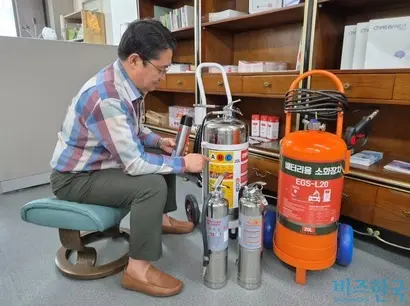
EGS Plus's vision does not stop at industrial sites. Recently, it has been expanding its scope to life-friendly fire prevention solutions aimed at small lithium battery fires that frequently occur at home or in daily life. A 500ml spray-type fire extinguisher, which has finished sample production and is currently under full-scale development, is a prime example. This product is designed so that ordinary people can easily deal with fires from electric scooters, laptops, or power banks at home. Unlike existing fire suppression methods that require spraying from a distance using high nitrogen pressure, it is characterized by allowing anyone to intuitively and easily spray the extinguishing liquid from a close distance to help with initial suppression when a fire occurs.
In particular, this spray-type fire extinguisher is raising expectations that it could be an alternative to in-flight power bank fires, which are a headache for the aviation industry. CEO Kim explained, "In the event of thermal runaway in a passenger's power bank inside a pressurized airplane, the current procedure for flight attendants is to pour bottled water as a stopgap measure," adding, "If portable spray-type fire equipment is introduced, in-flight fires can be suppressed immediately and safely." He emphasized, "As long as there are EVs and batteries, the risk of fire exists everywhere in the world," and added, "I will leap forward as a total fire prevention solution company that goes beyond being 'the first in Korea' to create a new global standard for EV and ESS fire suppression worldwide."