

[비즈한국] As the saying 'The Advance of K-Defense' goes, the K-defense industry is enjoying a boom alongside the conflicts of the world. However, there is always a component that holds K-Defense back: the propulsion system. Importing engines and transmissions not only hampers our military's combat readiness but often disrupts exports as well.
The most famous case is the 'localization of the K2 power pack.' It took nearly a decade to replace the existing German engine and transmission with domestic alternatives. The transmission was particularly problematic, but through tremendous effort by the manufacturer, a world-class tank transmission was eventually developed and installed in the export version of the K2.
In fact, even before the K2 tank, the K9 self-propelled howitzer faced difficulties due to export restrictions on German engines. It was only recently, nearly a decade after the problem arose, that a domestic engine for the K9 was developed.
The situation was equally serious for aerial weapon systems. Although the development plan for a domestic engine for the KF-21 has recently been launched, it will take another decade to reach practical deployment. The LAH-1 Mirion, our military's next-generation light armed helicopter, is also unable to be mass-produced as planned due to unstable supplies of French engines. Essentially, engines and transmissions are the major culprits plaguing the K-defense industry.
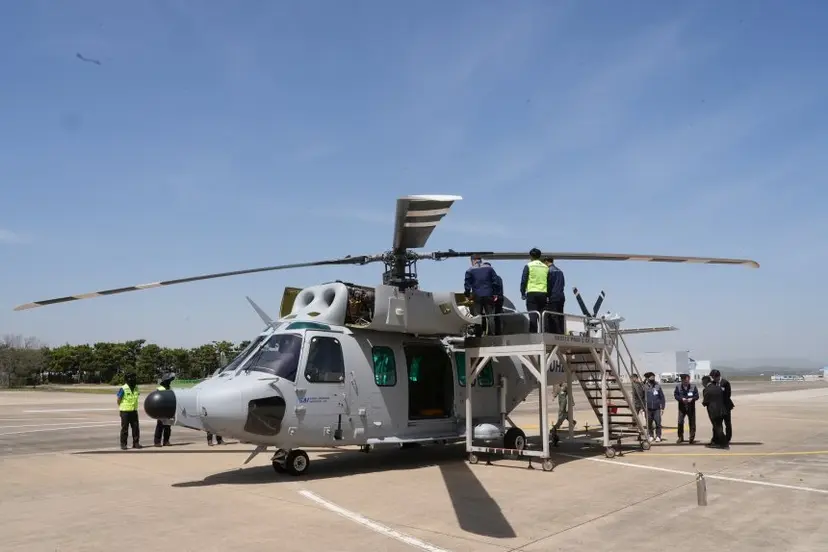
Amidst this, the news on the 21st that Korea Aerospace Industries047810 successfully localized the Surion Main Gear Box is an important milestone for the Korean aerospace industry. This is because it was a continuous process of arduous and difficult development.
Originally, a domestic transmission company attempted to localize the Surion gearbox, but it was unsuccessful, leading to the import of gearboxes for Airbus Helicopters' H215M. This process not only caused delivery delays but also prevented the Surion helicopter from utilizing the maximum output of its T-700-701K engine, meaning engine power could not be properly transmitted to the main rotor. Furthermore, as the gearbox is a high-priced item accounting for about 30% of maintenance costs and 20% of the purchase price, it resulted in significant foreign currency outflow.
There were many reasons to localize the gearbox, but the difficulty of development was substantial. KAI began basic research in 2021 to succeed in this localization. Starting in July 2023, they initiated full-scale development through a weapon system package program combined with technology transfers from overseas firms, finally succeeding in test operations. Because tests and stability certification will take time, full completion and airworthiness certification are expected only in 2028. The development cost is expected to exceed 180 billion won.
The expected effects of the successful gearbox development are clear. A 'Super Surion' exceeding the existing Surion can be born. With a 27% increase in power and a 15% increase in maximum takeoff weight, the Surion is effectively upgraded to possess performance nearly equivalent to a new helicopter. Since the overhaul cycle and lifespan are doubled, maintenance costs will also decrease, making it virtually a new helicopter with the same exterior.
The problem is that there are still movements to disparage and criticize the 'upgraded Surion' that applies this hard-developed gearbox. In-depth articles have even emerged retroactively interpreting that the performance improvement of the Surion was unnecessary. While the Surion is called a 'lightweight' class and the UH-60 a 'middleweight' class helicopter, the Surion equipped with the localized gearbox uses the same engine as the UH-60 and can produce almost identical output, allowing it to demonstrate UH-60 class cargo transport or armament operation capabilities.
The gearbox localization, a challenge pursued over a long period, is now on the verge of bearing fruit. The next-generation Surion performance improvement project, which includes the new domestic gearbox, new mission computer, cockpit display, new electro-optical equipment, new navigation equipment, automatic flight control system, and Directional Infrared Countermeasures (DIRCM) to jam anti-aircraft missiles, must be promoted in a timely manner. If the military does not use a new, upgraded Surion, it will not be easy to secure additional export opportunities.
Furthermore, it is necessary to verify the military's requirements for a heavy-weight Surion attack helicopter to operate alongside the LAH, replacing foreign-made attack helicopters that suffer from high prices and parts obsolescence. Currently, the MAH-1, an amphibious attack helicopter based on the Marineon, has been successfully developed. The MAH-1, based on the baseline Surion, also has operational capabilities equivalent to foreign attack helicopters by mounting domestic Cheongeom anti-tank missiles, laser-guided rockets, and 20mm cannons.
If the development of an Army-type Surion attack helicopter, tentatively named SAH-1, is pursued—equipped with the newly developed gearbox and DIRCM—we can look forward to a powerful domestic attack helicopter that can mount more armaments than the amphibious attack helicopter while ensuring maneuverability with ample power. This would not only partially resolve the delivery issues of the LAH-1, which relies on French engines, but also provide a powerful domestic attack helicopter capable of carrying 16 domestic anti-tank missiles.
More important than missiles are the drones currently in the spotlight. Recently, it has become a trend for attack helicopters to adopt the Manned-Unmanned Teaming (MUM-T) concept, equipping 'ALE' drones that are launched from the helicopter. The Altius-600 drone from the U.S. company Anduril, which foreign attack helicopters can carry, costs about $1 million based on Taiwan export prices, making it much more expensive than domestic ALE drones or domestic anti-tank missiles, and therefore difficult for our military to operate.
To properly utilize core technologies that have been localized, we must invest correctly. The military must make decisions based on long-term cost savings, economic feasibility through localization, and ease of maintenance. This is why I argue that our military should take an interest in developing domestic attack helicopters with excellent armament capacity, following the localization of the Surion gearbox.