

[비즈한국] The semiconductor boom has paradoxically brought unprecedented tension to the labor and management of Samsung Electronics005930. As dissatisfaction stemming from compensation gaps with competitors reached a tipping point, a majority labor union emerged. Having secured the legal status of employee representative, the union pursues a pragmatism that prioritizes the interests of employees without relying on higher-level unions. With skepticism toward compensation principles amid record-breaking performance and the rise of a new union armed with practical benefits, where will this strike lead on a path Samsung has never traveled before?
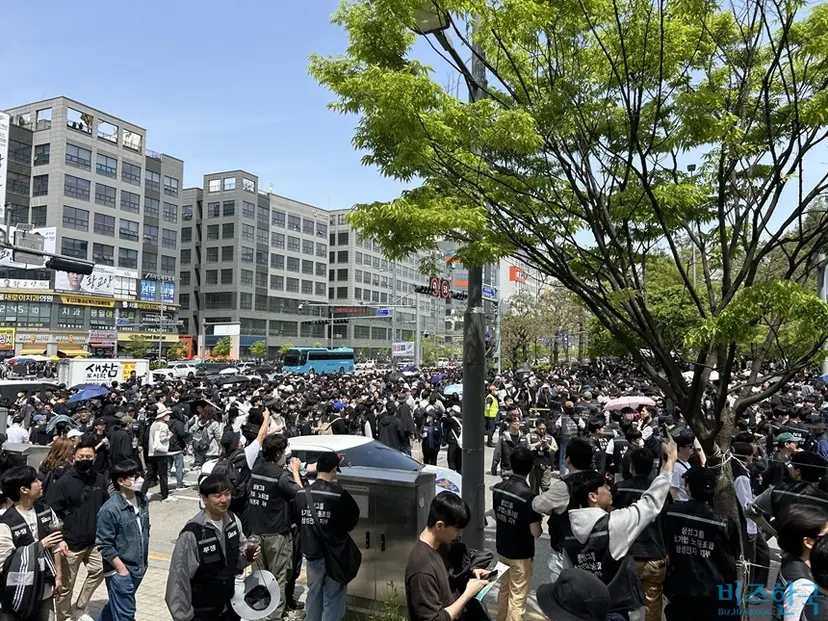
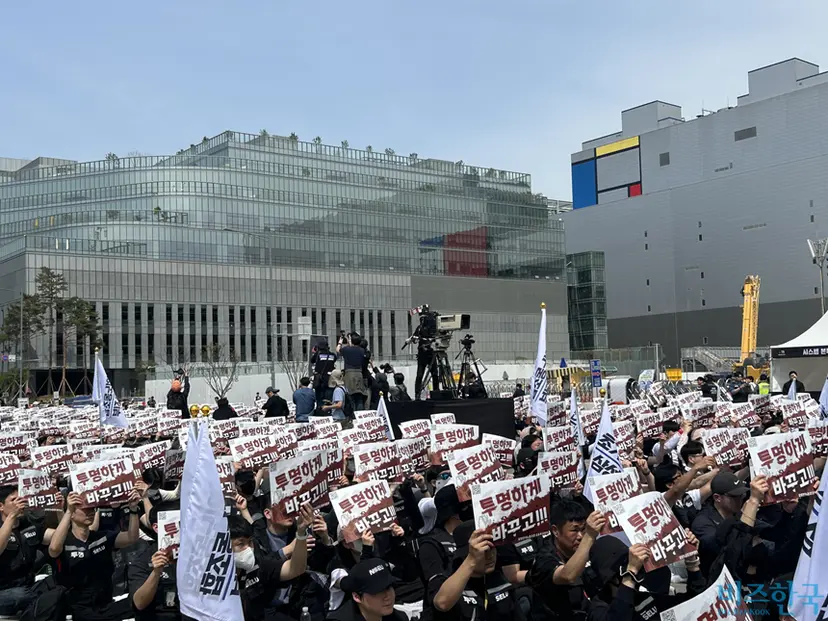
On the 23rd at noon, the six- to eight-lane road within the Samsung Electronics Pyeongtaek campus was covered in an unprecedented crowd. It was the site of the '4.23 Struggle Resolution Rally,' the largest collective action since the company's founding. Following a route of about 1km from the campus entrance to the main stage, union members wearing matching black union vests gathered.
Crowds Fill Pyeongtaek Campus, Largest Gathering Since Founding
The goal of '30,000 participants' set by the Samsung Electronics Labor Union Joint Struggle Headquarters, which organized the rally, became a reality. Organizers estimated that about 40,000 people (approximately 34,000 according to police estimates) gathered at the scene, which is more than half of the 76,000 total members of the Samsung Group's super-enterprise union, the backbone of the joint struggle headquarters, and 10 times the size of last year's first strike resolution rally (about 4,000 people).
The event, scheduled for 1 PM, began around 2 PM due to delays in managing the crowd. The atmosphere at the site was closer to one promoting unity rather than a tense struggle. Although some people covered their faces with hats, sunglasses, and masks, the overall atmosphere was relaxed, with participants taking commemorative photos with colleagues. Even as the event was about to begin, some were seen sitting in the shade of the grass to avoid the scorching sun instead of joining the ranks. The scene also reflected an organizational culture unfamiliar with union activities, such as repeated practice sessions for picketing before the event.
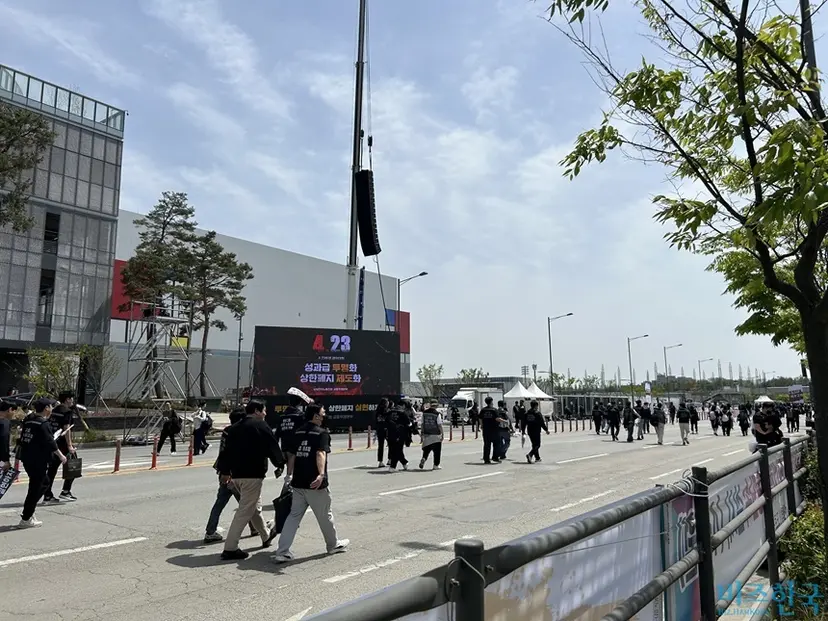
Also participating at the site were chairmen of unions from various Samsung affiliates, including the National Samsung Electronics Union (NSEU), the Samsung Display Open Branch of the super-enterprise union, the Samsung Fire & Marine Insurance000810 Branch, and the Samsung Biologics207940 Branch.
Choi Seung-ho, chairman of the Samsung Electronics branch of the super-enterprise union, who climbed onto a crane, said, "The company is abandoning Samsung's management principle of 'Human First,' claiming that only market conditions determine the company's performance, not the sweat and effort of employees." He added, "If the factory stops for the 18 days of the general strike, there will be a void of nearly 18 trillion won. We must show the management that those numbers come from our hands."
He continued, questioning, "People say, 'If you don't like the temple, you should leave,' but if there is no fair compensation for the workforce in the most important industries like semiconductors, AI, electronics, and automobiles, who will take responsibility for the future?" He emphasized, "The Joint Struggle Headquarters is carrying out the strike to change Samsung Electronics' flawed system."
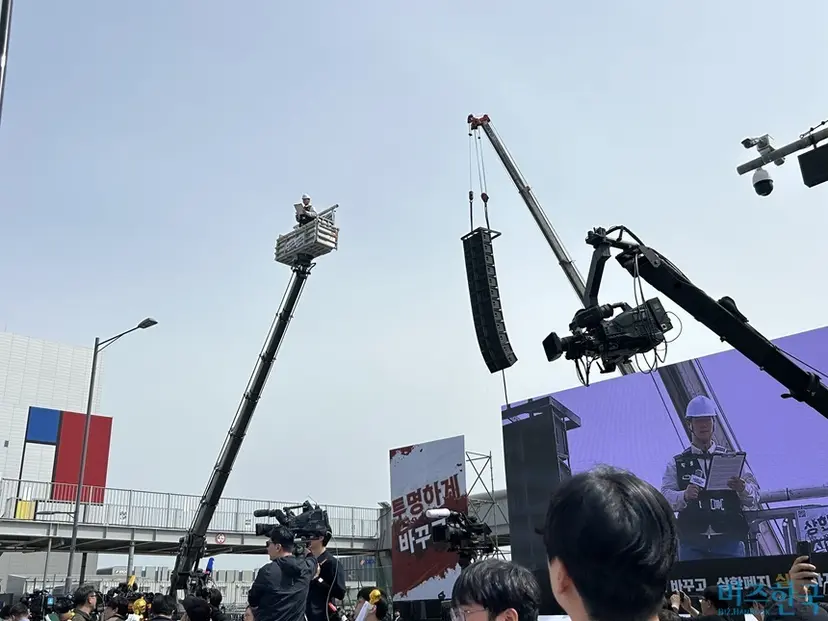
Woo Ha-kyung, acting chairman of the National Samsung Electronics Labor Union, pointed out the issue of fairness, stating, "Chairman Lee Jae-yong's stock has skyrocketed by tens of trillions, and the management is throwing multi-billion won bonus parties." Hong Gwang-heum, chairman of the super-enterprise union, emphasized organizational solidarity, saying, "Today's history is the first page of an epic drama that has challenged the massive fortress called Samsung for the first time."
Immediately after the resolution rally, Chairman Choi met with reporters to mention conditions for resuming negotiations. He stated, "A sincere apology from the management must come first, and they must bring negotiation agenda items in advance. Fulfilling these two things is a prerequisite." He added, "If the management knows the importance of semiconductors, I hope Chairman Lee Jae-yong will actually come out once," calling for direct dialogue. He also clarified his position on non-DS (semiconductor) business units, saying, "The DX (Device Experience) division's VD (TV/home appliance) business unit is making a profit but is being treated as a loss based on EVA (Economic Value Added). As a majority union, we can demand additional resources together next year."
Concerns over 1 Trillion Won Daily Loss… Views on Reduced Competitiveness
The union raised the level of its struggle a notch starting from this day. After reaffirming its existing position of demanding 15% of the DS division's operating profit as performance bonuses, the union declared a shift to a 'check-off' (automatic deduction of union dues) system and issued struggle guideline No. 2, encouraging participation in a de facto general strike using annual leave from May 21 to June 7. A check-off is a procedure to formalize member status with the company and is known as the final step to maximize organizational momentum for a general strike. The union expects the scale of check-off participation to be between 50,000 and 60,000.
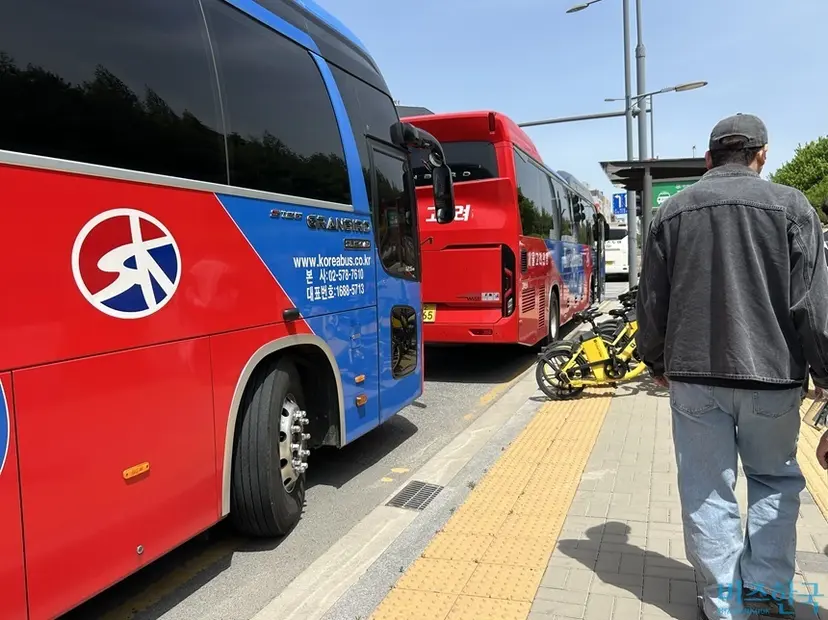
The resolution rally was a form of collective action intended as a prelude to strengthening solidarity among members and pressuring the management, but it is assessed as having gone beyond a simple rally and affected the production site as well. It is reported that the blocking of major roads within the campus delayed the entry of construction vehicles and commuter buses, and also affected the construction of the Pyeongtaek P4 and P5 fabs. Some business sites reportedly went on holiday.
Employee A from the Foundry Business Unit, whom I met at the site, said, "About 400 out of 450 people in the department participated," adding, "Even in an automated line, if personnel are absent, some processes are bound to stop. Even with just today alone, there will definitely be an impact on production volume." He continued, "Two years ago, employees hesitated to participate out of concern for the company's losses, but this time it's different. Now the atmosphere is so heated that union vests are being hung on office chairs. Communication issues between labor and management have persisted, and there is now an atmosphere that we must raise our voices even if inevitable losses follow."
Employee B, an employee in his 30s in the Memory Business Unit who said he joined the union early this year, expressed his anticipation, saying, "I could see the sharp increase in performance, but I felt that the compensation fell short of expectations. Seeing the number of participants on the site, I think it will have a significant effect on the pre-strike negotiations."
Escalating Conflict: "Union Risk vs. Verification of Power"
The management seems to be struggling with countermeasures while being wary of the expansion of union risk. The industry's attention is focused on the economic repercussions the strike will bring. Based on Samsung Electronics' projected operating profit of 300 trillion won for this year, it is estimated that a strike would result in a loss of about 1 trillion won per day. There are even observations that if an 18-day general strike becomes a reality, the damage could approach 30 trillion won.
On the other hand, the union believes that it has demonstrated its organizational power with the gathering of 40,000 people starting from this resolution rally, and that it can further increase its bargaining power based on this.
The aftermath of the conflict is expanding beyond costs to a debate over technological competitiveness. If the 15% of operating profit demanded by the union is paid as performance bonuses, the scale could reach up to 45 trillion won. This figure exceeds Samsung Electronics' research and development (R&D) expenses last year (37.7 trillion won). Accordingly, some shareholders held an anti-strike rally before the resolution rally that morning, expressing their concerns. The management is also responding by filing for an injunction to prohibit illegal industrial action.
Meanwhile, the Samsung Biologics Sangsaeng (Win-Win) Union, which held a rally the day before, announced its policy to proceed with the strike on May 1 as planned, despite the court partially granting the management's application for an injunction to prohibit industrial action. The court judged only a portion of the purification stage in the biopharmaceutical production process as 'work that cannot be stopped.' Park Jae-seong, chairman of the Sangsaeng Union, said, "It is a partial citation, and since it is a ruling that we must work only on some processes that turn products into final goods, it is expected that there will be no major difficulties in the strike."
![[Deconstructing the Samsung Strike] ① Samsung Electronics and Bio Performance Bonus Strikes: What are the Decisive Issues?](https://s.bizhankook.com/attachments_thumb/2026/05/98301_thumb.webp)
![[In-depth Analysis of Samsung Strikes] ② Samsung Biologics Union Rally Features Pop Songs and Selfies: "Trust Over Performance Bonuses"](https://s.bizhankook.com/attachments_thumb/2026/05/98306_thumb.webp)
![[In-depth Analysis of Samsung Strike] ③ [On the Scene] The 'Giant' Ball Set in Motion by Hynix Shakes Samsung](https://s.bizhankook.com/attachments_thumb/2026/05/98335_thumb.webp)
![[In-depth Analysis of Samsung Strike] ④ The Shockwaves the Strike Will Bring to the Semiconductor Market During the 'HBM4 Golden Time'](https://s.bizhankook.com/attachments_thumb/2026/05/98412_thumb.webp)
![[Samsung Strike Analysis] ⑤ The Root of 'Relative Deprivation' Felt by Six-Figure Earners](https://s.bizhankook.com/attachments_thumb/2026/05/98425_thumb.webp)