

[비즈한국] Warnings have emerged that while major South Korean companies demonstrate a strong commitment to decarbonization—recording some of the highest levels of climate transition management capabilities in Asia—the domestic "transition finance" system required to practically support this remains structurally inadequate.
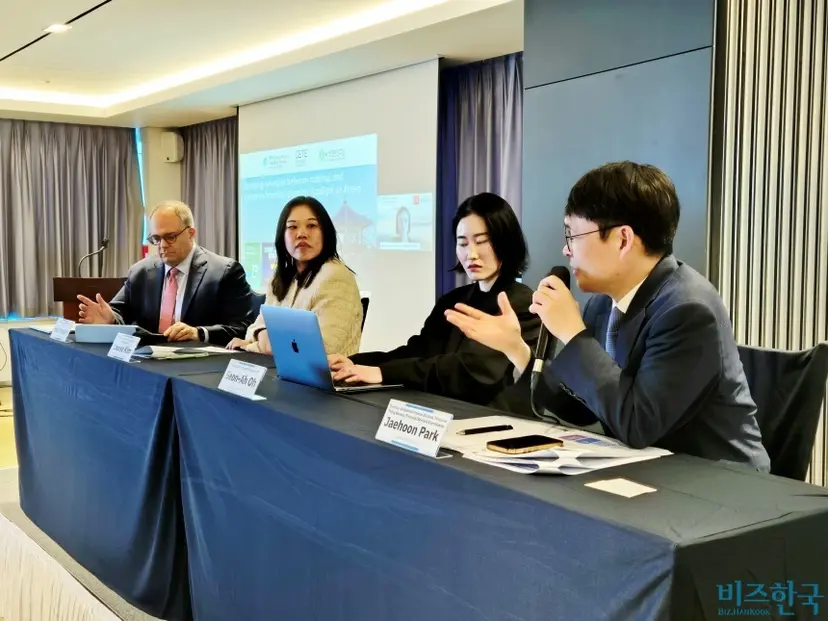
On the 23rd, the TPI Global Climate Transition Centre under the London School of Economics (LSE), the Centre for Economic Transition Expertise (CETEx), and the Green Transition Institute held a seminar titled 'Scaling Synergies Between National and Corporate Transition Plans: Spotlighting the Korean Case' during the United Nations Framework Convention on Climate Change (UNFCCC) Climate Week in Yeosu, Jeonnam.
During the seminar, Antonina Scheer, Policy Deputy Director at the TPI Centre, presented the results of an assessment of 46 major South Korean companies as part of the TPI Centre's climate action evaluation of 2,016 global firms. The TPI Centre’s corporate climate action assessment consists primarily of two pillars: 'Management Quality' and 'Carbon Performance'.
Management Quality evaluates how well climate change is integrated into corporate governance and management strategies on a scale from Level 0 to Level 5. Level 1 signifies an awareness phase of climate change, while Level 2 involves building capabilities such as measuring and managing greenhouse gas emissions. From Level 3, climate risks and responses are integrated into operational decision-making, and Level 4 involves systematically evaluating climate change as a strategic risk. Level 5, the highest level, is achieved when a company voluntarily establishes and implements a concrete transition plan.
According to the presentation, 18 out of 46 (39%) major South Korean companies achieved 'Level 5', the highest grade for transition management capability. This is an excellent result, significantly exceeding the global average (16%), as well as the Asian average (14%), Japan (27%), and China (0%). Representative companies that achieved Level 5 include POSCO (steel) and SK Innovation096770 (oil & gas).
South Korean companies also showed strength in Carbon Performance, which assesses the suitability of corporate emission reduction targets against Paris Agreement goals. 45% of Korean companies met the Paris Agreement standards, surpassing both the global average (28%) and the Asian average (24%). However, 18% of the total companies either had no voluntary climate disclosures or provided inadequate information. Korean Air003490 fell short of the Paris Agreement targets, while the integrated shipping company Pan Ocean028670 had no or inadequate climate-related disclosures.
Deputy Director Scheer stated, "For corporate efforts to translate into actual greenhouse gas reductions, policy directions that provide market certainty—such as disclosure rules, carbon taxes, and transparency in climate investment plans—are needed." She added, "Furthermore, the NDC (Nationally Determined Contributions) needs to be broken down at the sectoral level so that companies can plan their capital expenditures."
The seminar emphasized the importance of transition finance to realize corporate greenhouse gas reduction plans. Transition finance differs slightly from 'green finance', which funds eco-friendly industries. While green finance invests in businesses that are low-carbon by nature, such as solar or wind power, transition finance provides capital to help industries that are carbon-intensive but realistically indispensable—such as steel, petrochemicals, cement, shipping, and aviation—to shift toward reducing their emissions.
In other words, it is financing for companies that may not be completely "green" right now, but intend to change their carbon-intensive structures with clear reduction plans and implementation paths. Therefore, it goes beyond simple funding; it also requires the scientific validity of reduction targets, the specificity of implementation plans, and external verification and post-disclosure.
Kim Jung-soo, Director of the Sustainable Solutions Group at ING Bank APAC, pointed out that from an investor's perspective, transition finance is more difficult to execute than traditional green finance. Director Kim emphasized, "To attract capital from global investors, companies cannot rely on their own internal plans; independent third-party external verification, post-monitoring, and transparent disclosure are essential."
Oh Sun-ah, a researcher at the Green Transition Institute, pointed out that the government's transition finance guidelines apply standards loosely across all stages, including entry, verification, disclosure, and sanctions. Researcher Oh expressed concern, saying, "There is an issue where fossil fuel activities are included in the K-Taxonomy (the Korean green classification system), which could lead to capital inflows that extend the lifespan of high-carbon infrastructure such as liquefied natural gas (LNG) power plants."
![[UN Climate Week] Climate Crisis and Energy Security, the Common Answer is 'Renewable Energy'](https://s.bizhankook.com/attachments_thumb/2026/05/98275_thumb.webp)
![[UN Climate Week] Brainstorming Decarbonization Solutions for Steel and Petrochemicals for K-GX](https://s.bizhankook.com/attachments_thumb/2026/05/98368_thumb.webp)
![[UN Climate Week] Central Government Rushes, Local Governments Follow... A Long Road to Carbon Neutrality](https://s.bizhankook.com/attachments_thumb/2026/05/98379_thumb.webp)
![[UN Climate Week] Companies Ready for Decarbonization: "Calling for Transition Finance"](https://s.bizhankook.com/attachments_thumb/2026/05/98401_thumb.webp)
![[UN Climate Week] "Without Green Transition, Korean Steel Industry Faces Loss of Global Competitiveness"](https://s.bizhankook.com/attachments_thumb/2026/05/98382_thumb.webp)