

[비즈한국] Paradoxically, the semiconductor boom has brought unprecedented tension between labor and management at Samsung Electronics005930. A majority union emerged as dissatisfaction stemming from the compensation gap with competitors reached a tipping point. Having secured the legal status of an employee representative, the union advocates for pragmatism, aiming to look after the interests of employees without relying on higher-level labor organizations. With skepticism toward compensation principles amid record-breaking performance and the arrival of a new, pragmatic union, where will this strike lead on a path Samsung has never traveled before?
“And you’re standing on the edge, face up ’Cause you’re a natural.”
(You are standing on the edge now, look up. Because you were born for this.)
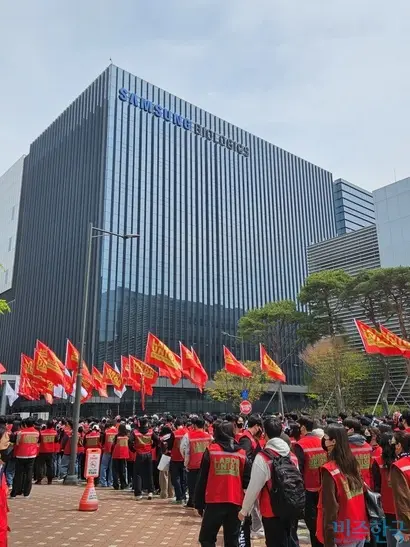
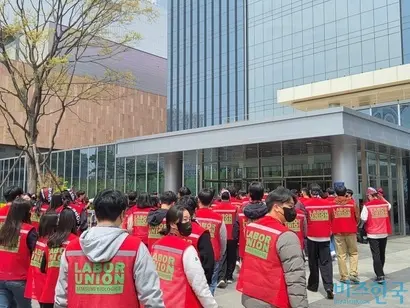
Noon, the 22nd, in front of Gate 1 of Samsung Biologics207940 in Yeonsu-gu, Incheon. The hit song 'Natural' by the world-famous rock band Imagine Dragons blared through the air. It was the site of the Samsung Biologics Sangsaeng (Mutual Growth) Union’s struggle rally.
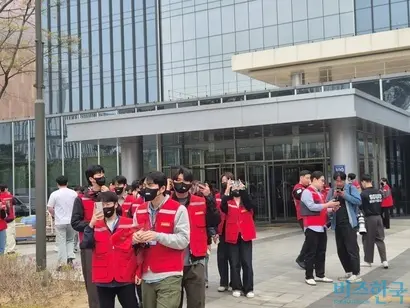
It was a far cry from the typical labor rally scene, where participants wear red headbands and sing struggle anthems or protest songs with grim expressions. At first glance, the sight of employees gathering in small groups, taking selfies with their smartphones, and laughing looked more like a festival. This is the new labor movement grammar of the so-called MZ generation.
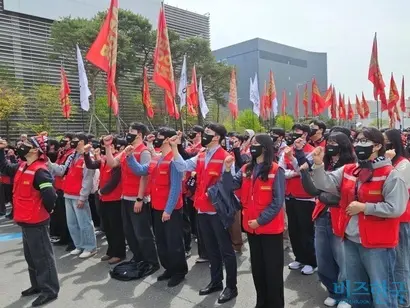
The union estimates that over 2,000 members participated in the rally that day. Pre-registrations alone reached 2,100. Employees from all job categories, not just production, participated, proving that dissatisfaction is not limited to a specific department. Employees who did not attend the rally could also be seen watching from a distance.
Winning Performance Bonuses? “The Core Issue is Restoring Broken Trust”
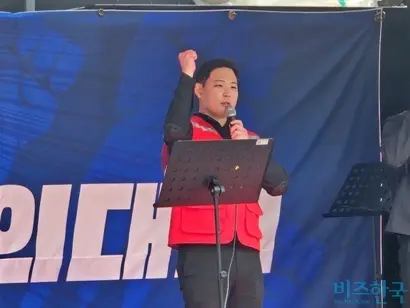
Park Jae-sung, head of the Sangsaeng Union, who took the microphone that day, clarified that the crux of the labor-management conflict is not just about wage hikes or performance bonus feasts. “We are not gathered here simply for improved wage conditions,” Park emphasized, raising his voice. “This is a struggle to restore broken trust and change the vertical and irrational decision-making structure where the company decides unilaterally and we are expected to just follow.”
The union has placed the emphasis of this industrial action not on money, but on the lack of respect and the need to restore lost trust. The direct catalyst for the labor-management conflict was the personnel document leak scandal that surfaced in November of last year. The leaked documents reportedly contained information regarding forced department transfers (re-linking), stigmatization of low-performers, and even the use of in-house mental health counseling records for disciplinary action or performance evaluations, which deeply shocked the employees.
In addition, the company's irrational handling of issues, such as the controversy over discriminatory holiday gift payments for contract workers, also came under fire. Park criticized, “The company hired major law firms Bae, Kim & Lee and Kim & Chang, spending more money to avoid giving holiday gifts worth a total of 15 million won to contract workers,” adding, “We must now put an end to the arrogant decisions and irrationality of management that even defies the legitimate decisions of the Labor Relations Commission.”
Seo Dong-min, a union member who took the podium, also spoke for the mood on the ground: “Are we here simply because the wage increase rate is low? We are here because we don’t want to work in an unfair environment, and we want to be compensated fairly for our work to protect our families and coexist with the company.”
Five-Day General Strike: Losses of Over 300 Billion Won Inevitable Due to Culture Process Nature
As the labor and management remained deadlocked through 13 rounds of negotiations and mediation by the Labor Relations Commission, the union pulled out the general strike card for May. The strike is scheduled to last for five days, from May 1 to May 5. Park explained that including public holidays like Labor Day and Children's Day was a strategic decision to minimize the burden on members—such as the use of annual leave and wage losses (from unpaid strikes)—while dealing a definitive blow to the company, given the nature of bio-factories that must run 24/7.
If the strike materializes, the financial blow to the company is expected to be significant. It is reported that the company filed for an injunction to ban industrial action, claiming that an immediate loss of 640 billion won would occur if the strike took place.
In a Q&A session with reporters following the rally, Park explained the impact of the strike by citing the specific nature of the culture process, which is central to biopharmaceutical production. He explained, “According to the company’s own data, the daily loss in revenue is about 12.8 billion won. If we go on strike for 5 days, and we assume that all batches in the culture stage—which take about 30 days—are discarded, a total of 35 business days of losses would occur (5 days of actual strike plus 30 days of culture time).”
Converted into monetary terms, this is expected to result in a loss of approximately 300 to 350 billion won. The union argued that even with temporary financial bleeding, correcting the company’s decision-making structure is essential from a long-term investment perspective. Hong Gwang-heum, Chairman of the Samsung Group Super-Corporate Labor Union, also gave a speech of solidarity. He lent weight to the claims of the Samsung Biologics branch, stating, “Our cry is not the greed of gluttonous pigs, but an effort to ensure our value—built through our blood, sweat, and tears—is fully recognized by a leading global company.”
A 40-Minute Festival-Like Rally: The Ball is Now in Management's Court
The 40-minute rally, which felt more like a festival, concluded peacefully without any physical clashes or major noise disturbances. After the rally ended, union members orderly cleaned up trash and left the site. However, underneath that facade was a firm warning directed at the company.
The deadline to prevent a catastrophe is April 30. Park left the door open, stating that regardless of the results of the injunction application expected on the 24th, the union is willing to return to the bargaining table at any time if management brings concrete and sincere proposals. He emphasized, “While there may be adjustments to financial compensation like performance bonuses, the top priority of this industrial action is to secure a reform plan for personnel principle systems to address last year’s document leak scandal and appropriate measures against those responsible for the incident.”
In some parts of the industry, there are also growing concerns over the union's plan to push ahead with a general strike. The logic is that trust with global pharmaceutical companies is critical in the CDMO (Contract Development and Manufacturing Organization) business, and if production schedules are delayed due to a strike, it could lead to difficulties in attracting clients in the long term.
An industry insider commented, “In the bio industry, supply delays are not just a simple breach of contract; they can immediately lead to the loss of market status. Since lost volume and market share are difficult to regain, the union’s demands for improved conditions could, in the long run, degrade the company’s order-taking capacity and have a negative impact on job retention.”
![[Deconstructing the Samsung Strike] ① Samsung Electronics and Bio Performance Bonus Strikes: What are the Decisive Issues?](https://s.bizhankook.com/attachments_thumb/2026/05/98301_thumb.webp)
![[In-depth Analysis of Samsung Strikes] ② Samsung Biologics Union Rally Features Pop Songs and Selfies: "Trust Over Performance Bonuses"](https://s.bizhankook.com/attachments_thumb/2026/05/98306_thumb.webp)
![[In-depth Analysis of Samsung Strike] ③ [On the Scene] The 'Giant' Ball Set in Motion by Hynix Shakes Samsung](https://s.bizhankook.com/attachments_thumb/2026/05/98335_thumb.webp)
![[In-depth Analysis of Samsung Strike] ④ The Shockwaves the Strike Will Bring to the Semiconductor Market During the 'HBM4 Golden Time'](https://s.bizhankook.com/attachments_thumb/2026/05/98412_thumb.webp)
![[Samsung Strike Analysis] ⑤ The Root of 'Relative Deprivation' Felt by Six-Figure Earners](https://s.bizhankook.com/attachments_thumb/2026/05/98425_thumb.webp)