

[비즈한국] Obesity is no longer a matter of individual willpower. It is a 'structural disaster' that causes 15 trillion won in socioeconomic losses annually. Bizhankook has set out to find fundamental solutions to the massive obesity bill facing our society. We examine the collapsed dietary environment for children and adolescents, and explore the intense policy dilemmas surrounding the reimbursement of obesity drugs and the introduction of a sugar tax. Furthermore, beyond the limits of medication-centric views, we highlight the innovation front of K-Bio, which is poised to change the landscape of the 100 trillion won global market.
Childhood and adolescent obesity is no longer a problem of personal gluttony or laziness, but a massive structural disaster facing our society. At the 63rd Spring Academic Conference of the Korean Society for the Study of Obesity (KSSO) held at the Walkerhill Hotel in Seoul last month, concerns were poured out regarding the crumbling dietary environment for children and adolescents. In particular, experts identified the 'double burden of malnutrition,' where both obesity and underweight are increasing simultaneously, as an urgent task our society must solve.

Sweetness that became a 'shield for complaints'... The collapse of public school meals
School meals are the final stronghold where children can have a balanced diet at least once a day. However, at the academic conference, criticisms continued, stating, "In an attempt to meet student preferences, overlapping food groups are served at once, or the proportion of processed foods is increasing abnormally for the sake of cooking convenience.".
The biggest problem is parental complaints. As parents complain about menus that do not suit their children's tastes, schools are compromising with sugar-heavy menus for administrative convenience. It has now become a daily routine, rather than an exception, for beverages and bread to be added as snacks once or twice a week. In effect, schools are becoming breeding grounds for obesity-inducing environments.
A parent who attended the KSSO conference bitterly pointed out the reality: "Parents say, 'Why don't you include this food that my child likes?', and the schools end up fulfilling all these demands, seemingly transforming into increasingly unhealthy menus." Regarding this, Professor Jung So-jung of the Department of Pediatrics at Konkuk University Medical Center noted, "We are aware that meal satisfaction surveys are getting worse," adding, "Linked projects that gather opinions from academic societies and reflect them in policies need to be strengthened.".

One side is obese, the other is 'bone-thin'... Nutritional polarization created by algorithms
While public school meals are collapsing into sweetness in reality, the digital environment in which children are trapped is even more serious. Recently, in classrooms, the 'nutritional polarization' phenomenon is deepening, with an increase in severely obese patients on one side and those suffering from anorexia on the other.
Unlike obesity caused by nutritional excess, being underweight acts as a factor that hinders physical development in adolescents going through puberty. Experts point out that because bone mass does not accumulate sufficiently due to lack of nutrition, it can increase the risk of fractures or osteoporosis in the future. Furthermore, it can weaken immune function, increasing the risk of infection, or become a cause of mental health issues such as depression and anxiety.
Professor Hong Yong-hee of the Department of Pediatrics at Soonchunhyang University Bucheon Hospital explained, "Overweight and underweight are within the spectrum of malnutrition and are not opposite problems," adding, "If an underweight child gains weight while growing, they accumulate fat more easily, which can actually increase the risk of chronic diseases such as obesity, diabetes, and cardiovascular disease.".
It is pointed out that the digital media environment, such as the algorithms of YouTube and TikTok, is fueling the worsening phenomenon of obesity and being underweight. Algorithms inject two extreme worlds into children who are trapped in front of mobile phone screens for 2 to 4 hours or more every day. They bombard one side with provocative 'mukbang' (eating shows) and food delivery advertisements, inducing binge eating and obesity, while demanding the 'bone-thin' (extremely skinny) challenge on the other side by glorifying the unnaturally thin bodies of celebrities.
The World Health Organization (WHO), recognizing these problems, strongly recommended reducing screen time in a new 2023 guideline. Digital devices not only deprive children of physical activity but also instill distorted dietary obsessions, making children forget how to eat healthily themselves.
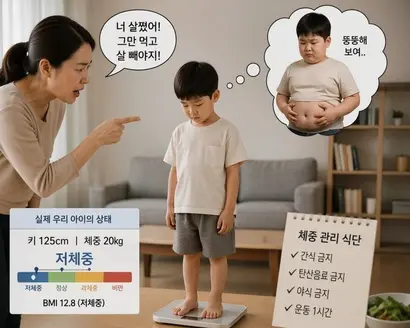
In addition, it is suggested that accurate growth assessments for children are important, as parents' distorted perceptions of their children's weight can lead to them being underweight. Professor Hong emphasized, "There is research showing that 18% of parents with children of healthy weight perceive them as obese," adding, "Accurate growth assessment and education on healthy weight for parents are crucial.".
Socioeconomic costs are 15 trillion won... 'No medicine works' without changing the environment
Approximately 80% of childhood obesity leads to adult obesity. Fat cells that increase during childhood create a body constitution that easily gains weight even with great effort after becoming an adult. This leads to the early onset of various chronic diseases such as type 2 diabetes and cardiovascular disease, resulting in 15 trillion won in socioeconomic costs annually.
Experts emphasize that the stigma of obesity, which dismisses it as a matter of individual willpower, must be erased. It is unreasonable to tell children to 'eat less and exercise' while leaving them exposed to the temptations of ultra-processed foods created by adults and a digital environment of distorted aesthetics. Before cheering for the emergence of innovative obesity drugs, fundamental measures such as correcting school meal trays that have succumbed to sweetness and lowering the barriers of the digital algorithms children face seem urgent.
![[The 15 Trillion Won Obesity Bill] ① School lunch trays ruined by 'complaints', children's health ruined by 'algorithms'](https://s.bizhankook.com/attachments_thumb/2026/05/98376_thumb.webp)
![[The 15 Trillion Won Obesity Bill] ② A society fattened by delivery apps: Medication alone is not a cure](https://s.bizhankook.com/attachments_thumb/2026/05/98333_thumb.webp)
![[15 Trillion Won Obesity Bill] ③ Is Covering Wegovy and Mounjaro a Benefit or a Burden to National Health Insurance?](https://s.bizhankook.com/attachments_thumb/2026/05/98389_thumb.webp)
![[15 Trillion Won Obesity Bill] ④ “Use Sugar Tax for Obesity Drug Subsidies,” Checking the Feasibility…](https://s.bizhankook.com/attachments_thumb/2026/05/98452_thumb.webp)
![[15 Trillion Won Obesity Bill] ⑤ "Eat, Patch, Lasts a Month": The Current Status of Localizing Obesity Treatments](https://s.bizhankook.com/attachments_thumb/2026/05/98465_thumb.webp)