

[비즈한국] This is not a plan for revitalizing golf courses. It is, quite literally, a story about the 'road.' There used to be a book titled 'The Way to the Golf Course.' It was a book created by a membership exchange. It provided brief introductions to golf courses across the country and guided readers on how to get there. It was a must-have for golfers, kept tucked away somewhere in their cars. (I'm sure I have it somewhere if I look.) The instructions were something like, 'Take the Gyeongbu Expressway, exit at such-and-such IC, take such-and-such national highway, and turn right at such-and-such intersection.'
It was a book that made you spread out the page for the golf course you were visiting the day before, memorizing and studying the route repeatedly just in case you took a wrong turn and ended up late. Of course, on the day of the round, I would often hold the book in one hand and the steering wheel in the other. Those were the days I learned numbers like National Route 3, 42, 45, 46, and 47. There was no GPS navigation back then. If you made a wrong turn once, you were bound to keep making them. Since I had to stay sharp, I naturally developed a good sense of direction. Now, I confuse the last digits of the national highways.
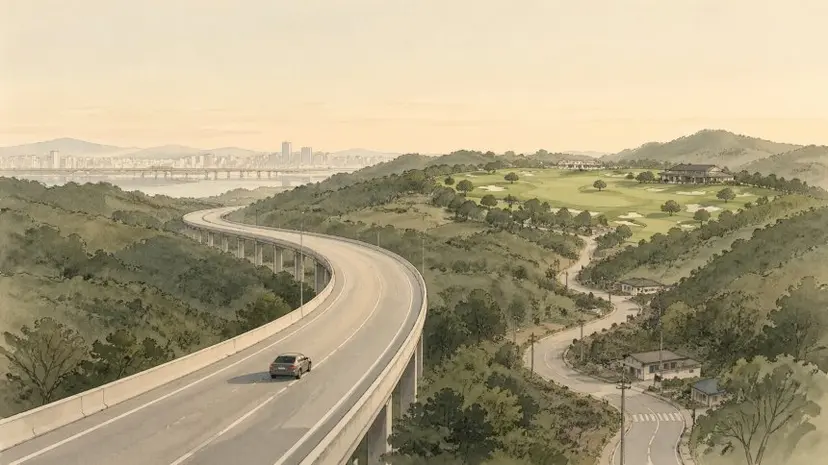
A certain golf course in Pocheon, Gyeonggi-do, is less than 60 kilometers from my house. Yet, it felt far. Club72 in Yeongjongdo is nearly 80 kilometers away, but given the reality of South Korea where it takes less than an hour if you leave at dawn when there is no traffic, it becomes a reasonable (?) distance. It's because of the road. It depends on how much time you spend on the expressway and how much you have to drive on winding roads after exiting. During the summer vacation season, I once got stuck for 4 hours on National Route 47 coming from Pocheon to Seoul. That was before the Guri-Pocheon Expressway was built.
It goes without saying that a good road makes distances feel shorter. This is because we measure physical distance in time. Just as apartment prices rise due to a newly built subway station, the value of golf course memberships rises when a new road is built in front of them. 'Only minutes away from Gangnam thanks to the opening of the [So-and-so] Expressway' is the number one PR talking point.
Pristine Valley and Midas Valley were not exactly close golf courses either. That was the case until the Seoul-Yangyang Expressway was built. Yangju CC was also close in terms of distance, but before the automobile-only road was built, you had to drive for quite a while at a reduced speed along that old road—the same one I used to take for college retreats. Oak Valley CC is a course I personally like. At the same time, it was a burdensome course for a day trip. Even after driving diligently on the Yeongdong Expressway and reaching the Munmak IC, I would think, 'We're almost there,' but in reality, I still had a long way to go after passing the interchange. This was before the Gyeonggi-Gwangju (Second Yeongdong) Expressway's Seowonju IC was built.
For Blue Heron, they even built a back road to the golf course shortly after exiting the interchange. There were even rumors that someone influential was behind the Nami-cheon IC on the Jungbu Expressway because it was an interchange added to an existing road. It's understandable, isn't it? An interchange that didn't exist suddenly appeared. The surrounding golf courses were the biggest beneficiaries. Places that were burdening because they were far, despite having great courses, became closer.
I had been going to Anseong Benest since its days as Seven Hills, long before it became 'Benest.' Of course, I went occasionally. The course wasn't bad, but the route was complex and far. When the distance is far, your heart also drifts away. The road up past Geumgwang Lake is quite long, and the route from Seoul to that lake was also complex and arduous. This was also before the Sejong-Pocheon Expressway was built.
The Sejong-Pocheon Expressway simplified the route from my house to Anseong Benest and reduced the time. It took just over an hour. Anseong Benest in an hour! It wasn't very far from the Anseong-matchum IC to the golf course. A course that used to require great effort to visit can now be visited with a light heart. That is the 'power of the road.' Thanks to that road, people like me who think, 'It's worth going now,' will increase, and won't the number of visitors increase, too? It is the 'road' that revitalizes a golf course.
A lot of time has passed. While I was playing golf, many new roads were built. At the very least, South Korea is the best country in the world at building roads. Whenever I think, 'I wish there was a road from here to there,' that road appears before I know it. It makes the roads that need to exist, exist. They are likely building roads even now for our 'way to the golf course.' I wonder which golf course will be revitalized by the next 'road.'
Who is the author, Kang Chan-wook? An advertiser and writer. Starting as a copywriter at Cheil Worldwide, he is currently the CEO of the video production company 'Sidae-ui Siseon' (Perspective of the Era). Fond of golf, he obtained his USGTF teaching professional certification, and with a passion for writing, he has published books on golf such as 'The Joy of Golf,' 'Bad Golf,' 'Sincere Golf,' and 'Golf Thoughts, Thinking Golf.' He runs the YouTube channel 'Bad Golf,' sharing various stories and thoughts surrounding golf with readers and viewers.