

[비즈한국] New telescopes reveal secrets that were previously invisible. As soon as the Hubble Space Telescope was launched, astronomers discovered strangely warped galaxies throughout the universe and realized that the universe is actually rippling with waves of spacetime. Now, such gravitational lens images have become a common everyday occurrence, appearing no matter where we look.
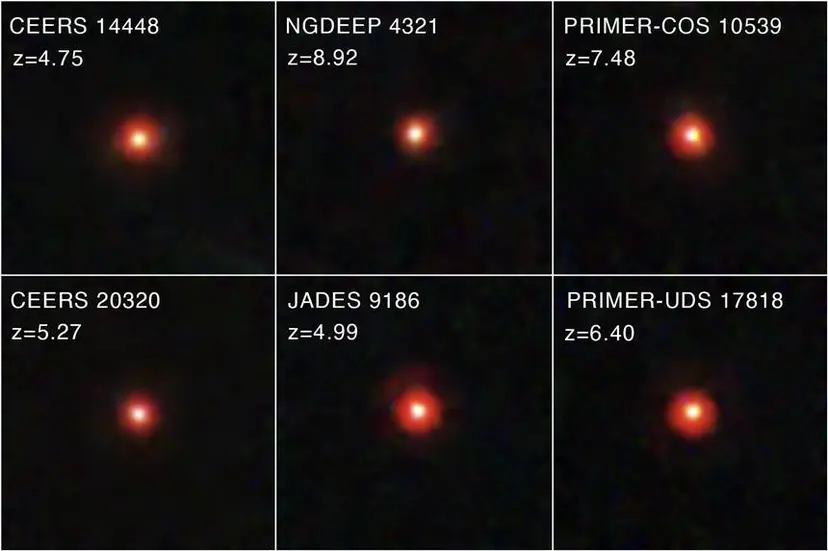
The James Webb Space Telescope continues to show even more baffling sights that even Hubble could not see. In particular, when James Webb looks into the very distant, early universe, too many red dots appear at the edge of the universe. These red dots are called LRDs (Little Red Dots), and their exact identity has not yet been revealed. It is difficult to call them ordinary primordial galaxies, but it is also difficult to see them as massive, shining stars in the very distant universe.
The problem is that they are found quite commonly. If they were found only occasionally, we might think of them as one of the strange celestial bodies in the early universe, but that is not the case. LRDs seem to be a very common landscape of the early universe.
The red dots were first discovered while exploring to solve the missing link yet to be resolved in the evolution process of galaxies. A giant black hole hides at the center of almost every galaxy, and the mass of that black hole is neatly proportional to the mass of the galaxy. In fact, in terms of mass ratio, the black hole at the center of a galaxy is a negligible level, only 1/1000 of the total galaxy mass, but the fact that the (relatively) small black hole follows a neat law with the mass of the giant galaxy makes us wonder about the possibility of co-evolution between black holes and galaxies.
The problem is that we do not know the exact origin of the black hole at the center of the galaxy. For much lighter stellar-mass black holes, we know the mechanism by which black holes are created through the collapse of heavy stars. However, it is not yet certain for the supermassive black holes at the center of galaxies. It is not even clear whether the galaxy was created first and then matter clumped together at its center to form a black hole, or whether the black hole was born first in the early universe and the galaxy we see today was formed as matter gathered around it.
Astronomers expected that if James Webb looked to the edge of the universe, it would see the scene where the primordial supermassive black hole is formed. A black hole attracts surrounding matter with strong gravity and causes it to orbit very rapidly. Therefore, the light around the black hole undergoes an extreme Doppler effect, and the wavelengths of its emission lines appear broader in the spectrum. This is called line broadening. If such features are found in the spectrum, we can know that there is a giant black hole at the center.
Many celestial bodies showing such broad line widths were discovered through James Webb observations, and surprisingly, their appearance in the photos was even more baffling. If matter is orbiting that fast, the size should naturally be very large. However, the red dots that appeared in the photos were actually very small. This suggests that while this celestial body might have a very heavy mass, it could be a very compact, high-density lump of very small size. But this is neither a normal galaxy nor a black hole we know. It is a completely different kind of celestial body that we have never seen before.
The very distinct red light is also a mystery. At first glance, one might think it emits a lot of infrared light because the giant black hole is wrapped in a very thick and dense dust cloud. In cases where an active galaxy is hidden within a giant dust cloud, strong infrared light is actually observed even in nearby galaxies. But there is a problem. Such active galaxies emit not only infrared light but also stronger light such as X-rays and gamma rays. However, the LRDs captured so far emit only vivid, bright red infrared light.
Some astronomers estimate that this is because a very light primordial galaxy with few stars harbors a very heavy black hole that is disproportionate to its size. It is sometimes considered evidence for the hypothesis that black holes grew in size first, and then matter gathered later to form the galaxy. However, such an overly compact, or "tight" lump, is difficult to imagine in existing standard universe models. Even with simulations, such celestial bodies are not well reproduced. This means that the way the early universe evolved could be quite different from the picture we have peacefully thought of until now.
This study argues that the identity of LRDs is what is known as a 'Direct Collapse Black Hole,' where a giant gas cloud collapsed all at once. A giant gas cloud can skip the process of making stars, bypass processes like supernova explosions, and collapse directly to create a primordial black hole nearly 1,000 times the mass of the Sun. And that can eventually grow into a massive supermassive black hole with tens of millions of times the solar mass living in the center of today's galaxy by gradually swallowing more matter and merging with others.
Direct collapse black holes are considered seeds for supermassive black holes, but their existence has not yet been clearly proven through actual observation. However, in this study, astronomers argue that the identity of LRDs is indeed these legendary direct collapse black holes. They simulated the formation process of direct collapse black holes and reproduced what kinds of light and spectra should be observed in the surroundings; the result was similar to the typical appearance of the LRDs currently captured by James Webb.
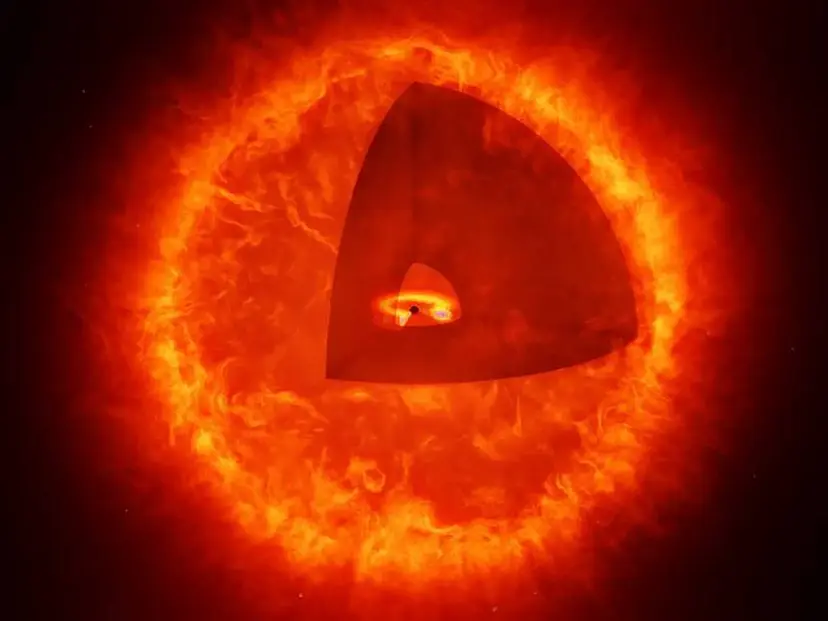
The result is quite interesting. You just need to have a giant black hole at the center and cover it with a very ordinary dust cloud in the surroundings. The dust cloud absorbs the light leaking from around the black hole and re-emits it, resulting in the emission of only red light, which is skewed mostly toward the infrared. And exactly the spectrum of the LRD is created. Stars are not needed here. The exact spectrum of an LRD can only be reproduced if there are no stars and only hydrogen gas and dust clouds are hiding the black hole.
Unlike other common active galaxies, the reason why gamma rays and X-rays are not well observed in LRDs can also be explained. If a giant cloud collapses so instantly and a giant black hole is created, the dust cloud must have been quite dense to begin with. Because the black hole is hidden inside a very dense dust cloud, most energy cannot penetrate the dust cloud, and the ordinary levels of X-rays emitted by the black hole are absorbed as is. The dust cloud absorbs the X-rays and re-emits them as infrared light, making the LRD even redder, but no other powerful X-ray emissions are detected.
Some even give such models a more dramatic name: a black hole star! It is a form that has a black hole at its center, surrounded by a high-density gas cloud as if it were one giant star, harboring the black hole. Furthermore, because it is a celestial body in the early universe, the gas and dust cloud is mostly made of pure hydrogen. Therefore, it is safe to consider it a giant mass of hydrogen harboring a black hole at the center—truly a giant star containing a black hole.
The universe is so strange. It becomes even stranger, especially as we go back to the universe of the past. We thought the universe was a world filled only with ordinary stars and galaxies, but it wasn't always that way. Perhaps after a very, very long time, today's universe might be considered strange. All of today's ordinary stars and galaxies will eventually disappear and be pushed out of the mainstream of the universe. And celestial bodies of bizarre forms we cannot imagine will reveal themselves, take over as the new mainstream of the universe, and turn today's stars and galaxies into strange existences. When that time comes, we will be the new LRDs.
References
https://ui.adsabs.harvard.edu/abs/2026arXiv260114368P/abstract
https://www.aanda.org/articles/aa/full_html/2025/09/aa54681-25/aa54681-25.html
Who is Ji Woong-bae? He loves cats and the universe. After watching 'Galaxy Express 999' as a child, he dreamed of spreading the beauty of the universe. Currently, he is an assistant professor in the Faculty of Liberal Arts at Sejong University, participating in various science communication activities such as lectures and writing. He has written books such as 'A Piece of the Universe Every Day', 'Scientists of the Starry Universe', 'Things You Can Know Though You Cannot Go', and 'Strange Questions That Come to Mind When Looking at the Universe', and translated books including 'The Hitchhiker's Guide to the Real Universe', 'How I Killed Pluto', 'Quantum Life', and 'Cosmigraphics'.