

[비즈한국] Companies sometimes make decisions that are difficult to explain based solely on money. Understanding the laws or systems hidden behind these decisions can provide a clearer perspective. 'Useful Business Laws' (Al-Ssul-Bi-Beop) introduces clues to help understand business trends.

As competition between businesses heats up, marketing naturally becomes more aggressive. In the process, disputes over a competitor's advertising also rise. When a business deems a competitor's advertisement inappropriate, what means of recourse are available?
The first option that comes to mind is criminal prosecution. For instance, one could consider filing a complaint for obstruction of business or fraud. However, companies actually engaged in business often feel significant pressure about taking advertising disputes directly to criminal court. Even in practice, it is extremely rare for fraud to be recognized in advertising-related disputes. This is because criminal liability is difficult to establish unless the case is an exception where the falsity is blatant and the potential for moral censure is extremely high.
Looking at actual cases, there was an instance of 'anomalous sales' advertising, where a new product that had never been sold before was immediately placed on sale, with a prior price and discounted price listed side-by-side as if a previous sales price had existed. In another case, products sold as 'special project' mountain-grown wild ginseng were actually just artificially cultivated ginseng, and the certificates were fake, yet they were marketed as authentic mountain-grown wild ginseng planted by seeds in deep valleys and harvested after decades. Unless the falsity of the advertisement is clear and it can be seen as significantly distorting the transaction counterparty's judgment, establishing criminal liability is not easy.
Civil claims for damages are also an option. Looking at legal precedents, there are not a few cases where liability for damages was recognized due to false advertising. Most of these involve consumers challenging real estate presale advertisements or financial investment product marketing. A typical example is when a buyer files a claim for damages against a developer or contractor because an advertisement promised the construction of a marine park or a light rail transit near the apartment, but those plans were never actually carried out.
On the other hand, it is relatively difficult to find cases where a competitor successfully held another competitor liable for damages due to false advertising. The reasons are clear. First, it is questionable whether a legally evaluable loss occurred for the competitor due to the false advertisement. Even if a loss is acknowledged, proving the causal link between the advertisement and the loss is extremely difficult. Ultimately, while civil and criminal litigation in advertising disputes between competitors may be theoretically possible, they are rarely easy or efficient tools in practice.
For this reason, practitioners often move to the next step: reviewing potential violations of the Fair Labeling and Advertising Act or the E-Commerce Act. The Fair Labeling and Advertising Act prohibits unfair labeling and advertising and provides for administrative sanctions. While criminal reporting is institutionally possible, most cases end at the administrative sanction stage, except for exceptional cases like the humidifier disinfectant scandal. Advertising cases involving E-Commerce Act violations are also generally handled as an extension of this Fair Labeling and Advertising Act practice.
Unfair advertising prohibited under the Fair Labeling and Advertising Act is generally categorized into: △false/exaggerated advertising, △deceptive advertising, △unfair comparative advertising, and △slanderous advertising. However, these concepts are largely based on indeterminate terms. Expressions like 'false,' 'exaggerated,' 'deceptive,' 'likely to mislead,' and 'likely to harm fair trade order' are not clearly defined by their wording alone. Ultimately, they must be interpreted based on the context of specific cases, the expression style of the ad copy, the media where the ad was placed, trading practices, and consumer perception.
Sometimes, literature or commentaries list the provisions of the Fair Labeling and Advertising Act as if one could identify unfair advertising just by reading the statutes. However, actual practice is not like that at all. In many cases, the statutes alone do not help much in determining whether an individual advertisement is illegal. Depending on the interpretation, a large number of real-world advertisements could all appear to be unfair. This is because advertising essentially involves a certain level of exaggeration and emphasis to attract consumer attention. Consequently, practitioners must look beyond the statutes to include the Fair Trade Commission's (FTC) rulings, court precedents, and recent enforcement trends.
Looking at FTC rulings, cases acknowledging unfair advertising can generally be grouped into several types. First, cases where the falsity and potential for consumer confusion are relatively clear. For example, a tutoring academy based in Daegu advertised that its instructors were graduates of the 'Seoul National University Department of Mathematical Sciences' and claimed it 'produced many SKY and medical/dental school admits every year,' but this was either untrue or significantly exaggerated. The FTC issued a corrective order for this.
There was also a case where a golf ball seller used phrases like 'No. 1 KPGA ball usage rate' and 'The most influential ball selected by KPGA pros,' making it seem as if the balls were the most frequently chosen by players in KPGA-sanctioned first-tier tours. In reality, there was no objective or rational basis to support such claims. The FTC deemed this unfair advertising and imposed a corrective order along with a fine of 206 million won. These cases demonstrate the high legal risk associated with using definitive terms like 'No. 1,' 'most,' 'overwhelming,' or 'most influential' without objective evidence.
Second, the deceptive advertising type where consumers are misled by omitting important facts that should have been disclosed. This has become more frequent due to recent IT advancements and the popularization of online platforms. For instance, there have been cases where advertising agencies recruited influencers to post reviews of restaurants or accommodations on social media without disclosing that the posts were advertisements based on economic interests. The FTC judged this as unfair advertising that misled consumers into thinking they were spontaneous reviews and issued corrective orders.
A similar context applies to a case where a tax platform operator used phrases like 'A new refund has arrived,' 'Selected for refund inquiry,' and 'You are a priority refund check subject.' In reality, no new refund had occurred, nor had the user been selected through a specific process. It merely created the perception that a substantial benefit had already occurred for the individual consumer. The FTC deemed this unfair advertising and imposed a corrective order and a fine of 71 million won.
Third, cases where specialized testing, analysis, evaluation, or certification is needed to justify an advertisement, but efficacy or safety is claimed definitively without such objective evidence. For example, a product label for a mattress disinfectant claimed that it 'used materials harmless to the human body,' while analysis from domestic and international specialized research institutes showed that it contained ingredients with a certain level of toxicity or health hazards depending on the contact route.
The FTC viewed this ad as false/exaggerated and issued a corrective order. Recently, as consumers are highly interested in toxic ingredients, eco-friendliness, non-toxicity, antibacterial properties, and functionality, ads in these areas require particularly strict review. Expressions like 'harmless to the human body,' '100% safe,' and 'completely non-toxic' are highly attractive in marketing but can be very dangerous if there is insufficient evidence to support them. Therefore, businesses should temper the level of their expressions and ensure they obtain sufficient test and analysis data from professional institutions beforehand.
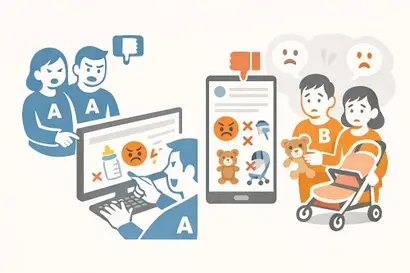
Fourth, though relatively rare, there are advertisements that secretly slander or criticize competitors. In a case where an advertising agency used 54 internet sites to post 274 comments and posts slandering a competitor's baby mat product, the FTC judged this to be deceptive advertising and imposed a corrective order and a fine of 500 million won. This type often takes the form of online public opinion shaping, review manipulation, or viral marketing rather than traditional advertising. However, in essence, it negatively affects consumer choice by artificially creating a negative perception of a competitor, which is enough to become an issue under the Fair Labeling and Advertising Act.
Summarizing these cases, it is evident that unfair advertising is not indiscriminately recognized in any ad, but rather concentrates on certain types of behavior and areas of interest. Notable examples include definitive expressions of market dominance or superiority without objective evidence, 'hidden' advertisements that conceal economic relationships, claims about human safety or functionality without supporting data, and posts or comments that secretly slander competitors.
However, the reason unfair advertising cases are difficult in practice is separate. Primary enforcement authority is concentrated in the FTC, and given that the FTC must handle a large volume of cases, it inevitably prioritizes cases based on severity, policy priorities, and social impact. Therefore, even if a reporter thinks an advertisement is suspect, it is hard to rule out the possibility that the case will be closed as 'no charges' or by terminating the review process if the FTC determines there is low need for policy enforcement or insufficient social concern. For this reason, in the past, it was difficult to easily advise businesses to actively report competitors for unfair advertising.
However, the situation has recently changed. As the domestic online commerce environment has reorganized around a small number of large platforms, the internal judgments of individual platforms now have a much greater impact on the business of sellers than in the past. Now, how a platform evaluates a specific ad or sales post is practically as important as the FTC's final sanctions. If a competitor reports a rival's ad to a platform, and the platform removes the ad or restricts its visibility based on its own criteria, that business's operations can suffer significant restrictions. In some cases, platform actions can lead to more immediate and fatal results than FTC sanctions.
Ultimately, for businesses today, advertising compliance is no longer a matter of post-dispute response, but a constant management task directly tied to business continuity. Businesses advertising or selling products on online platforms must meticulously check their ad copy, images, review management methods, comparative expressions, and claims regarding safety/efficacy for legal issues in advance. Simultaneously, there is a need to continuously monitor competitors' advertisements. This is because advertising disputes are no longer just simple arguments over copy, but a comprehensive risk management issue intertwined with platform distribution structures, FTC enforcement, and market competition strategy.