

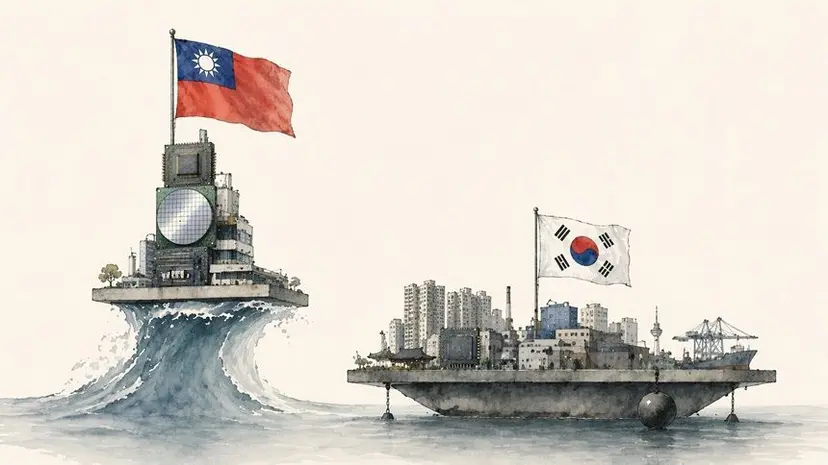
[비즈한국] This year, Taiwan's GDP per capita surpassed $40,000 for the first time among the four East Asian economies, widening the gap with South Korea, which remains in the high $30,000 range. However, experts warn that it is premature to interpret this gap solely as Taiwan's 'economic superiority.' While both nations are riding the wave of the AI-driven semiconductor boom, Taiwan's rapid ascent also carries the risk of over-reliance on a single industry centered around TSMC.
According to the World Economic Outlook report released by the International Monetary Fund (IMF) on the 15th, Taiwan's GDP per capita is projected to reach $42,103 (approximately 61.8 million won) this year, a 6.6% increase from the previous year. South Korea’s figure stands at $37,412 (approximately 54.91 million won), a mere 3.3% increase from the previous year, failing to narrow the gap with Taiwan, which overtook South Korea 22 years ago. The IMF forecasts that the gap between the two countries will widen to over $10,000 within five years by 2031.
The 'Semiconductor Illusion' Critique: Applying Equally to Taiwan
Taiwan's growth is impressive. Its real GDP growth rate for 2025 is estimated to exceed 7%, a figure that far surpasses the expectations of both Taiwanese statistical authorities and external forecasting institutions. This is a result of the foundry ecosystem, centered on TSMC, exclusively handling the AI chip demand from global big tech firms like NVIDIA.
However, there are voices of caution even within Taiwan regarding the sustainability of this growth. Alicia Garcia-Herrero, Chief Economist for Asia Pacific at Natixis, a French global investment bank, described Taiwan's 6% growth projection as "totally crazy" for an advanced economy in an interview with Global Finance Magazine. She also raised concerns that Taiwan's economic growth is "focused on industries that are entirely dependent on demand from that single sector," referring to semiconductors and packaging.
In fact, exports account for 67% of Taiwan's GDP, with AI-related items making up more than 65% of total exports. As the current account surplus exceeds 15% of GDP, reaching a world-leading level, external risks such as accusations of currency manipulation and pressure for currency appreciation are also growing. In short, Taiwan's crossing of the $40,000 GDP per capita threshold can be interpreted as a 'result of riding the AI super-cycle' rather than 'structural strength.'
South Korea is also recording record-breaking performances due to the High Bandwidth Memory (HBM) boom led by Samsung Electronics005930 and SK Hynix000660. In its report titled 'Review of the Sustainability of the Global Semiconductor Expansion' released on the 12th, the Bank of Korea noted that the current semiconductor expansion is expected to continue until at least the first half of 2027, but also identified the verification period for AI investment profitability, the ability of big tech firms to secure funding, and the technological pursuit by Chinese memory firms as risk factors.
What is noteworthy is that most of these risk factors apply equally to Taiwan. If the monetization of AI investments is delayed or big tech capital expenditure (CAPEX) slows down, TSMC, which manufactures those chips, will inevitably take a direct hit just as much as the Korean companies that supply HBM. Ju Won, head of the research division at the Hyundai Research Institute, also pointed out in January that "the reversal in GDP per capita is largely due to the depreciation of the won and reflects a 'semiconductor illusion,' so it should not be over-interpreted."
The Real Reasons for the GDP Gap: 'Population and Exchange Rates,' Not 'Semiconductor Structure'
Ultimately, the analysis suggests that the key variable driving the GDP per capita gap between South Korea and Taiwan lies in structural differences rather than the superiority of the semiconductor industry. First is the difference in population size. South Korea (approximately 51.68 million), with a population 2.2 times that of Taiwan (approximately 23.4 million), is inherently at a disadvantage in per-capita metrics. Second is the weakness of the Korean won. Due to the nature of dollar-denominated GDP, with the won-dollar exchange rate hovering in the 1,460 range, South Korea’s dollar-denominated GDP per capita is calculated as lower than its actual economic power. If the exchange rate were to drop to the 1,400 range alone, GDP per capita would rise to the $38,500 range.
Third is the structural difference in potential growth rates. Due to the world's fastest rates of low birth rates and aging, South Korea's potential growth rate is estimated at 1.7–2%. While Taiwan also faces aging issues, it has relative leeway in its manufacturing base, immigrant inflows, and female economic participation rates. This represents a long-term difference in underlying strength, unrelated to the semiconductor cycle.
There is no need to undervalue Taiwan's achievements. However, the binary view that contrasts Taiwan as a 'semiconductor-based structurally superior nation' and South Korea as a 'nation swayed by the memory cycle' simplifies reality. Both nations are riding the same wave of the AI boom, and the impact when that wave subsides is a challenge both countries must overcome.
Nevertheless, the persistence of Taiwan's industrial policy—creating an ecosystem around TSMC and designing incentives for R&D investment—is highly commendable. At the same time, the homework we need to solve is not just the semiconductor cycle itself, but rather structural issues beyond semiconductors, such as the stagnation of other manufacturing and service sectors, domestic demand slump, demographic structure, and exchange rate volatility.