

[비즈한국] Whenever you create touchpoints between Korean startups expanding to Germany and German companies looking toward Korea in Europe, you always encounter similar scenes. There is good technology. There are good investors. There are certainly European players interested in Korea. However, a structure where these three meet regularly, trust each other, and actually move on to the next action is rarer than you might think.
There are quite a few Korean investors in Europe. In Germany alone, venture capitalists (VC), corporate venture capitalists (CVC), family offices, and business development experts are actively working in cities like Berlin, Munich, Frankfurt, and Cologne. Yet, they have rarely functioned as a single network connecting Korea and Germany, or even Korea and Europe at large. Some look at Korean startups, others review European deals, and some contemplate strategic partnerships for major corporations, but this flow has never been connected into an ‘operating system.’
That is why I did not want the ‘Korea–Germany Investors Network – Inaugural Dinner,’ held in Berlin, to be just a simple dinner. This event, prepared jointly by the Embassy of the Republic of Korea in Germany and the company I work for, 123 Factory, may look like a networking event with a dinner on the surface, but in reality, I hoped it would be the starting point for an execution-oriented public-private partnership investor network that connects Korea and Germany.
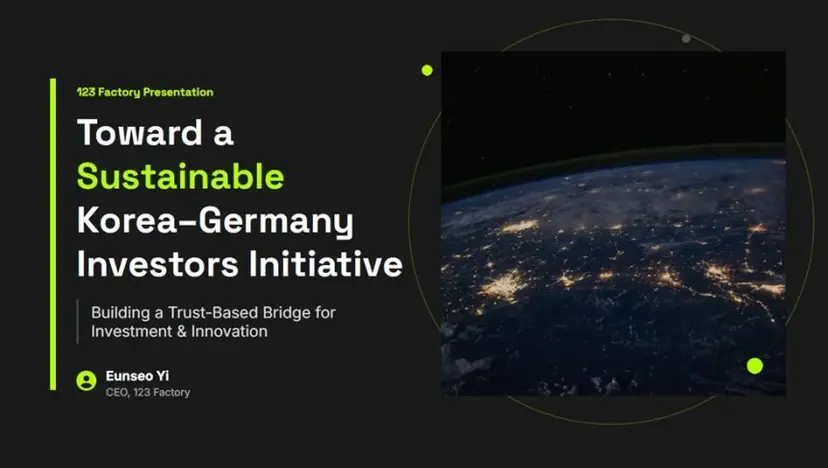
The format of the event was intentionally kept small and flexible. There were no long speeches and no heavy panel discussions. Starting at 6:00 PM (local time) on April 17, attendees arrived and greeted each other at the reception, followed by welcoming remarks from Lim Sang-beom, the Ambassador of the Republic of Korea to Germany, at 6:30 PM. Afterward, institutions like KIC, KOTRA Hamburg, and KEIT introduced their organizations and explained Korean investment opportunities. 123 Factory gave a brief explanation of why such a gathering is needed now, followed by a session where attendees introduced themselves in turn.
The critical question I kept asking myself was: "Will we be able to meet again after this first gathering? If so, why and how?" Amidst a buffet-style dinner and free-flowing networking, I believed that time spent candidly discussing which sectors each person is watching, which companies they are meeting, and what is currently missing between Korea and Germany was more important than any formal presentation to ensure the thought "I want to meet them again" takes root.
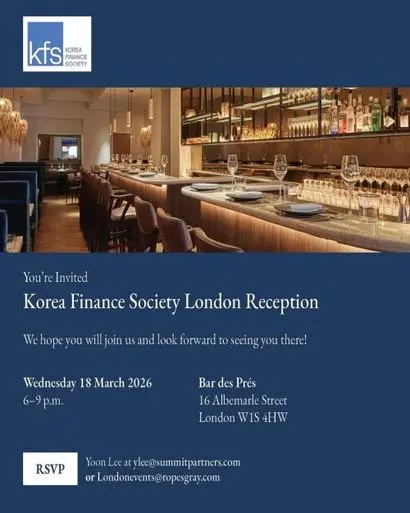
The direct starting point for this gathering was the Korean Financial Society (KFS), a Korean-American financial network in the U.S. Additionally, the European version of the KFS meeting held in London on March 18 served as a significant stimulus for me. Seeing Korean finance professionals and investors voluntarily connecting across borders and converting mutual information and trust into actual assets for cooperation convinced me that such a foundation could be created in Germany, and it turned my thoughts into a more concrete plan.
To turn that concept into reality, the Embassy of the Republic of Korea in Germany first laid the official groundwork. I took on the role of contemplating how the private sector could make this network function effectively. The environment in Europe is a bit different from the U.S. The ecosystem is scattered across multiple cities—London, Berlin, Paris, Amsterdam, and Zurich—and investor interests are more segmented into areas like finance, deep tech, industrial technology, climate tech, mobility, and healthcare.
Therefore, a network in Europe cannot be sustained by merely "exchanging business cards." Ultimately, there must be a structure that is truly helpful to one another—in other words, an operational structure. Specifically, we need a setup where Korean finance professionals and investors voluntarily connect and turn their shared information and trust into assets. This was the word I thought about the most while preparing for this gathering: Operational.
Anyone can talk about vision. Phrases like "Korea-Germany cooperation is important," "Korean startups need to enter Europe," and "European investors should also look at the Korean market" have been repeated countless times. But when it comes down to practical work, things often stall in front of questions like: Who will introduce which company? Who will help with local verification? Who will connect the next meeting? Which event will we meet at again? Who will support business development after the investment? I hoped this network would become a structure that gradually fills such gaps.
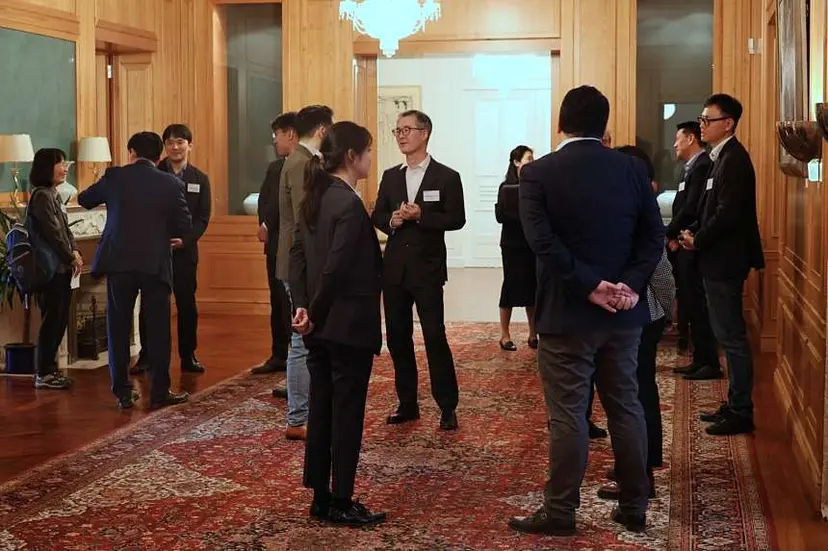
Looking at the profiles of the attendees, the need for such a network becomes even clearer. In addition to Korean investors, the event included investors, strategic department officials, and business development experts who are seriously considering the possibility of collaboration with Korea. Some are already contemplating deep-tech cross-border funds connecting Europe and Korea, while others have shown interest in Korea's regional industrial ecosystems. Others were looking for Korean technology with high potential for successful business commercialization in the European market. I believe this combination is crucial. It is because a network should not just be bound by the identity of being "Korean," but rather composed of people who have the genuine will to actually build something between Korea and Germany.
Moving forward, I intend to expand the connections to a European level beyond Germany. If Korean investors scattered across London, Paris, and Berlin meet, it becomes possible to have much more substantial discussions—not just for socialization, but for deal sourcing, joint review, and introducing Korean companies.
Next is a tech tour of Korea's regions. While Korea's investment ecosystem is still Seoul-centric, actual industrial competitiveness is often more deeply rooted in the regions. Gwangju's mobility, Daejeon's deep tech, and Ulsan's manufacturing and shipbuilding-based industries have strengths that are difficult for external investors to understand through documents alone. Therefore, when showing Korea to others, I believe it is more persuasive to show the sites and technological foundations of regional industries directly, rather than just having a few startups give presentations. This is because investors ultimately gain conviction in the field.
In this regard, another significance of this event is that the division of roles between the public and private sectors was relatively clear. The embassy provided the foundation so that this gathering could start with public trust and dignity. Public institutions provided institutional and policy links between Korea and Germany. And field-oriented partners like 123 Factory took on the role of designing and driving actual follow-up actions. I believe this combination is quite important. The government cannot do everything, and it is difficult for the private sector to build trust alone. Ultimately, the network comes to life only when the primer and the engine work together.
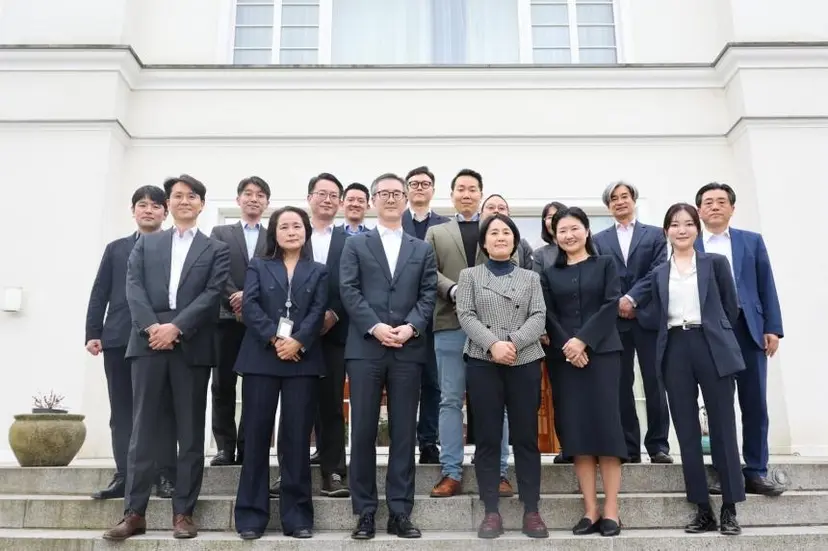
In fact, I am a bit wary of the word "networking." Even in Europe, too many events talk about networking, but a significant number of them are forgotten immediately after the event. Business cards pile up, but no relationships remain; conversations were pleasant, but there is no next step. That is why I thought this meeting had to be different from those events, at the very least. I wanted participants to leave not just with the feeling that they "met some good people," but with a sense that they "have a hunch about what they can do with this person next."
It was even more meaningful to be able to create this in Berlin. On the surface, Berlin may look free and loose, but in reality, it is one of the places in Europe where the most experiments take place. It is a city where the public and private, technology and culture, and capital and ideas meet in unexpected ways. It is symbolic that the investor network between Korea and Germany is taking its first step in this city. Rather than being remembered as a grand declaration, I hope this dinner is remembered as a starting point when we look back a few years from now and say, "That was when we first properly connected with each other in Berlin."
We must end networking that is all talk. Between Korea and Germany, and among Korean investors within Europe, we now need functioning relationships and an executable structure for cooperation. I look forward to this Berlin evening being the first scene of that.
The author, Lee Eun-seo, majored in law in Korea and studied theater in Berlin. Based in Berlin—a city of art and a European startup hub—she leads 123 Factory, which connects the startup ecosystems of Korea and Germany while growing alongside the city.